



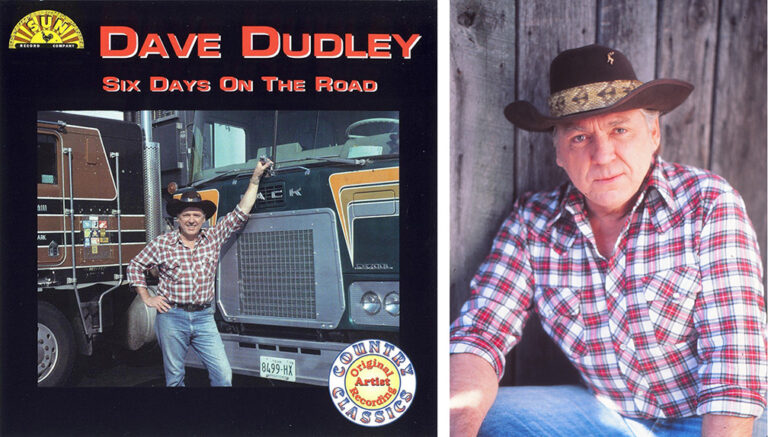
Dave Dudley (1928-2003) released seven singles for country radio between 1955 and 1962, but as he told Vic Willis of The Willis Brothers on television one night in 1963, “None of them were very good.”
However, Dudley made up for any perceived early career failures that very evening when he debuted his signature song “Six Days on the Road,” a cut from his first album “Dave Dudley Sings ‘Six Days on the Road.’”
The song not only started Dudley on a career focused on the working man and truck driving songs, but it also landed him the No. 2 position on the Billboard Country Charts and No. 32 on the Billboard US Chart.
Likewise, his performance offered inspiration to other musical artists like Merle Haggard, Red Sovine and others who later made careers of singing tales of the All-American working man — a man proud of his country and not afraid to express his love for America, family and God.
In the beginning
David Darwin Pedruska, alias “Dave Dudley,” was born in Spencer, Wisconsin, in 1928. His grandparents, immigrants from Germany, gave him a guitar at the age of 11, and Dudley taught himself to play. In the meantime, he built his skills as impressive baseball pitcher.
By 16, after considerable urging, his father gave Dudley permission to enlist in the military, and he joined the Navy for a two-year stint. Unfortunately for Dudley’s baseball career, the New York Yankees immediately came calling — and he had to pass up a contract to fulfill his commitment to the Navy.
All was not lost, however: Soon after his time in the military was up, the Chicago White Sox offered Dudley the contract he’d been looking for. He pitched for three years before injuring his arm while playing for a Gainesville, Texas, baseball club. He never fulfilled his dream of becoming a big-league ball player.
A new direction
After his baseball career, Dudley returned to the north-central U.S. and started working as a truck driver for the railroad. But he soon returned to his roots and became engrossed in his other childhood dream — becoming a musician.
Dudley chose his second-favorite subject, country music, as a profession. He worked as a disc jockey for radio stations in both Iowa and Minnesota while pursuing a recording career. Fortunately, the stations where he worked offered Dudley his own time slot to showcase his performances.
After forming the Dave Dudley Trio, he and his band hit the road. Dudley passed the time writing songs. But the Trio soon broke up, and Dudley wandered into a solo career. He released several singles during the first seven years as a solo artist, two of which charted. “Under the Cover of the Night” gave him his biggest early hit, rising to No. 18 on the charts.
Tragedy strikes
On Dec. 3, 1960, Dave Dudley was almost killed when he was hit by a car. As he recovered, walking on crutches for a year, he sank his $14,000 insurance settlement into his career: He founded Golden Wing Records, a self-funded shot in the arm for his music career.
Knowing the venture would likely make or break his chances to be anything more than a nightclub performer, Dudley headed to Nashville to pick songs for his recording session.
“Of all the songs I selected in Nashville for my big recording session, (Six Days on the Road) was the one song I thought I couldn’t do,” Dudley later said. “It was the last song I did during the session.”
Not expecting it to be a success, Dudley recorded the song on the fly in just two takes. Those two takes jump-started his career, and he was soon running in high gear.
Six Days on the Road
Dudley’s label produced “Six Days on the Road,” a song he topped only once on the charts even after signing with Mercury and other established labels. Only Johnny Cash’s “Ring of Fire,” a song dominating the charts when “Six Days” entered the fray, kept Dudley from a No. 1 hit.
“Six Days on the Road” is among the most popular and well-known trucking songs in history. Dudley’s barreled vocals make listeners feel as if they are riding shotgun to Dudley himself. But it wasn’t that the song had any unique quality; it just helped set the stage for another two decades of trucking songs that have accompanied drivers along the road.
Still, “Six Days” does its best to summarize a truck driver’s life, if only during the era it debuted.
The popularity of “Six Days on the Road” came as a surprise. After recording the song, he spent his time playing a night club in Fargo, North Dakota — far from Nashville. He got a call from his producer who told Dudley “Six Days” had sold 10,000 copies. Dudley was pleased.
“10,000,” he said. “That’s the best we’ve ever done.” His producer clarified. “I mean it’s selling 10,000 a day. And we can’t press them fast enough. There’s demand for another 5,000.”
Dudley said he was so shocked he hung up the phone without a word.
“I never suspected ‘Six Days’ would perform so well,” he said. “I kept thinking I’d wake up in the morning, and things would be different.”
The song performed so well for Dave Dudley that it turned him into a nationwide star. In 1957, Country Music and Jamboree labeled him as a “man with homespun lingo sounding like Tennessee Ernie Ford” and a “country gentleman.”
But that reputation had grown slowly. Dudley had appeared at the Big D Jamboree in Dallas, and he’d even made his way to the Grand Ole Opry. Still, no hit song had followed him or made him a nationwide name.
All that changed in with “Six Days.”
While Dudley may have been playing a Fargo, North Dakota, nightclub when releasing “Six Days,” that schedule — plus a touring schedule — picked up dramatically.
Later in his career, Dudley said his band, “The Roadrunners,” put about 100,000 miles on their vehicles a year.
“I judge how good a year we’re having by how many tires we wear out,” he said. “Ten tires is a good year.”
By the 1970s, he’d appear in concert with other trucker country performers such as Del Reeves and Cledus Maggard and the Citizens Band of “White Knight” fame.
While Dudley couldn’t get a job driving an over-the-road route during his brief trucking career, “Six Days” even opened opportunities in that vein: He was granted honorary membership with the trucker’s Teamsters Union following the song’s success, a movement he said was started in Tennessee.
“With a license, I can drive anywhere I want, I guess,” he said. But OTR trucking was no longer in Dave Dudley’s career sights.
Until next time, keep in mind that your life can change overnight. Dave Dudley’s did — and we’ll explore more of his career next month.
This is Part 1 of a two-part series. Check back next month for Part 2!

Since retiring from a career as an outdoor recreation professional from the State of Arkansas, Kris Rutherford has worked as a freelance writer and, with his wife, owns and publishes a small Northeast Texas newspaper, The Roxton Progress. Kris has worked as a ghostwriter and editor and has authored seven books of his own. He became interested in the trucking industry as a child in the 1970s when his family traveled the interstates twice a year between their home in Maine and their native Texas. He has been a classic country music enthusiast since the age of nine when he developed a special interest in trucking songs.