





This article is Part 2 of a two-part series. To read Part 1, click here.
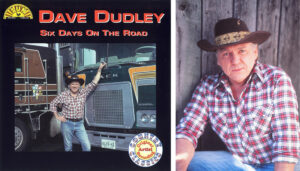
Dave Dudley uses the opening lyrics of “Six Days on the Road” to set the stage for the remainder of the song, which is one of the most popular in trucker country history.
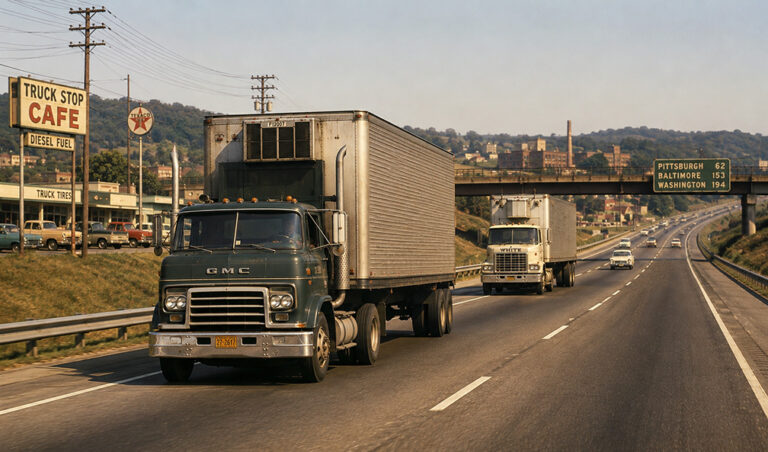
When he sings, “I pulled out outta Pittsburgh, a-rollin’ down that Eastern Seaboard,” the listener knows the driver is headed south — and that he’s doing so with a vengeance. His diesel is “wound up and she’s a-runnin’ like-a never before,” and the driver isn’t going to let any speed traps stop him on his way home.
Adding realism to the song and showing that the musician knew of what he sang, Dudley tossed in trucker terms of the time, including “10 forward gears,” “a Georgia overdrive” and the names of other trucks — “Jimmy” (a GMC tractor) and “White.” Again he reminds everyone that he has no intention of slowing down as he passes “everything in sight.”
Reality comes back into the picture when Dudley lets the listener know that the Interstate Commerce Commission (“ICC”) is conducting inspections down the road.
Despite his load being over the weight limit and his logbook overdue for an entry — issues that have been automated in the world of trucking today — Dudley avoids the problem by dodging the weigh stations that dotted the interstate landscape. Of course, the driver wouldn’t be able to “dodge” much of anything in the 21st century. But “Six Days” is a song of the 1960s, and it addresses issues of that era.
Once Dudley establishes that he’s rolling home with no plans to get delayed, he lets the listener know his truck may not be all he claimed when he left Pittsburgh. It’s “a little old but that don’t mean she’s slow,” he informs listeners. And a flame blows smoke as black as coal out of the diesel stacks (the environmental movement was still nearly a decade away). Regardless, the truck has served him well. By song’s end, he is heading into his hometown, and he is one happy driver.
As he mentions earlier in the song, Dudley has the only woman in his wife waiting for him, and despite six days on the road, he’s going to be with her by nightfall.
In general, “Six Days” is an upbeat and positive tune, but if one reads between the lyrics, the problems that plague truck drivers and the profession ring true.
The driver is a lonely person far from home for too long. In the case of male drivers (almost exclusive to the profession when “Six Days” was released), the driver has had his share of ladies make passes at him at truck stops along the way. However, he consistently gives them the cold shoulder because the person he loves is at the end of the rainbow — his latest week-long route. Keeping to a schedule and staying legal would be concerns if he weren’t so obsessed with getting home.
And to throw in another statement of the era, the song addresses one issue of the truck driving profession that resonates today.
In the second verse of the song, the driver admits to taking “little white pills” that keep him awake.
Of course, today we are all well aware that “awake,” “attentive” and “safe” are not necessarily comparable terms. Dudley referenced some sort of “uppers” that aren’t the norm among drivers today (after all, random drug screening makes taking those white pills more difficult to get away with). In later years, his reference came under the scrutiny of people with agendas other than making music.
Perhaps the combination of caffeine and energy supplements could just as well substitute and make the lyrics as accurate to the industry today.
In fact, in recent covers of “Six Days on the Road,” the little white pills are gone. Instead, the driver sings of passing “little white lines.” To the discerning listener, the change in lyrics to fit the times does not go unnoticed.
Johnny Cash’s famous refusal to change one word in Kris Kristofferson’s line, “Lord, I wish I was stoned” in his live national television performance of “Sunday Morning Coming Down” in the late 1960s set a high bar against bending to executives’ opinions of society’s needs in terms of lyrics.
In the case of “Six Days,” the change in lyrics reflects a loss of continuity and meaning in Dave Dudley’s wildly popular song. It’s unlikely he would approve of the change in his signature song today.
Dave Dudley had a solid, if not widely popular, music career.
Over the course of 22 years beginning in 1963, he recorded 35 albums on eight labels; 20 of those albums reached the Top 40 country charts. Of the 60 singles he released, 41 charted — and 33 reached the Top 40.
As it turned out, “Six Days on the Road” wasn’t even Dudley’s highest charting song. In 1970, he released the Tom T. Hall penned “The Pool Shark” on an album of the same name, and the song carried Dudley all the way to a week at No. 1 in its 14 weeks on the charts.
Regardless of the success of “The Pool Shark,” thanks to “Six Days on the Road,” that No. 1 song is only a footnote in Dave Dudley’s career. “Six Days” alone has appeared on dozens of compilation albums over the years, repeatedly used as a staple by record companies to boost sales of various collections of trucker country music.
Over the past six decades, “Six Days” has been performed by some of country’s biggest stars, and covers of the song continue to be recorded today.
But Dudley was far from a one-hit wonder.
Over the course of his career, he had hits including trucker anthems “Trucker’s Prayer,” “Truck Drivin’ Son of a Gun,” and “There Ain’t No Easy Run.”
“The truck driver will always be the king of the road,” Dudley said when looking back on the success of “Six Days on the Road.” “The reason the song was such a hit was that it was a truck driving song that was authentic.”
Dave Dudley died of a heart attack in Danbury, Wisconsin, on December 22, 2003.

Since retiring from a career as an outdoor recreation professional from the State of Arkansas, Kris Rutherford has worked as a freelance writer and, with his wife, owns and publishes a small Northeast Texas newspaper, The Roxton Progress. Kris has worked as a ghostwriter and editor and has authored seven books of his own. He became interested in the trucking industry as a child in the 1970s when his family traveled the interstates twice a year between their home in Maine and their native Texas. He has been a classic country music enthusiast since the age of nine when he developed a special interest in trucking songs.


Ai garbage