



DEL RIO, Texas — Commercial truck traffic through the Del Rio-Acuña border gateway increased more than 20 percent during the 12 months ending in July 2026, the fastest growth among the Ports-to-Plains Corridor’s three Texas border gateways and a sign of the growing economic activity that could benefit from improved access to Future Interstate 27.
More than 93,000 trucks crossed through Del Rio during the period, nearly 16,000 more than the previous year, according to data presented by Daniel Covarrubias, Ph.D., director of Texas A&M International University’s Texas Center for Border Economic and Enterprise Development, during the 2026 Ports-to-Plains Alliance Annual Conference.
Held Sept. 8–10 in Del Rio, Texas, and Ciudad Acuña, Coahuila, the conference brought together transportation, trade, government and industry leaders from the United States, Mexico and Canada to examine the infrastructure and economic connections needed to move Future I-27 from designation to delivery.
$6B in Two-Way Trade
Covarrubias said more than $6 billion in two-way trade moved through the Del Rio port during the 12-month period, an increase of nearly 13 percent. March through July 2026 each established an all-time monthly record for northbound truck crossings at the port.
Much of that activity reflects the close relationship between Del Rio and Ciudad Acuña. Acuña has 52 manufacturing plants employing more than 35,000 people, Covarrubias said. Machinery and computers, seats and seat parts, electrical machinery, and vehicles and parts together account for 82 percent of Del Rio’s imports from Mexico.
The relationship also works southbound. Aircraft and aircraft parts accounted for $521 million in exports from Del Rio to Mexico, approximately 30 percent of Del Rio’s exports to Mexico, reflecting an established aerospace supply chain operating on both sides of the border. Texas Border Business
Two Cities, One Economic Future
Del Rio Mayor Alvaro “Al” Arreola emphasized the economic relationship between the two communities.
“There are two cities, but we share one region, one economic future,” Arreola said.
Presentations during the conference showed how that border activity connects to a much larger economy.
“Last year, this port grew 20 percent on its own. Imagine what it does with a corridor behind it,” Covarrubias said.
A Gateway to Commerce
Liliana Flores, Port Director for the Port of Del Rio, described Del Rio not simply as a border community, but as a gateway connecting international commerce with transportation, agriculture, manufacturing and markets throughout North America.
Once freight leaves the port, the economic activity associated with it continues through transportation, fuel, warehousing, services, jobs and investment as goods move to destinations farther north. The same connections extend south into Mexico.
The potential economic effect of improved interstate access was quantified by Regional Economic Models, Inc. (REMI).
Future I-27 Extension
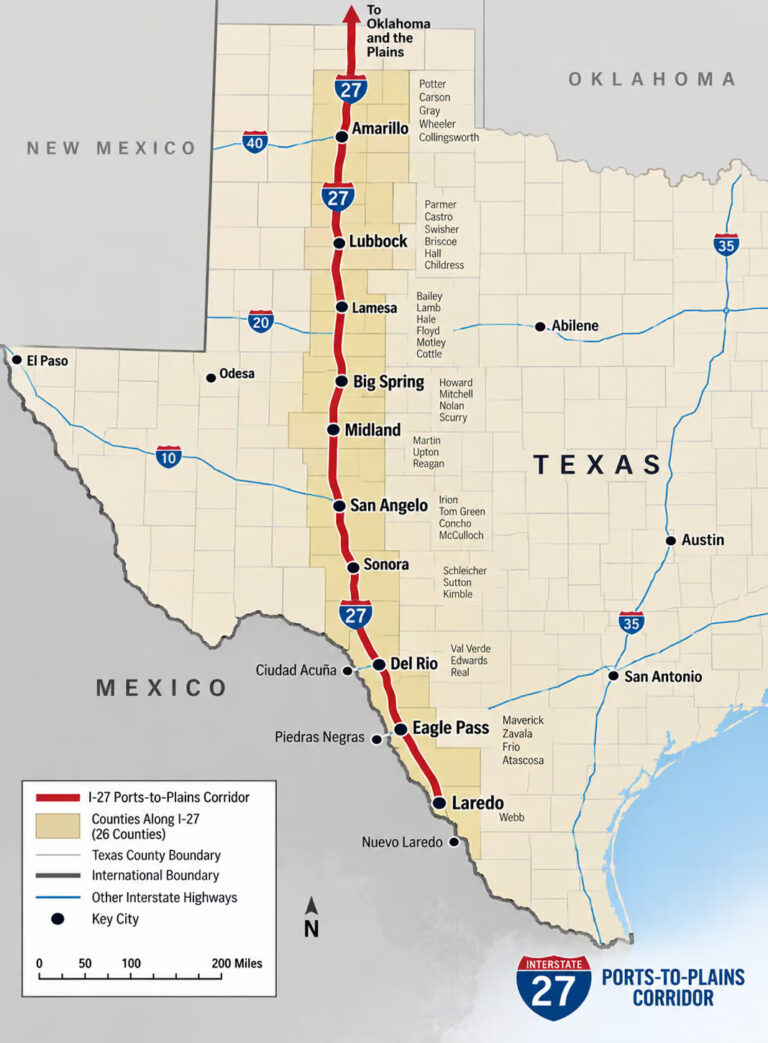
Billy Leung, senior vice president of REMI, presented economic modeling for a proposed 113- mile Future I-27 extension toward the Rio Grande Valley. The analysis examined both the economic activity created during construction and the longer-term benefits that could result from improved mobility and lower transportation costs.
The modeled $5.51 billion capital investment would generate approximately $13.03 billion in economic output during the 25-year construction period and support an average of approximately 2,677 jobs annually, according to REMI.
Leung emphasized that the larger economic value of interstate infrastructure comes after construction, when improved mobility can reduce transportation costs and allow businesses and industries to become more competitive.
Improved Access
REMI identified manufacturing, health care, finance, transportation, warehousing, wholesale trade and other industries among those positioned to benefit from improved access.
Manufacturing represented approximately 24 percent of projected employment growth associated with the Rio Grande Valley extension.
REMI also modeled the larger Future I-27 system in Texas. That analysis projected approximately $99 billion in economic activity associated with construction of the Texas corridor, with additional long-term economic gains resulting from improved mobility after the interstate is completed.
The economic discussion extended across the border into Ciudad Acuña, where conference presentations focused on nearshoring and reshoring, aerospace and defense manufacturing, industrial development, livestock, commerce and tourism, investment attraction and the region’s competitive advantages.
Those presentations reinforced a common theme across the three-day conference: border infrastructure and inland transportation infrastructure increasingly function as parts of the same economic system.
Proximity Matters
Covarrubias said Del Rio and Acuña already possess several advantages that become increasingly important to North American supply chains — proximity, shorter supply lines and transportation redundancy. Improved corridor access could give the region additional capacity to build on these advantages.
Future I-27 is envisioned as a north-south interstate system connecting Texas and its international gateways with agricultural, energy, manufacturing and population centers throughout the Great Plains and ultimately with Canada.
For communities such as Del Rio and Acuña, the economic case is not simply about moving more vehicles across an international bridge. It is about what happens after those vehicles cross — and how efficiently goods, workers and businesses can connect with the rest of North America.

Dana Guthrie is an award-winning journalist who has been featured in multiple newspapers, books and magazines across the globe. She is currently based in the Atlanta, Georgia, area.