




WASHINGTON — The American Trucking Associations (ATA) is commending members of the House Judiciary Committee for voting to pass the Combating Organized Retail Crime Act (CORCA), a bipartisan bill that seeks to establish a unified, federal response to the proliferation of cargo theft perpetrated by criminals who often operate across state and international borders.
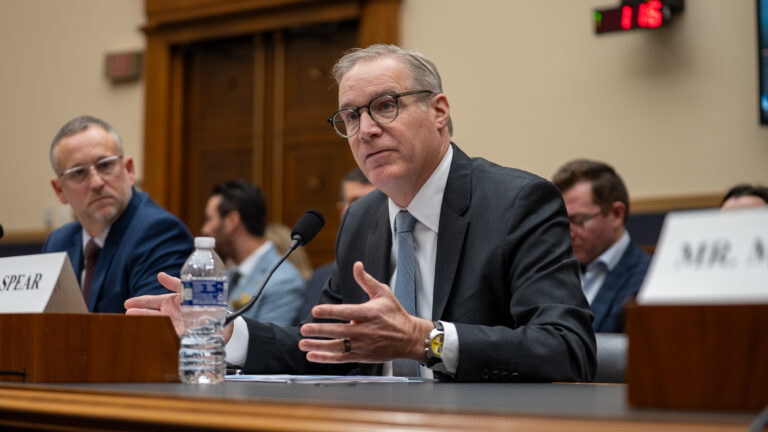
This major development is the result of months of advocacy led by ATA, including multiple congressional hearings where members of the Federation served as key witnesses. Most recently, ATA president and CEO Chris Spear testified before a House Judiciary Subcommittee in December to urge lawmakers to support CORCA.
As CORCA heads to the full House of Representatives for consideration, Congress is poised to use the appropriations process this week to enhance enforcement capabilities against cargo theft.
Trucking a Top Target
“As the transportation mode entrusted with moving nearly three-quarters of the nation’s freight, trucking has become a top target for organized crime rings, including transnational organizations,” Spear said. “These brazen criminals rob our industry of millions of dollars every day, raising costs for consumers and putting truck drivers at risk in the process. The trucking industry refuses to accept this status quo any longer. The passage of CORCA by the House Judiciary Committee represents a pivotal moment in our fight to protect our supply chain. We thank Reps. David Joyce (R-OH) and Susie Lee (D-NV) for leading this bipartisan bill, and we appreciate members of the committee for supporting this effort to bolster federal law enforcement’s ability to investigate and unravel complex, multi-jurisdictional cargo theft cases.”
High Tech and High Cost
Cargo theft is becoming increasingly prevalent and high-tech, and it often originates overseas. The American Transportation Research Institute calculates that cargo theft is costing the trucking industry over $18 million per day. Strategic theft, a category of crime that uses cyber fraud and identity manipulation to divert freight, has surged by 1,500% since 2021 according to CargoNet. Ninety percent of motor carriers are small businesses operating 10 trucks or fewer, and they are under enormous strain to counter their technologically advanced adversaries. The transnational aspect of cargo theft also poses a national security threat. The proceeds from stolen goods finance other criminal activities, including drug trafficking, organized crime, and even potentially terrorism.
Combating Organized Retail Crime Act (CORCA)
Introduced by a bipartisan, bicameral group of lawmakers last year and now cosponsored by approximately half of both the House and Senate, CORCA would help law enforcement connect the dots by enhancing legal frameworks; improving enforcement capabilities; and fostering coordination among federal, state, and local agencies. The Department of Homeland Security would be tasked with leading a cohesive national response to cargo theft.
More Progress on Cargo Theft
According to the ATA, Congress is also on the cusp of passing an appropriations package—with report language championed by ATA—that would begin the process of establishing a unified, federal response to cargo theft. Once the President signs the bill into law, which is expected as soon as this week, the provisions will:
- Direct DOJ to provide a briefing within 120 days on plans to establish regional task forces, led by the FBI and in partnership with HSI; TSA; FMCSA; and federal, state, and local law enforcement to investigate and refer cases for prosecution.
- Direct the Executive Office of U.S. Attorneys to submit a report within 90 days that identifies U.S. Attorneys’ Offices (USAOs) with the highest rates of crime involving cargo theft and directs those USAOs to assign at least one additional attorney to cargo theft prosecutions.

Dana Guthrie is an award-winning journalist who has been featured in multiple newspapers, books and magazines across the globe.