




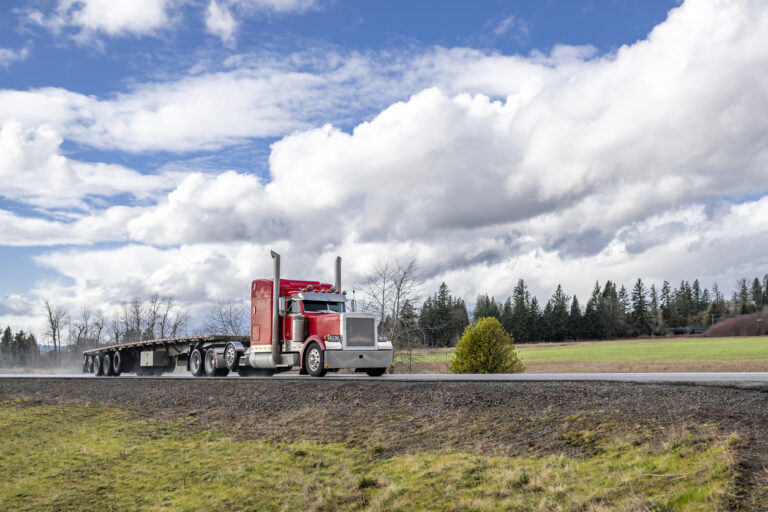
BEAVERTON, Ore. —The streak of consecutive week-over-week spot rate increases for flatbed equipment has ended at 24 as spot rates decline over all equipment types.
“For the first time since October, broker-posted spot rates in the Truckstop.com system declined for all three principal equipment types during the week ending June 19,” FTR said. “Although spot rates in all equipment types are far stronger than they were a year earlier, they moved in a mostly seasonal manner last week. Van spot rates likely will rise this week and next heading into the July 4th holiday.”
Total Spot Loads
Total load activity declined 7.7% week over week after falling 11.5% during the previous week. Volume was more than 37% higher than during the same 2025 week as loads for flatbed and dry van continue to run far above the levels a year earlier. Truck postings increased 4.2%, and the Market Demand Index – the ratio of loads to trucks – fell to the lowest level in seven weeks.
Total Spot Rates
After 21 straight weeks of increases, the total market broker-posted rate declined 2.3 cents per mile after barely increasing in the prior week. Excluding a calculated fuel surcharge, though, the total rate ticked up three tenths of a cent as diesel prices nationwide have plunged more than 46 cent in just three weeks. Although carriers operating in the spot market typically do not receive surcharges, the calculation is a proxy for the portion of the rate needed to offset higher fuel costs.
Fuel-adjusted spot rates increased week over week for both dry van and flatbed. Spot rates excluding a fuel surcharge still declined for refrigerated equipment, although only by less than a penny. The faster drop in fuel costs than in spot rates recently means that fuel-adjusted rates slightly outperformed all-in rates year over year. All-in broker-posted rates were more than 52% higher than in the same week last year while rates excluding a calculated surcharge were more than 53% higher.
Dry Van Spot Rates
Dry van spot rates eased by seven tenths of a cent although rates excluding a calculated fuel surcharge increased just under 2 cents. All-in rates were more than 53% higher than during the same 2025 week while fuel-adjusted rates were more than 55% higher. Dry van rates rose sharply for loads originating in the Northeast and were slightly higher in the South Central region but declined in all other regions.
Dry van loads declined 2.2%. Volume was more than 33% higher than in the same 2025 week. Load postings increased in the Northeast and Mountain Central regions but fell in all other regions.
Refrigerated Spot Rates
Refrigerated spot rates declined by a little more than 3 cents while rates excluding a calculated fuel surcharge dipped by six tenths of a cent. Both all-in rates and fuel-adjusted rates were a little more than 46% higher than during the same week last year. As with dry van, spot rates rose for loads originating in the Mountain Central and Northeast regions but were down week over week elsewhere.
Refrigerated loads decreased 2.9%. Volume was about 5% higher than during the same 2025 week. Load postings increased sharply in the Mountain Central region and modestly on the West Coast but were down in all other regions.
Flatbed Spot Rates
Flatbed spot rates declined for only the second time in 31 weeks, dipping 1.2 cents. However, excluding a calculated fuel surcharge, rates increased 1.4 cents. All-in flatbed spot rates were 52.5% higher than in the same 2025 week while fuel-adjusted rates were up 53.7%. Spot rates increased for loads originating in the Southeast and on the West Coast but were down slightly elsewhere. The decreases in the Northeast and Midwest were fractions of a cent.
Flatbed loads fell 10.0%. Volume was 48.5% higher than in the same week last year for the softest comparison in 11 weeks. As was the case with dry van, volume rose in the Mountain Central and Northeast regions but fell in all other regions.

Dana Guthrie is an award-winning journalist who has been featured in multiple newspapers, books and magazines across the globe. She is currently based in the Atlanta, Georgia, area.