




FORT WAYNE, Ind. — The North American Council for Freight Efficiency (NACFE) is releasing its third report from Run on Less – Messy Middle, Forecasting the TCO of Powertrain Alternatives: The Messy Middle Cost Report.
“The core takeaway is that there is no universal TCO; it’s a custom calculation that changes with every zip code and duty cycle,” says Emilia Sibley, lead author of the report and NACFE’s emerging technologies consultant. “While we’ve forecasted parity dates across the board, the real goal of this report is to help fleets outrun those projections. We’re giving fleet owners the framework to start capturing the financial upside of the Messy Middle today.”
Run on Less – Messy Middle
This report is designed to guide fleet owners through the financial realities of transitioning to alternative powertrains by analyzing the Total Cost of Ownership (TCO) across four distinct commercial powertrains: legacy diesel, compressed natural gas/renewable natural gas (CNG/RNG), battery electric (BEV), and hydrogen fuel cell (FCEV). By combining real-world operational data from Run on Less – Messy Middle with industry trends, this report provides baseline TCO estimates across multiple duty cycles and forward-looking timeframes.
The report focuses solely on Class 8 vehicles, includes multiple fuel choices, grounds its assumptions in real-world data — from Run on Less – Messy Middle and other sources — provides forecasts out to 2035, accounts for duty cycles and utilization and highlights the variables that matter when determining TCO. Critically, the analysis assumes zero incentives in its TCO calculations. This provides a worst-case scenario that reveals when parity occurs organically through technology improvements and operational savings.
A Strategic Framework
“TCO analysis is more than just a math exercise; it’s a strategic framework that allows fleets to look past the sticker price and see the true long-term value of an asset,” says Gerard Westhoff, senior associate, carbon-free transportation at RMI. “By balancing upfront capital with lifetime energy and maintenance savings, we can move beyond guesswork and accurately project which technologies will win in the market.”
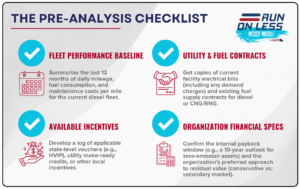
The report provides fleets with an action plan for constructing a TCO analysis that is tailored to their fleet-specific routes and costs and a step-by-step analysis exercise to help fleets determine which powertrains make sense in their various duty cycles.
Report Findings
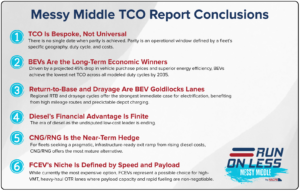
Based on NACFE’s 2025 to 2035 modeling and sensitivity analysis, NACFE offers the following conclusions for fleet owners and industry stakeholders:
This is the third of five reports surrounding Run on Less – Messy Middle. NACFE plans to publish two additional reports throughout 2026 — an emissions report and a final findings report.
Click here to view the full report.

Dana Guthrie is an award-winning journalist who has been featured in multiple newspapers, books and magazines across the globe. She is currently based in the Atlanta, Georgia, area.