



Is the government’s Hazmat data getting misread?
According to Russ Thompson, President of Roadmaster Group, the answer is yes.
Roadmaster is the parent company of Tri-State Motor Transit Company, one of the largest hazardous materials carriers in the United States.
Thompson said shippers and brokers who vet hazmat carriers by looking at raw violation counts are asking the wrong question and may be choosing the wrong carrier
“The system used to score those carriers, he says, was never designed to tell shippers what they think it does,” Thompson said.
Tri-State hauled 27,399 hazmat loads and recorded 52 violations, a rate of 0.18 percent, according to a Tri-State press release.
“A general freight carrier the same size that hauls hazmat on just five percent of its loads could record the same 100 violations at a rate of 6 percent,” Thompson said. “Under the Federal Motor Carrier Safety Administration’s (FMCSA) Safety Measurement System, both carriers can appear in the same compliance tier. The raw count looks identical. The actual safety picture is not.”
“The way hazmat carriers are currently scored creates a fundamental problem,” Thompson said. “A carrier doing the most hazmat work will accumulate more inspections and more opportunities for violations to appear on paper than a carrier that rarely touches it. The system does not adjust for that. More hazmat experience can actually make your safety score look worse.”
The math the Hazmat Scoring System Is missing
Ninety-nine percent of Tri-State’s approximately 30,000 loads involve hazardous materials. Thompson puts the math plainly: 100 violations for a carrier hauling 30,000 hazmat loads represents a 0.3 percent rate. The same 100 violations for a carrier hauling hazmat on 5 percent of its loads represents a 6 percent rate. FMCSA’s current system treats those carriers as roughly equivalent.
They are not.
FMCSA itself warns that SMS data should not be treated as a federal safety rating or used to conclude a carrier’s overall safety. A forthcoming overhaul may reduce month-to-month scoring volatility, but Thompson says it will not resolve the volume-blind problem.
“For Tri-State, the consequences of that blind spot have been anything but theoretical,” Thompson said.
The party the Hazmat scoring system does not hold accountable
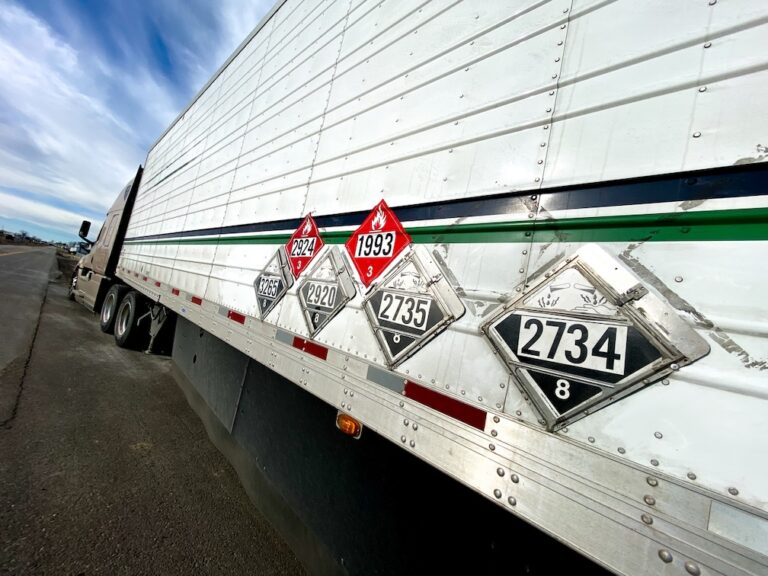
Thompson argues that most shippers overlook a second flaw: the majority of hazmat violations are not caused by the carrier.
“Under federal law, shippers are responsible for properly placarding freight before it leaves their facility,” he said. “But roadside violations appear on the carrier’s FMCSA record, not the shipper’s. A shipper that fails to placard correctly faces no direct regulatory consequence.”
“Shippers have no regulatory incentive to change because the violations do not go against them,” said Thompson. “Our drivers catch a meaningful number of shipper paperwork errors before the truck leaves the facility. But we do not catch everything, and once we leave, the violation is ours.”
Thompson added that Tri-State has responded by proactively training shippers at locations where violations indicate systemic placarding failures. Since implementing that program, the company has trained shippers at multiple locations and states.
When a government agency got it wrong
“The stakes are not theoretical,” Thompson said. “Tri-State once faced a multi-million-dollar fine from a regional enforcement agency following an inspection campaign at a major shipping facility. Using public violation records and its own load data, Tri-State demonstrated its per-load violation rate was a fraction of the next-largest carrier at the same facility. The agency had more total violations against Tri-State than any other carrier, because Tri-State was hauling more loads than every other carrier combined.”
Thompson said the resolution included Tri-State training the agency’s local shippers on proper placarding, a program that has since expanded to other customer locations.
The questions shippers should actually be asking
Thompson said he recommends shippers probe any hazmat carrier with the following before tendering a load:
How many of your hazmat violations are attributable to driver error versus shipper placarding failures?
What are your top three most-cited violation types, and what have you done to address them?
How many total loads do you haul annually and what percentage is hazmat? What is your violation rate per hazmat load?
“A carrier hauling 30,000 hazmat loads a year with 52 violations is performing at a fraction of the risk of a carrier hauling 1,500 loads with the same count,” said Thompson. “Shippers who do not ask the right questions are making carrier decisions based on a number that does not mean what they think it means.”

Bruce Guthrie is an award-winning journalist who has lived in three states including Arkansas, Missouri and Georgia. During his nearly 20-year career, Bruce has served as managing editor and sports editor for numerous publications. He and his wife, Dana, who is also a journalist, are based in Carrollton, Georgia.