



BURLINGTON, Wash. (AP) — Record floodwaters began slowly receding in Washington state on Friday after triggering evacuations, inundating communities and prompting dramatic rescues from rooftops and vehicles. But authorities warned that waters would still be high for days, and that danger from potential levee failures remained.
“This is not just a one- or two-day crisis,” Gov. Bob Ferguson said at a news briefing. “These water levels have been historic, and they’re going to remain very high for an extended period of time.”
President Donald Trump has signed the state’s request for an emergency declaration, Ferguson said.
An unusually strong atmospheric river dumped a foot (30 cm) or more of rain in parts of western Washington over several days and swelled rivers. No deaths have been reported, Ferguson said.
Authorities have yet to estimate the costs, but photos and videos show widespread damage, with entire communities or neighborhoods flooded around western and central Washington. Officials have conducted dozens of water rescues, debris and mudslides have closed highways, and raging torrents have washed out roads or bridges.
Officials issued “go now” orders Wednesday to tens of thousands of residents in the Skagit River flood plain north of Seattle, including the farming city of Burlington, home to nearly 10,000 people. By Friday morning, muddy water overflowed a slough and rushed into homes, prompting more urgent warnings for Burlington.
National Guard fans out amid flood evacuations
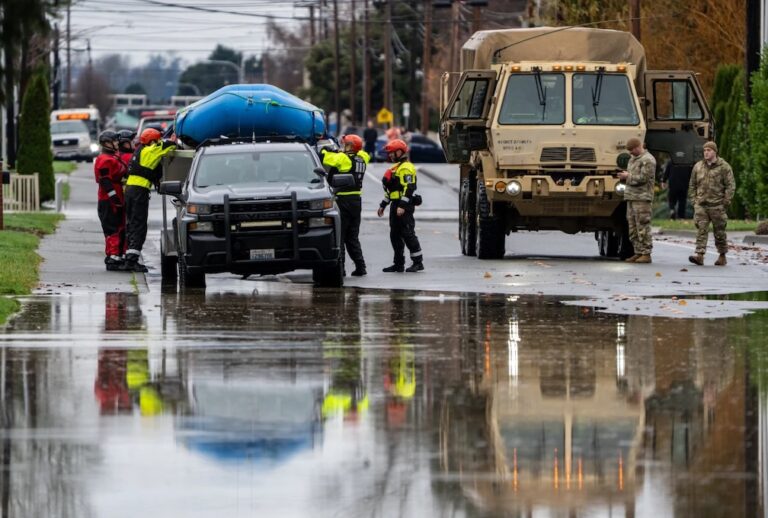
National Guard members knocked on hundreds of doors in Burlington early Friday to tell residents about the evacuation notice and help transport them to a shelter if needed. By late morning the evacuation order was lifted for part of the city and waters were slowly receding. But the river remained high, and flash flooding remained a risk due to prolonged pressure on the levees.
The Skagit River drains a wide swath of the rugged Cascade Range before winding west across broad, low-lying farmlands and tulip fields on its way to Puget Sound. Cities like Burlington sit on that delta, leaving them especially vulnerable to floods.
The river crested overnight at 37 feet (11 meters) in the valley’s biggest city, Mount Vernon, surpassing the previous record by a few inches. A flood wall completed in Mount Vernon in 2018 held fast and protected the downtown area.
About 1,000 Burlington residents had to evacuate in the middle of the night, Ferguson said. The water was reportedly 2 to 3 feet (0.6 to 0.9 meters) deep in certain areas as it flooded homes, police department spokesperson Michael Lumpkin said.
Mario Rincón had been staying at a hotel with his family, including a week-old infant. They returned to their Burlington property Friday but couldn’t get inside to assess the damage, as murky floodwaters reached part-way up the first floor. He had moved some items upstairs in anticipation.
“It’s going to be a few days before the water recedes,” he said. “We’re going to be looking where to stay in the meantime, and it’s kind of difficult because my mom and my mother-in-law are visiting from Mexico until the end of December for the holidays.”
The heaviest rain is over in the region, but the impact remains widespread.
“It’s going to take a while for the flood waters to recede,” said Robert Ezelle, director of the Washington Military Department’s emergency management division. “There’s a lot of water that fell in the mountains and it’s gonna take its time to work through the river drainages.”
More rain is expected beginning Sunday. That will cause rivers to rise again, Ezelle said.
Near the U.S.-Canada border, Sumas, Nooksack and Everson — which together have about 6,500 residents — were inundated. The border crossing at Sumas was closed.
Sumas Mayor Bruce Bosch said much of the city had been “devastated” — just four years after a similar flood. In a social media message, he acknowledged the community was anxious to return to their homes.
“Hang in there,” he wrote.
In King County, crews worked through the night to fill a sinkhole on a levee along the Green River in the Seattle suburb of Tukwila, county executive Girmay Zahilay said Friday. Another county wastewater employee got trapped inside a treatment facility during flooding but continued to work for days to keep critical plant operations running, Zahilay said.
“That commitment protected public health for millions of people,” he said.
Crews reach people by boat and by helicopter
Authorities across Washington state in recent days have rescued people from cars and homes.
Helicopters rescued two families on Thursday from the roofs of homes in Sumas that had been flooded by about 15 feet (4.6 meters) of water, according Frank Cain Jr., battalion chief for Whatcom County Fire District 14.
Near Deming, two homes collapsed into the Nooksack River as erosion undercut them. No one was inside at the time.
Animals were also rescued, including a rooster that had found refuge on a tree branch. Kayakers navigating floodwaters near Burlington hoisted their paddles to save the animal.
Further south in Oregon, a landslide took out a portion of a highway near the central Oregon coast, the state transportation department said, adding it would be a long-term closure.
Climate change has been linked to some intense rainfall. Scientists say that without specific study they cannot directly link a single weather event to climate change, but in general it’s responsible for more intense and more frequent extreme storms, droughts, floods and wildfires.

The Associated Press is an independent global news organization dedicated to factual reporting. Founded in 1846, AP today remains the most trusted source of fast, accurate, unbiased news in all formats and the essential provider of the technology and services vital to the news business. The Trucker Media Group is subscriber of The Associated Press has been granted the license to use this content on TheTrucker.com and The Trucker newspaper in accordance with its Content License Agreement with The Associated Press.