



Trucking freight rates are climbing, and that means carriers are trying harder to find drivers. Pay raises and added benefits are being announced almost daily.
If you’ve been thinking of a job change, now might be a good time for you to make your move. You could be in a new-hire orientation class next week (or the one following).
Orientation can be a frustrating experience for both drivers and the carriers trying to hire them.
At most carriers, there is generally some training regarding safety and on company policies … and a ton of paperwork. None of that matters, however, if the driver and carrier don’t seal the deal with a driver joining the fleet. All too frequently, drivers travel to orientation and leave before getting the keys to a truck.
It’s easy to think about an orientation as a “new employee’s class,” but in reality, there’s more to it. In many cases, orientation is an extended job interview, where drivers and carriers learn more about one another before making a final decision. It’s often the first face-to-face experience for either party.
Unfortunately, sometimes one party or the other doesn’t like what they see or hear and decides not to go through with the hire.
Too often, surprises at orientation are the result of failing to gather information before making the trip.
Know what matters most to you
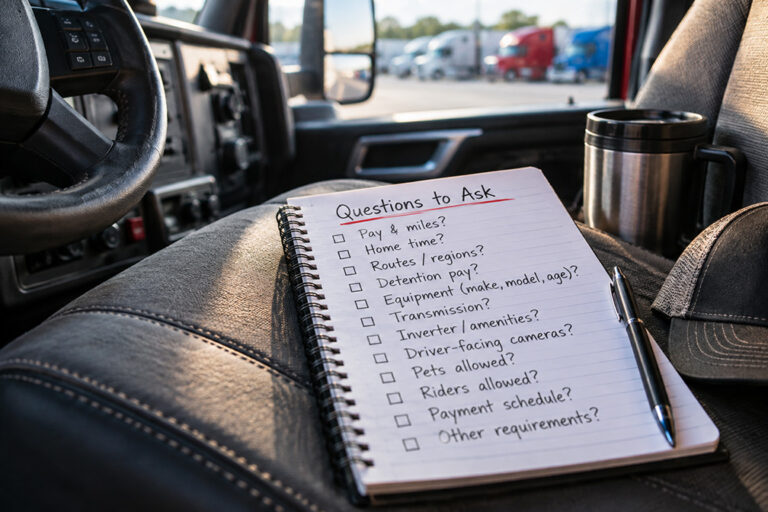
Drivers, before you make that phone call or send in that mini-application, take a few moments to make a list of what you’re looking for in a new driving job. First, determine what’s most important to you.
Higher pay is always attractive, but drivers sometimes find out that a higher pay rate per mile doesn’t always translate into a bigger paycheck. Here are some good questions to ask about pay:
- How many miles can I realistically expect each week?
- Am I paid for all miles, dispatched miles or loaded miles?
- What are the carrier’s average dwell times, empty miles and out-of-route miles?
- Does the mileage rate change based on length of haul or destination?
- How much detention, layover, breakdown and other accessorial pay is offered?
- How do I claim accessorial pay, and when will I receive it?
- How often will I be paid, and what paperwork or other requirements must I complete?
Home time: Make sure you’re speaking the same language
Where you’ll be driving and how often you’ll get home are important to some drivers. Those who prefer to stay out on the road for longer periods are often less concerned about where the load takes them — with the exception of certain areas they don’t like to drive in. Others, who want to get home more often, need to understand carrier routes and whether they have the freight to get you to your home as often as you’d like. If the carrier says you’ll be running 48 states and Canada AND that you’ll be home every weekend, you’ll be justified in being suspicious.
When it comes to weekends, it’s wise to make sure you and the carrier are on the same wavelength. You may be thinking that a “weekend” is home on Friday afternoon and back to work on Monday. The carrier, however, probably gives themselves more leeway. Their policy may be that you’re home for at least a 34-hour reset with at least part of the off-time falling on a Friday, Saturday or Sunday. You may get home on Saturday and need to leave out Sunday afternoon for a Monday delivery.
What’s waiting for you behind the wheel?
Some drivers are picky about equipment. The desire to drive newer equipment makes sense as it is generally cleaner and may experience fewer breakdowns. If you have a preference for a certain brand of truck, or you need a large sleeper area, or you have to have an inverter for powering appliances — whatever your preference is, list it and be sure to ask about it.
That’s also true of driving characteristics. Some drivers prefer more horsepower, especially if they drive in mountainous areas. Some prefer the convenience of auto-shift transmissions, while others prefer the added control of a manual transmission. Whatever your equipment requirements, know them up front and communicate them to the recruiter.
Dash cameras are an important issue to drivers and carriers these days, especially if there’s a lens that records the driver’s actions. Some drivers don’t like cameras at all; others don’t mind them as long as they face forward. Some don’t care either way. Determine where you fit in and find out about the carrier’s policy up front. If a driver-facing camera is a deal-breaker for you, find out if the carrier uses them before you agree to orientation.
Here are a few good questions to ask about equipment and policies:
- What make, model and age of truck will I be assigned?
- Will the truck have the transmission, sleeper space and amenities I need?
- Are trucks equipped with driver-facing cameras?
- Are pets allowed? Are there restrictions or deposits?
- Can I bring a rider? Are there age limits, relationship restrictions or insurance charges?
Pets are also important to many drivers. Some carriers, however, may not allow pets due to customer requirements or maintenance experience. Others may allow pets but have size or weight restrictions or restrict the number of animals — or even the breed — you can bring. Many carriers that allow pets require cleaning or damage deposits. These are sometimes non-refundable. If traveling with a pet is important to you, find out before you accept the job.
The same goes for rider policies. If you plan to bring along a rider, find out what the carrier’s policies are up front. Some restrict riders to immediate family only, others have age limits, and often there is an extra charge for insurance. Ask.
No surprises, no regrets
It’s important to think through what you need in a trucking job and to prioritize which items are most important to you. Then be sure to ask the recruiter or representative so you’ll know what to expect when you arrive at orientation. That’s the best way to ensure a good start on your next great driving opportunity.

Cliff Abbott is an experienced commercial vehicle driver and owner-operator who still holds a CDL in his home state of Alabama. In nearly 40 years in trucking, he’s been an instructor and trainer and has managed safety and recruiting operations for several carriers. Having never lost his love of the road, Cliff has written a book and hundreds of songs and has been writing for The Trucker for more than a decade.