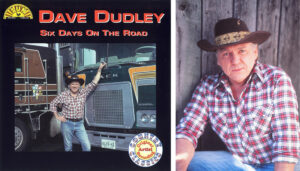




For most folks, the name James Wesley (“Jay”) Huguely doesn’t come to mind when recalling the great songs of trucker country’s golden era. After all, an accomplished actor, director, theatre owner, playwright, producer and television writer doesn’t typically find a seat at the table with the likes of Dave Dudley, Del Reeves and C.W. McCall.
But Jay Huguely contributed more to entertainment than his long resume suggests.
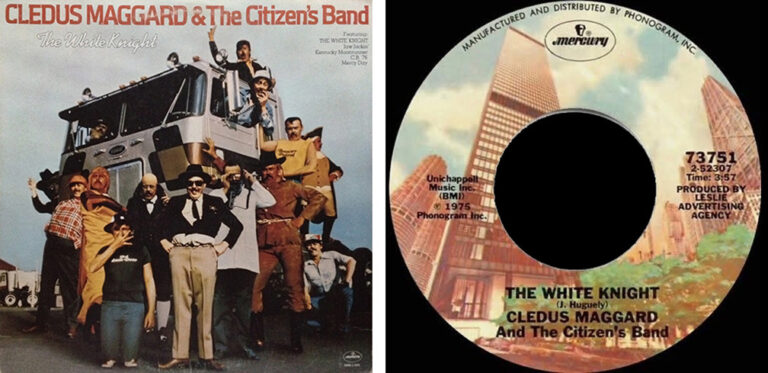
For a brief time in 1976, Huguely was better known as Cledus Maggard — and Cledus Maggard and the Citizen’s Band recorded one of the most popular novelty songs in trucker country history. “White Knight” reached No. 1 on the country charts in February of that year.
Who was Jay Huguely?
Huguely was born in Kentucky in 1940. During his school days he demonstrated a knack for the airwaves and stage when he participated in many debate and speech contests, always scoring high marks with the judges.
By the time he entered Eastern Kentucky University, his voice had landed him a job with a local radio station, where he worked as both a disc jockey and newscaster.
But show business had something more in store for Jay Huguely than limited-watt radio.
Soon, Huguely was directing shows at a playhouse in Florida. At age 20, he graduated from New York’s American Theater Wing.
His local supporters back in Kentucky knew that their hometown boy had to the potential to make it big. With their financial backing, Huguely set off for London, England, where he studied at the Royal Academy of Dramatic Art. By 1962, he had graduated with honors and received a scholarship to study at the Royal Opera House.
It was there that he discovered his talents went beyond acting and that he was actually a fine singer.
The early days
Upon returning to the United States, Jay Huguely appeared in some off-Broadway plays and caught the attention of producers for both his acting and directing skills. He appeared across the Southeast in shows such as “Music Man,” “Man of La Mancha” and “110 in the Shade,” among others.
But by 1974, Huguely had tired of life on the road and chose to settle down into an honest job as a creative director at an advertising agency in Greenville, South Carolina. After winning 17 “Addy” awards, it was at the agency that inspiration for Huguely’s alter-ego, Cledus Maggard, struck.
The CB radio phenomenon
The ad agency president assigned Huguely the job of developing a campaign for a client that was hoping to capture the popularity of the citizen’s band (CB) radio in the mid-1970s.
While truck drivers had made the CB famous, by 1975, CB radio had become a cultural icon. It seemed everyone had one, either at home or in their vehicle. Folks across the country had adopted the trucker lingo for chatting and the CB had become a true phenomenon — one that was lucrative for the dozens of companies that turned out cheap electronics.
The concept of conversing on a CB was new to Huguely.
“I grew up in Quick Sand, Kentucky; that’s halfway between Jackson and Hazard,” Huguely told the Music City News in 1976. “I drove a few pickups and — while living in New York — taxis, but I didn’t know anything about the big rigs.”
To learn more about this cultural phenomenon, Huguely borrowed a friend’s car that was outfitted with a CB.
“I listened for an hour,” Huguely said. “Then I came back to the station and recorded the commercial, doing the voices and ad-libbing the words from my notes.”
Everyone was impressed with the radio spot … except for the client.
The birth of Cledus Maggard and “White Knight”
But for the creative Huguely, the failed campaign sparked a personal idea to capitalize on the popularity of the CB. At the urging of the ad agency’s president, Cledus Maggard was born. (More precisely, Maggard was reborn. Huguely had actually conceived the concept for the character many years earlier.)
Backed by the ad agency, a Greenville radio station debuted the song “White Knight,” and it sold 2,000 copies its first day. The agency and record club decided to press another 10,000 copies.
Huguely was taken aback.
“All I could think of was that the ad agency would be giving away the record as Christmas presents for the next 20 years,” he said.
When Mercury Records released “White Knight” as a single, it immediately soared in popularity, not just because of Maggard’s masterful use of CB lingo in a rapid-fire fashion but because of the storyline.
Maggard narrates “White Knight” as a seemingly hyperactive CB-obsessed truck driver who’s making his way across Georgia late one night. He feeds off the CB reports of clear sailing with no police on the interstates. These reports are provided by White Knight, supposedly a fellow trucker.
Well, it turns out that “White Knight” is actually a Georgia trooper posing as a truck driver over the radio waves in efforts entice drivers to fly down the highway without a care. As fate must have it, Maggard takes advantage of what he believes to be a “free pass” across the state.
It doesn’t end well for the hapless Maggard, who’s arrested for driving 92 in a 55 mph zone. The drawling Georgia trooper taunts Maggard as he stops him, reminding him of all the other arrests and citations he’s written that evening by posing as the “White Knight.”
The song ends with Maggard turning against his CB radio and threatening to “pull the old thing out by the wires. I don’t care if it is a Johnson,” he says, referring to a popular CB radio brand of the day.
Riding the wave of CB popularity
“White Knight” was strictly a novelty song. It was never intended to have the staying power of more serious trucker country like “Six Days on the Road” or “East Bound and Down.”
Even so, the song enjoyed its day in the sun — and so did Cledus Maggard. Maggard and his Citizen’s Band of five musicians went on to record two albums worth of mostly forgettable songs focused on the CB theme.
Maggard appeared around the country, singing his hit at county fairs and the like, and he turned up on television shows like “Hee-Haw” and “POP! Goes the Country.” Fame lasted for about five years before the CB bubble burst, and Jay Huguely returned to his original life.
The road forward
Huguely’s career in the entertainment industry continued after Maggard’s flirt with fame. He appeared in a Broadway musical and won accolades in Hollywood for his work as a director on television shows such as “Magnum, P.I.,” as well as a writer for “Quantum Leap,” “Murder, She Wrote,” “MacGyver” and other popular shows.
Over the course of his career, he collected a string of awards — and he even hauled in a few for “White Knight,” including Billboard’s top novelty artist.
“I really don’t know what to make of my success,” Huguely said of “White Knight.” “I’ve been in every form of entertainment and then you make it big coming in the back door. It is a thrill!”
Jay Huguely died unexpectedly in 2008 at age 68.
Until next time, when you see that “bubble gum machine” in your sideview mirror some evening, pull on over and be courteous to the police officer who approaches you. As Cledus Maggard would say, “You’ve hit the jackpot.”
And if you want to relive the glory days of Cledus Maggard, just head over to YouTube or your favorite music streaming service, type in his name and see what comes up!

Since retiring from a career as an outdoor recreation professional from the State of Arkansas, Kris Rutherford has worked as a freelance writer and, with his wife, owns and publishes a small Northeast Texas newspaper, The Roxton Progress. Kris has worked as a ghostwriter and editor and has authored seven books of his own. He became interested in the trucking industry as a child in the 1970s when his family traveled the interstates twice a year between their home in Maine and their native Texas. He has been a classic country music enthusiast since the age of nine when he developed a special interest in trucking songs.