




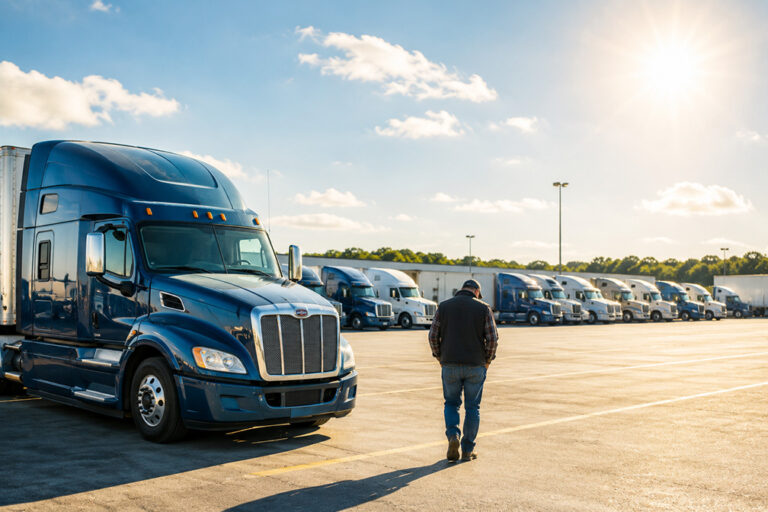
After the longest freight downcycle in recent memory, the trucking industry is finally turning the corner. Capacity is down and freight rates are moving upward. Analysts predict truck sales will increase during the second half of 2026 as carriers look to expand, taking advantage of a more favorable market.
The Catch
The phrase “driver shortage” is popping up in industry conversations. While there’s always a heated debate about whether the driver shortage is real, many driver recruiters and motor carriers might agree that finding — and keeping — quality company drivers can be a challenge.
And when the trucking industry is expanding, as it’s predicted to do soon, finding qualified drivers becomes more difficult.
New regulations and enforcement of existing requirements by the Federal Motor Carrier Safety Administration (FMCSA) may also make hiring drivers more difficult.
Non-Domiciled Drivers
On September 26, 2025, U.S. Transportation Secretary Sean Duffy issued an emergency action to restrict eligibility for commercial learner’s permits (CLPs) and commercial driver’s licenses (CDLs) for drivers who are domiciled in a foreign jurisdiction. This action was quickly published as an interim final rule in the Federal Register on September 29.
The new rules required issuing agencies to query the Systematic Alien Verification for Entitlements (SAVE) system, operated by the U.S. Citizenship and Immigration Services to verify the accuracy and legitimacy of each applicant’s provided documentation.
The U.S. Court of Appeals for the District of Columbia issued a stay, pending review, on November 13, 2025. The FMCSA published its final rule on February 13, 2026. In that rule, the FMCSA noted that more than 30 states have issued tens of thousands of non-domiciled CDLs contrary to federal regulations.
Impact on Driver Pool
At one point, Duffy estimated the impact to the trucking industry to be the loss of 194,000 drivers.
However, the actual impact will be very difficult to quantify. Why? Because revocation of a CDL is only one of the potential results of the crackdown. It’s unknown how many potential CDL holders will choose a different profession or return to their home countries to avoid the issue.
Additionally, the FMCSA’s enforcement of English language proficiency standards push more drivers out — even if their CDLs were issued properly.
Different carriers often have varying policies on non-domiciled CDL drivers, so some companies will be impacted directly by loss of drivers while others, who only hire U.S. citizens, may notice fewer driver applicants.
The latter is the case for David Wheeler, director of safety at Ohio-based MCK Trucking Inc.
“We have experienced some issues trying to find drivers recently,” Wheeler said.
“I’m not going to say that it’s 100% attributed to the non-domicile rules, because we didn’t hire drivers with the non-domicile CDLs to start with, but we HAVE seen a decrease in our orientation size in the last three to six months,” he continued. “I would say there’s just less drivers to go around now.”
Avery Vise, vice president of trucking at FTR Transportation Intelligence, is skeptical of any potential impact.
“For the most part the capacity situation that truckload is in was not really created by either the non-domiciled issue or the English language proficiency issue,” Vise said. “Basically, federal employment in truckload has come down to what is essentially the lowest level since February of 2014.”
Vise points out that the numbers he’s seen aren’t as impactful as some would claim.
“Secretary Duffy recently made comments that indicated at least 28,000 drivers had been removed due to improper non-domicile CDLs,” he said. “That’s not an insignificant number — but it’s not a market-moving number on its own.”
In addition, Vise says, holding a CDL and being an active driver are not necessarily the same thing, making estimates of industry impact more difficult.
“We have a strong belief that a lot of those CDLs were used for local applications, like construction or agriculture,” he said. “We suspect that a large number of those CDLs are being used for dump trucks and similar types of short haul.”
Pandemic Impact Lingers
Employment in the trucking industry has yet to return to pre-pandemic levels, according to Vise.
“Frankly, the broader capacity decline started three years ago,” he said. “There was a peak of employment, about late 2022, and then a steady decline.”
A part of that employment decline was the large number of drivers who took advantage of record freight rates by buying their own equipment and registering as independent carriers. According to Vise, many of them never went back.
“If you look at the numbers of registered carriers, there are roughly 34% more of them than before the pandemic,” he said.
Sourcing Qualified Drivers
Regardless of the reasons, more difficulty in sourcing qualified drivers will be a pain point for the trucking industry.
Even so, Wheeler says he views actions like the non-domiciled CDL crackdown favorably.
“I share a lot of the same sentiments that everybody else does,” Wheeler said. “I think it’s going to end up benefiting our industry because it’s going to remove a lot of bad actors.
“They’re going to get a lot of unqualified drivers out of the market,” he continued. “You’re seeing a big change in the spot market.”
History on Repeat?
Vise points to an earlier time when the trucking industry managed to find drivers, despite complaints of a shortage.
“We’ve seen this before,” he said. “Heading into the pandemic in 2018 and ’19, we added a lot of net drivers to the industry. When trucking companies have the ability to get rates, they have an amazing ability to get drivers.”
At the same time, Vise believes carriers might be more cautious about expanding capacity than they were during the last boom cycle.
“From late 2022 or early 2023 until maybe two months ago, it was a very difficult period of time for the trucking industry in general and truckload in particular,” he said.
“Are they going to be willing to add incremental capacity to take advantage of rates, or are they going to take a more profit-margin oriented view, remaining at their current size and maximizing profits?” he continued.
If the non-domiciled CDL crackdown and the English language proficiency enforcement significantly reduce the number of employable drivers, expanding capacity may be a difficult choice. Investing in trucks while having difficulty sourcing drivers for them won’t help profit margins.
Vise suspects the hard days of the past few years have resulted in a “change in attitude in truckload carriers.”
As the freight recovery unfolds, the true impact of removing non-domiciled CDLs may never be known.
This story first appeared in the July/August 2026 print edition of Truckload Authority, the official publication of the Truckload Carriers Association.

Cliff Abbott is an experienced commercial vehicle driver and owner-operator who still holds a CDL in his home state of Alabama. In nearly 40 years in trucking, he’s been an instructor and trainer and has managed safety and recruiting operations for several carriers. Having never lost his love of the road, Cliff has written a book and hundreds of songs and has been writing for The Trucker for more than a decade.