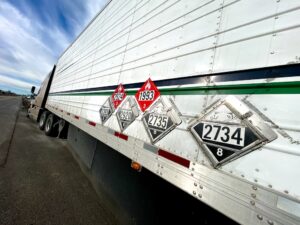




Let’s face facts: No driver actually likes DOT inspections.
After all, getting inspected by a law enforcement officer has something in common with visiting the dentist: Nothing GOOD is likely to happen. The best you can hope for is that no violations (or cavities) are found. Avoiding bad news is the goal of either process.
The two events have something else in common: Like cavities, most of the violations found during a roadside inspection could have been prevented if the person responsible had been — well, responsible.
If you ignore the guidance on how to keep your vehicle (or your teeth) in top shape, problems WILL arise.
Drivers are responsible for keeping themselves and their vehicles in good working condition.
The Commercial Vehicle Safety Alliance’s (CVSA) annual International Roadcheck event is a planned three-day inspection event that aims to remove unsafe drivers and vehicles from the roads.
There is, however, another motive for the event: By announcing the inspections in advance and providing guidance on the focus of inspections, it’s hoped that truck owners and drivers will step up their own inspections. By doing this, they can improve their own safety — and their chances of passing Roadcheck inspections.
There’s also an educational aspect to the event. During CVSA’s scheduled inspection blitzes, drivers have a chance to learn from inspectors: What are they are looking? What criteria are being used?
Results from this year’s Roadcheck, conducted May 12-14, were released in late August.
As usual, the results of the 2026 Roadcheck indicate that many drivers didn’t get the message.
Out of the 44,047 vehicles inspected, inspectors placed 10,350 out of service (OOS). That’s a 23.5% OOS rate for an inspection event that was publicized months in advance.
Additionally, 13,924 OOS violations were found, indicating that more than a third of the vehicles placed OOS had more than one violation.
As usual, brakes were the biggest culprit in OOS orders.
Nearly one-fourth (24.3%, or 3,379 instances) of OOS violations were for service brake violations.
Brakes, however, can count for two separate OOS violations on the same vehicle. That’s because another rule says that if 20% of brakes on a vehicle are defective, it’s OOS. If a typical 18-wheeler has 10 braking units, two on each axle, it takes two of them for an OOS order. The 20% rule resulted in the third-largest number of OOS violations with 2,072.
With automatic slack adjusters as mandatory equipment on modern trucks, drivers are no longer required to perform adjustments. In fact, many carriers prohibit drivers from adjusting brakes, and manufacturers of slack adjusters advise that when an out-of-adjustment unit is found, it should be replaced.
Even so, the driver still holds the responsibility of knowing the unit is in adjustment. Other components, such as the condition of drums or rotors and thickness of shoes or pads, are also inspection items the driver should be aware of.
Still, the percentage of drivers who actually crawl under trucks and trailers to check these things is miniscule. Most rely on inspections performed during truck maintenance. With the prevalence of “drop and hook” operations, however, drivers often find themselves hooked to a trailer that isn’t up to specs. A gravel (or dirt) lot at night isn’t the best place for a pre-trip inspection, either. Passing a DOT inspection, if it occurs, is often a matter of luck.
Other brake system violations, however, are much easier to inspect. Air leaks, chafing air lines, inoperative ABS lights and other issues are easy to identify with a quick inspection.
No. 2 on the list is tires.
While it might be easier to understand a driver failing an inspection due to brakes, there are far fewer excuses for the second-highest OOS violation — tires.
This year, inspectors found 2,914 OOS tire violations, good for 20.9% of all OOS violations.
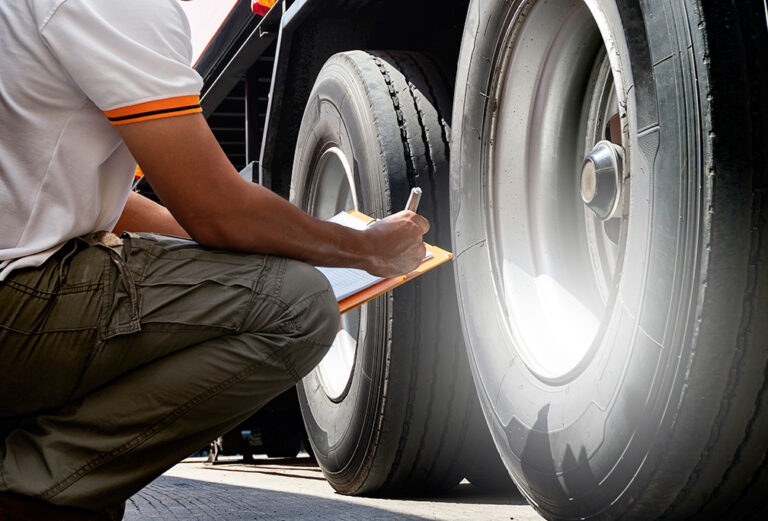
Except in the rare instances of tire damage occurring just prior to the inspection, the vast majority of tire issues can be identified with a pre-trip inspection. It isn’t hard to identify tires with inadequate tread, low air pressure, or tread or sidewall damage.
Then there’s this truth: A driver that doesn’t perform a pre-trip inspection — even after being notified that an inspection event is occurring — isn’t likely to be performing them at any other time.
Each year, CVSA selects focus areas for vehicle inspections.
Cargo securement was a focus area of this year’s Roadcheck, with 12.4% of OOS violations being due to securement issues. No information is available for how many violations were related to which trailer types. Flatbed, step-deck and RGN truckers deal with securement on every load, while dry van and refrigerated trailer operators may not deal with securement at all.
Drivers must also pass muster to remain on the road.
On the driver side, CVSA’s Level I, II and III inspections include driver documents, including electronic logging devices (ELDs).
This year, the top OOS violation for drivers was not having a Medical Certification Card, accounting for 1,072 (27%) of driver violations. That’s an issue for many drivers, especially with conflicting information being circulated. The FMCSA is supposed to be implementing rules that eliminate the need for drivers to carry cards, but glitches with computer systems keep causing implementation delays. The best practice is for every driver to make sure a card is received after every physical exam and to carry it along when driving.
Other OOS driver violations included 929 for hours-of-service violations, 620 for no CDL and 361 for English language proficiency.
Some drivers choose to take time off during Roadcheck and other inspection events to avoid the hassle altogether.
In fact, so many of them park their trucks that spot freight rates typically rise during inspection periods in response to the lower number of available trucks. While this strategy may help avoid an inspection — and potentially an expensive service call — it’s not the best action to promote safety. If there’s something wrong with the vehicle, it’ll still be wrong when it hits the road again.
It’ll be interesting to see the results of this year’s Brake Safety Week, which was conducted Aug. 23-29. It’s likely OOS numbers will remain high.
The point for drivers, however, is that CVSA events like International Roadcheck and Brake Safety Week provide opportunities for drivers to learn more about what’s likely to go wrong with their vehicles and where the inspection process needs to be stepped up.
The overriding goal for everyone should be increased safety.

Cliff Abbott is an experienced commercial vehicle driver and owner-operator who still holds a CDL in his home state of Alabama. In nearly 40 years in trucking, he’s been an instructor and trainer and has managed safety and recruiting operations for several carriers. Having never lost his love of the road, Cliff has written a book and hundreds of songs and has been writing for The Trucker for more than a decade.