




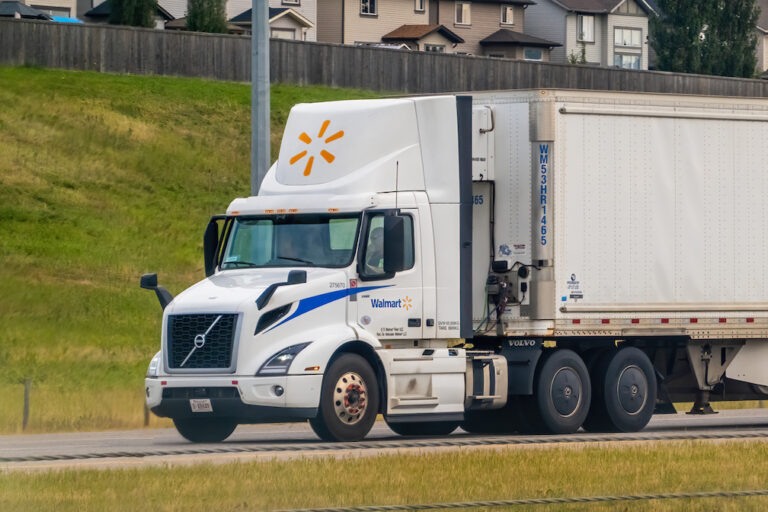
The food industry represents a significant percentage of shipments by truck, from raw materials like sugar and flour going to manufacturers or finished products headed for store shelves. So Darica Schneider, president of the Food Shippers of America (FSA) joined with a team of analysts at FTR Transportation Intelligence (ftrintel.com) to present an October 2 webinar to discuss the overall economic picture intoto present an October 2 webinar to discuss the overall economic picture into 2026 and its implications for the trucking industry.
FTR Chairman of the Board Eric Starks took on the first segment, saying that “uncertainty” is definitely a descriptor word of the current state of the market. A good deal of that uncertainty, he said, is related to tariffs.
“We started the year with (an effective tariff rate on imports) at just under two and a half percent,” he explained. “It went all the way up above 30 and it’s been bouncing around since then.”
Not knowing where tariffs will end up makes it difficult to predict prices in months to come. Will retaliatory tariffs imposed by other countries rise? Will a deal be made that keeps tariffs low? Will the courts intervene, changing tariff rates or throwing them out entirely?
“This is why everybody has been kind of on edge and unable to make a decision,” Starks said. FTR has forecasted that the import tariff rate will settle out between 15% and 20%, but “we don’t know for sure, because of the amount of uncertainty that is out there in the general marketplace.”
One concern Starks expressed is for the low payroll numbers coming from the U.S. Bureau of Labor Statistics (BLS). A chart showed the slowdown, from the economy adding over 300,000 jobs in December 2024 to a paltry 22,000 in August 2025. mining, construction and manufacturing, along with transportation and warehousing, have all seen job declines this year. Industries experiencing negative growth are producing less product for truckers to haul and pumping less money into the economy through employee wages and benefits.
Those numbers show up in the report on Real consumer spending, which was less than a half percent growth in the first quarter and about 1.6% for the second.
FTR forecasts consumer spending growth to hover around 1% per quarter for the next three quarters.
“The gist is that we’re going to see weakness in the consumer sector for the next three quarters before we start to see anything pick up,” Starks remarked. “And generally, we want to see something north of 2%, so this is very lackluster.”
Starks explained that Gross Domestic Product (GDP), which hit negative territory in the first quarter and rose nearly 4% in the second, was heavily influenced by tariffs. “We saw the first quarter go negative because we brought in a bunch of imports,” he emphasized. “Second quarter went positive because we didn’t bring in a bunch of imports.” Since imports aren’t produced domestically, those dollars are actually subtracted from the GDP. New tariffs and threatened future tariffs caused a rush to order imports before tariffs could be enacted, causing the negative first quarter GDP result. Once some tariffs took effect in the 2nd quarter, ordering slowed considerably.
“As we think about the fourth quarter and the first quarter of next year, we clearly see slowdown happening,” Starks said. “We’re not going for a recession right now, but I think there are a lot of signals that suggest we could be moving in that direction.”
That brought the presentation to the GDP Goods Transport Sector, which subtracts out domestically produced products that aren’t shipped and adds back in imported goods, which are shipped. After a fairly strong first quarter, again, due to import numbers, transported goods fell by more than 15% in the second quarter. The FTR forecast calls for growth to remain in negative territory for the next two quarters before a slow climb back to positive territory. “Traditionally, we need to see above 3% growth for it to actually have an impact on the underlying freight markets,” Starks said.
Finally, Starks noted that post-pandemic food inventories have remained lower than they were pre-pandemic. Retailers tend to try to keep enough inventory on hand to supply expected sales, so lower inventories does not suggest an expectation of increased consumer spending. He closed by stating that tariffs, in and of themselves, are not “good” or “bad,” but the uncertainty surrounding the change they bring to the market can have an impact.
FTR Vice President of Trucking Avery Vise was next. Discussing spot freight rates, he said, “For the last three years, the spot market has basically been running at a low level and has been stable.” In contrast, freight “volume, at points this year, has been running below last year, certainly below 2023 levels” he said. “We see an increase of just under 1% growth in refrigerated and dry van food loadings.”
The reason that rates are remaining low, according to Vise, is capacity. That’s the number of trucks available to haul the amount of freight available.
“We still have a capacity overhang that is driven principally by the small end of the market, one and two truck type operations that deal with brokers. That segment of the market still has 39% more drivers than it did before the pandemic.”
Using statistics from the FMCSA Motor Carrier Management Information System (MCMIS) database, Vise explained that the segment of trucking with 1-5 trucks reached 62.2% above pre-pandemic levels as drivers quit their trucking jobs to purchase their own trucks. That percentage has gone down each year since but is still 39% in 2025. There are more carriers registering between six and 100 trucks, too, about 17.8% more than pre-pandemic levels. The 101 or more trucks segment of the industry is in negative territory (1.9%) this year as large carriers downsize. Overall, however, there are still 12.2% more drivers than prior to the pandemic.
Until that excess capacity comes out of the fleet, Vise explained, rates are likely to rise very slowly. Eric Starks said, “To take 1% of capacity out of the market, you have to take roughly 40,000 trucks out.”
At that rate, nearly a half-million trucks will need to stop running to get back to pre-pandemic levels.
Some help could come from an unexpected arena, however. The FMCSA’s new rule against issuing CDLs to non-domiciled drivers is expected to remove 194,000 drivers from the U.S. fleet in the next two years. Enforcement of English Language Proficiency regulations could cost 20,000 more.
Premiums for trucking insurance have risen sharply, adding to operating costs for small carriers.
“We do expect that a number of those operations will go out of business later this year, or at least by early next year,” Vise predicted.
Finally, Trump tariffs of 25% on heavy-duty trucks not built in the U.S. will drive equipment costs skyward.
“That might be the breaking point for some trucking operations. The ATA estimates (the tariff) would add at least $30,000 to the cost of a truck built in Mexico, as 40% of trucks are currently,” Vise remarked.
Trucking conditions, without a surge in manufacturing creating an increase in load volumes, are expected to remain stagnant for the next year or longer.

Cliff Abbott is an experienced commercial vehicle driver and owner-operator who still holds a CDL in his home state of Alabama. In nearly 40 years in trucking, he’s been an instructor and trainer and has managed safety and recruiting operations for several carriers. Having never lost his love of the road, Cliff has written a book and hundreds of songs and has been writing for The Trucker for more than a decade.