



NEW YORK CITY — An announcement by the administration of New York City Mayor Zohran Mamdani last month has outlined a new plan to refurbish the Brooklyn-Queens Expressway (BQE).
The plan is extensive, and has ignited some resistance.
Mamdani and New York City Department of Transportation (NYC DOT) Commissioner Mike Flynn announced plans to rehabilitate the City-owned portion of the BQE between Atlantic Avenue and Sands Street.
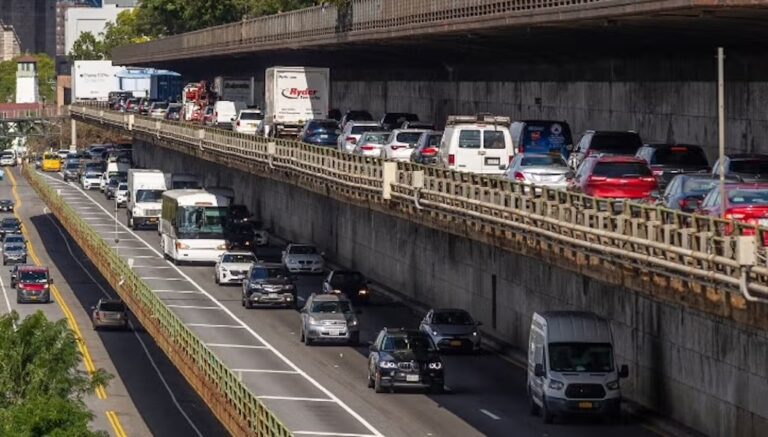
“The infrastructure is 20 years past its design life and deteriorating under the weight of 130,000 vehicles every day — more than double the capacity for which it was designed,” the Office of the Mayor stated in a news release.
“For decades, prior administrations have failed to deliver urgent long-term repairs to BQE Central — but we can no longer afford to wait for the perfect solution,” said Mayor Mamdani. “We’re going to fix the aging concrete, repair the deteriorating triple cantilever and build temporary roads that keep the highway operable during construction to avoid sending tens of thousands of cars and trucks onto local streets. This plan allows us to safely fix the BQE without slowing our city down or wasting decades more on magical thinking. The cost of inaction is too high, and the risks to New Yorkers are too important to delay any longer.”
Mamdani’s plan to stabilize BQE Central will use temporary bypass structures that allow NYC DOT to repair deteriorated sections of the highway and improve drainage, railings and lighting while protecting local streets from dangerous through traffic, facilitating the movement of goods and preserving access to historic destinations including the Brooklyn Heights Promenade and Brooklyn Bridge Park, according to the mayor’s release.
NYC DOT plans to build a temporary, two-level highway bypass on top of Furman Street, below the promenade, from Atlantic Avenue to Columbia Heights. This bypass will be no higher than the existing Queens-bound highway and will not block the promenade. The agency plans to build a second temporary, elevated highway bypass from Columbia Heights, over the Brooklyn Bridge approach, to the Manhattan Bridge.
According to the release, the approximately $4 billion, 10-year rehabilitation will break ground in 2030 and extend BQE Central’s design life for another 40 years. This reflects the shortest-term rehabilitation plan needed to keep the structure safe and stable while also allowing the City to work with the State, which controls the northern and southern segments of the BQE, on a long-term vision for the entire highway.
“Time is up. We are fixing the triple cantilever. After decades of kicking the can down the road and indecision that failed to yield substantial results, we will act with urgency to rehabilitate the City’s portion of the BQE to ensure the safety of New Yorkers and minimize the likelihood of massive traffic diversions into Brooklyn neighborhoods,” said NYC DOT Commissioner Mike Flynn. “While the City and the State must right the wrongs of Robert Moses with the BQE and other infrastructure plowed through urban communities, decades of political paralysis have left us out of options. Confronting the reality of cracked concrete, exposed steel and extensive rust damage simply cannot wait for another blue-ribbon commission.”
What there is time for is a little debate.
There are media pundits in New York that are offering alternatives, including demolishing the BQE altogether.
The Real Deal called for razing the road, which would offer development opportunities.
Meanwhile, the New York Daily News offered a unique political perspective in that city government has not solicited the feds because if the midterm elections were to shift leadership in the U.S. House and Senate, that the Speaker of the House would likely be Hakeem Jeffries, and the Senate Majority Leader could be Chuck Schumer, which both hail from Brooklyn.
Mamdani said every year of inaction costs the City $160 million and threatens highway closures that would force dangerous through traffic — including 13,000 daily truck trips — onto local streets
What does it mean for the trucking industry?
First, the BQE is what Zach Miller, who serves as Vice President of Governmental Affairs for the Trucking Association of New York (TANY), called a “crucial freight corridor.”
Both the City of New York and the State of New York own various sections of the BQE:
The City owns:
1.5 miles (12 percent) of the BQE in Brooklyn
Atlantic Avenue to Sands Street, including the Triple Cantilever, in Brooklyn Heights
Bridges and elevated highway through Downtown Brooklyn
The State owns:
10.6 miles (88 percent) of the BQE in Brooklyn
Areas in north and south Brooklyn where the highway is below street level (trenches)
Areas where the highway is on a structure above street level (viaducts)
The City and State will continue to collaborate as partners throughout the visioning and implementation processes.
Miller said the plans to repair and refurbish the BQE have been ongoing for the last 10-plus years, spanning two mayoral administrations. He also gave credit to the NYC DOT for it work in keeping BQE operational.
“They have done the patching up that they needed to do to keep the status quo, but that is a temporary situation,” Miller said.
Other fixes include banning overweight trucks on the BQE, which has ramifications for adjacent communities that have had to endure trucks routing through nearby neighborhoods.
“We are getting closer to the day where if nothing is done, New York City DOT will have no choice but the ban all trucks from the BQE,” said Miller, who labeled such an action as an unmitigated disaster situation.
That means around 13,000 to 14,000 trucks to be diverted around local streets, along already congested or very busy commercial corridors.
“That is a nightmare scenario that nobody wants,” Miller added.
Bruce Guthrie is an award-winning journalist who has lived in three states including Arkansas, Missouri and Georgia. During his nearly 20-year career, Bruce has served as managing editor and sports editor for numerous publications. He and his wife, Dana, who is also a journalist, are based in Carrollton, Georgia.