






Human trafficking, or modern-day slavery, has been reported in all 50 states, and the number of victims in the United States and Canada is estimated in the hundreds of thousands.
Around the world, it is estimated there are over 50 million slaves today.
While illegal, human trafficking is a booming business. Traffickers recruit out of our schools, online and in shopping malls, as well as the streets and other locations.
A large percentage of the people trafficked are women and children. And they need to be identified and recovered.
TAT is on a mission to stop trafficking.
TAT (Truckers Against Trafficking) recognizes that members of the trucking, bus and energy industries are invaluable in the fight against this heinous crime. As the eyes and ears of our nation’s highways, the professional drivers in these industries are in a unique position to make a difference and close loopholes for traffickers who seek to exploit our transportation system for their personal gain.
Founded in 2009, TAT informs members of the trucking, bus and energy industries, as well as other travelers, about the basic issues involved in human trafficking and educates on ways they can help. Over the years, the organization has grown considerably as awareness of this heinous crime has increased.
TAT’s mission is to educate, equip, empower and mobilize the members of key industries and agencies to combat human trafficking with the goal of building the largest army of transportation individuals dedicated to discovering and disrupting human trafficking.
Today there are over 2.5 million industry professionals registered as TAT Trained.
Since TAT began, professional drivers have made thousands of calls into the National Human Trafficking Hotline and to law enforcement, resulting in hundreds of cases and thousands of victims identified by truckers on the road.
Professional drivers are on the front lines of the fight against trafficking.
Here’s just one example of how a member of the trucking industry can make a difference in fighting the crime of human trafficking:
A truck driver pulled into a truck stop and noticed a beat-up RV, with men going back and forth from it to the convenience store. Then the truck driver saw a girl trying to look out the window, only to have her head forcefully pulled away. The truck driver called law enforcement. When they arrived on the scene, they found a man and woman inside the RV, as well as a 20-year-old female, who had been coerced from her home in Iowa 18 days earlier. During that time, the couple beat and burned the victim and sold her for sex. The two traffickers are currently serving sentences of 40 and 41 years.
Without the support, commitment, and actions of truck drivers, TAT would cease to exist, and the gains made against human trafficking in North America would take a leap backward.
Recognize the signs of trafficking.
The red flags of trafficking are clear enough to spot when you know where to look. They include:
- A person’s lack of knowledge of his/her whereabouts; not in control of ID/passport.
- Restricted or controlled communication — not allowed to speak for self.
- CB chatter about “commercial company” or flashing lights signaling “buyer” location.
- Acknowledgment of a pimp or “daddy” and making a quota. For example, “I can’t go home until I make this last $100.”
- A van or RV that seems out of place parked back by commercial trucks.
- A vehicle dropping someone off at a truck and picking the person up 15-20 minutes later.
- Any minor being sold for sex
- Evidence of pimp control, no matter the age of the victim.
- Someone who appears to be exchanging sex for anything of value (food, shelter, drugs, money or a ride).
- Someone exhibiting a disheveled appearance, who is unkempt, alone, and scared or extremely angry.
- Someone who may have bruises or injuries and/or is malnourished.
- Multiple individuals getting out of and returning to a central car or person at regular intervals (could be victims returning to give their earnings to the trafficker).
- Nonverbal cues or body language indicating fear, anxiety or trauma.
If you see multiple red flag indicators, call the authorities and report what you are seeing. If you see a crime in progress, call 911 in either the United States or Canada. To access victim resources or pass along a tip, call the National Human Trafficking Hotline at 1-888-373-7888 in the United States. In Canada, call 1-833-900-1010.
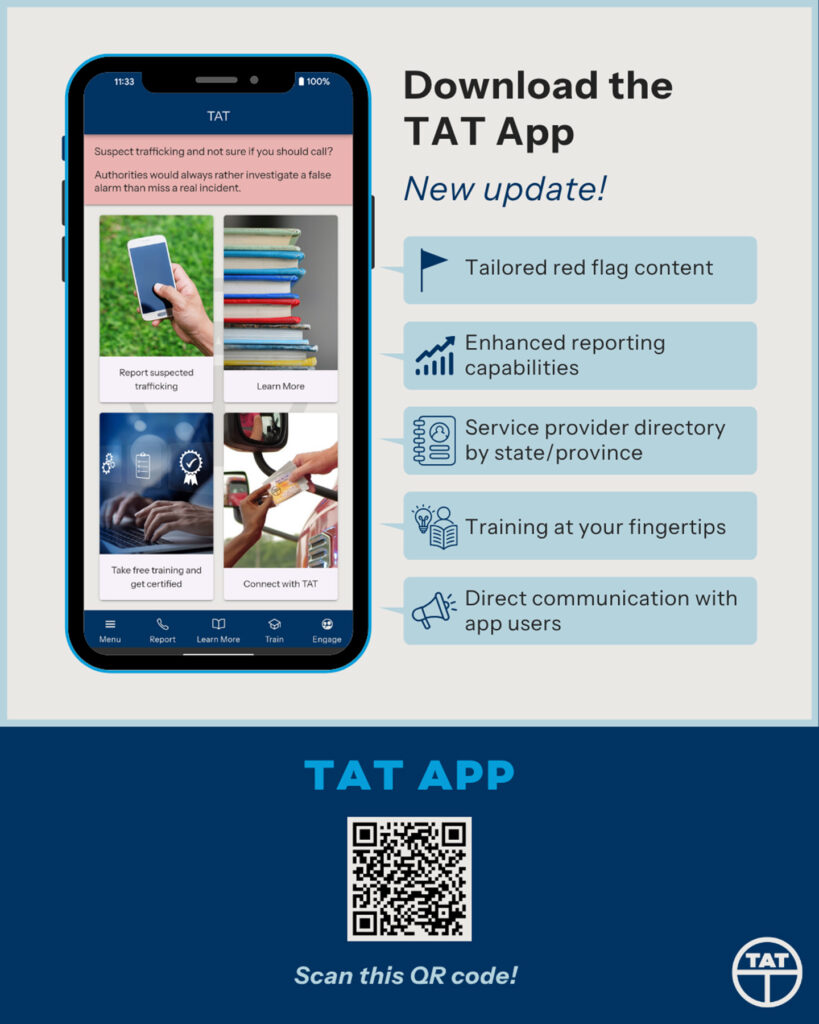
Scan the QR code below to download the TAT app:

Lyn Leeburg is the communications director for TAT (formerly Truckers Against Trafficking).
Established in 2009, TAT started with a simple yet powerful belief: Every truck driver can be a crucial ally in the fight against human trafficking.
Since then, TAT has grown to encompass a greater portion of the transportation industry, forming deep alliances to maximize collective effort through programs that include innovative training, partnerships with law enforcement, and advocacy efforts. Using targeted systems change as a model, TAT has raised awareness about trafficking, who it targets and its signs, and equipped individuals to take action whenever their lives intersect with it and its victims.
TAT is driven by the belief that together, we can make a difference.





Thank you for the update. Although retired from writing and editing for The Trucker newspaper for several years, I never lost my interest in TAT and the human trafficking problem. Congratulations on the great strides that have been made. I hope President Trump has been made aware of what TAT is doing. At one time he expressed an interest in eradicating human trafficking. Keep up the great work.
Dorothy, you left us some big, talented shoes to fill! Thank you for your love of trucking and journalism.