



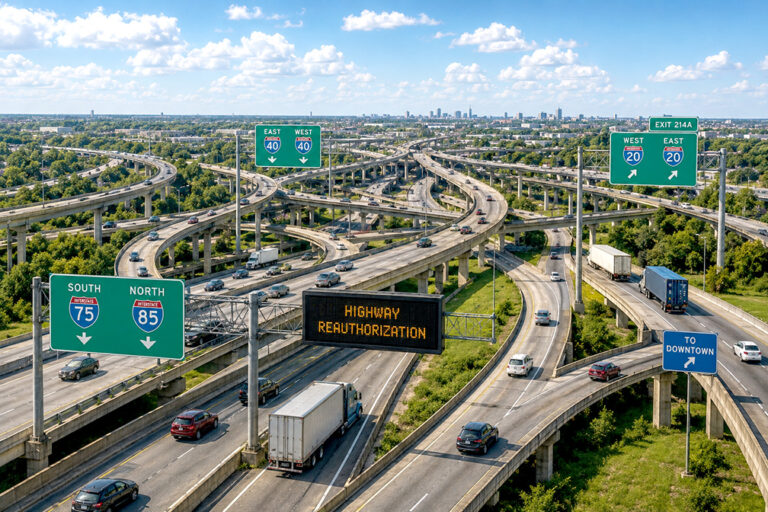
The chairman of the House Transportation and Infrastructure Committee, Sam Graves (R-MO) said it was his intention to get a new surface transportation reauthorization bill passed before the end of 2026; the old one expires on September 30, 2026.
A large step was taken in that direction on May 18 when the BUILD America 250 Act — the name given to the current highway reauthorization bill — was set for markup on the 21st. But “markup” is a process of debates, rewrites and amendments that could substantially change the bill before it is ever presented to the full House of Representatives for a vote.
For now, the bill is a five-year plan that earmarks $580 billion for the nation’s infrastructure, with $474.4 billion coming from the Highway Trust Fund. The funding would be allocated as follows:
- $376 billion would go to the Federal Highway Administration for road and bridge construction and repair;
- $87.6 billion would go to the Federal Transit Administration for use in mass transit; and
- $64.7 billion would go to the Federal Railroad Administration (this includes $31.1 billion for Amtrak).
But wait, that’s not all!
The bill is loaded with other provisions. They’re all highlighted in a 64-page summary released by Graves and Committee Ranking Member Rick Larsen (D-WA). Click here to download the summary.
Registration fees on motor vehicles
One item that trucking organizations have pushed for is the imposition of federal registration fees for electric and hybrid vehicles. Since no motor fuel is burned in an electric vehicle, no fuel taxes are collected to fund building and maintenance of roads. Methods of collection have been debated for years.
The BUILD America 250 Act would require states to collect a $130 registration fee, beginning in 2029, increasing the amount to a cap of $150. Hybrid vehicles, which do burn fuel but at a lesser rate, would initially be charged $35 with an eventual cap amount of $50.
Parking for trucks and other CMVs
The new reauthorization bill outlines the codification and improvement of Jason’s Law. Through the Build America 250 Act, truck parking gets another $750 million, which would be used to expand safe and reliable parking options.
Federal hair testing guidelines
Another provision of the bill — and one supported by trucking organizations — is hair testing for controlled substances.
Hair testing has proven to be effective in identifying use of substances that are often missed in urine testing and even in the recently-approved oral fluid testing.
Numerous carriers are currently requiring drivers to undergo hair testing, but test results can’t be entered into the Federal Motor Carrier Safety Administration’s (FMCSA) Drug and Alcohol Clearinghouse because the testing method hasn’t been approved by the U.S. Department of Transportation (USDOT).
The bill — if not changed in markup — would require the U.S. Transportation Secretary to recognize hair testing as an approved specimen collection type within one year of the Secretary of Housing and Human Services issuing “scientific and technical” guidelines for hair testing.
The bill does not provide a time limit for release of the guidelines.
Federal oversight of predatory CMV lease-purchase agreement programs
In 2025, the FMCSA published the results of its review of predatory commercial vehicle lease-purchase agreements, and the 2026 reauthorization continues the process.
Motor carriers would be required to provide a disclosure form to each party in the lease-purchase arrangement. The Transportation Secretary would be required to publish a template for such a disclosure form that includes financial expectations. The USDOT would also be required to carry out a public awareness campaign informing potential lessees how the programs work and the prevalence of predatory programs. The section also directs the Secretary to issue a rulemaking to prohibit the use of predatory lease-purchase agreements, but it does not define them.
Modifications to certain CDL regulations
One issue that has arisen with new CDL training requirements is the administration of testing for drivers who aren’t domiciled in the same state as the CDL school they attend.
In short, a driver who lives in one state but attends a CDL school in another state is often required to take the road skills portion of the CDL test back in their home state, where long delays for a testing appointment are often encountered.
A provision of the bill would allow states to administer a driving test to any CDL applicant, regardless of their state of residence. The bill also directs states to use third-party examiners for the knowledge (written) test. It isn’t clear how a passed test would be communicated back to the home state, or whether a CDL issued by the state the school is in would be transferable to another state.
Safe integration of autonomous commercial vehicles
The controversial issue of autonomous trucks is also addressed in the bill.
Manufacturers of automated driving systems (ADS) and ADS-equipped commercial motor vehicles would be required to meet all applicable regulations, demonstrate competencies through a “safety case,” and to adhere to all reporting requirements.
The safety case has been widely criticized as another government attempt to allow manufacturers to self-certify without appropriate government testing or oversight — an issue that has plagued other self-certification programs such as manufacturers of electronic logging devices (ELDs).
The bill contains further language that would include autonomous vehicles in the Transportation Secretary’s power to preempt state law, setting up potential conflict with states who might have requirements for driverless vehicles that don’t mesh with federal law.
Other programs included in Build America 250
The bill also reintroduces programs and proposals that have been presented and discussed in the past and may be familiar to many readers.
• Restroom access: One provision establishes restroom access requirements for drivers delivering to “covered” establishments.
• Under-21 CDL drivers pilot: Another extends the under-21 Apprenticeship Pilot Program until September 30, 2031, when the new reauthorization bill would expire.
• Warning beacons for autonomous vehicles: Also included is a provision for cab-mounted warning beacons for autonomous vehicles that are stopped along the highway due to breakdown or emergency. Current regulations call for warning devices, typically reflective triangles, to be placed in specified locations around the vehicle in such a scenario. With no driver to put out the devices, another method to alert oncoming traffic is needed.
• Vehicle per-mile user fee pilot: The bill reauthorizes the national motor vehicle per-mile user fee pilot program for another five years. It expands the current program to include data collection and reporting on the difference between the current fuel-usage based program and a more toll-like per-mile program.
There are countless other items in the bill as it stands now. To review them all, click here to download the 63-page summary.
Like many bills, there are a lot of items that could be whittled down or removed entirely from the final version submitted to Congress. Follow TheTrucker.com for updates.

Cliff Abbott is an experienced commercial vehicle driver and owner-operator who still holds a CDL in his home state of Alabama. In nearly 40 years in trucking, he’s been an instructor and trainer and has managed safety and recruiting operations for several carriers. Having never lost his love of the road, Cliff has written a book and hundreds of songs and has been writing for The Trucker for more than a decade.