




ATLANTA, Ga. — A new Altitude by Geotab study using real-world commercial vehicle data has revealed some of the most and least efficient cities for freight movement across the United States.
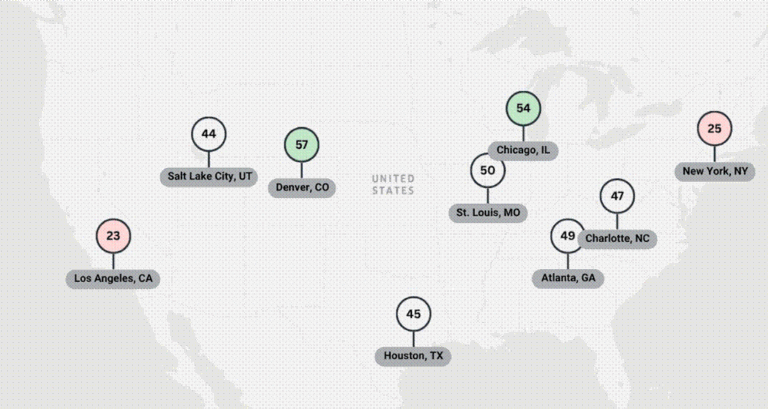
The Altitude Freight Efficiency Score, developed by Altitude by Geotab, ranks nine major urban areas based on how well their transportation networks support the flow of goods. Denver and Chicago emerge as the top-performing cities, while Los Angeles and New York rank lowest for freight efficiency.
“Cities looking to improve their freight efficiency should focus on investments that make traffic patterns more predictable, strengthen emergency response and disruption recovery capabilities, and reduce unnecessary vehicle idling as part of broader sustainability goals,” said Nate Veeh, associate vice president of market development at Altitude by Geotab The Altitude Freight Efficiency Score offers planners a consistent, data-driven way to benchmark progress and guide investment decisions.”
Key Driver of Economic Growth
According to the report, efficient freight movement is a key driver of economic growth – trucks move 72% of America’s freight by tonnage and are the sole source of freight services for more than 80% of American communities. But freight performance varies widely between cities. Strategic infrastructure planning, congestion management, and resilience to disruption all play a role in how effectively freight moves through urban areas.
The Altitude Freight Efficiency Score
The Altitude Freight Efficiency Score evaluates city performance across three areas:
- Infrastructure readiness.
- Infrastructure resilience.
- Infrastructure externalities.
It provides each city with a standardized score from 0 to 100. Scores above 50 reflect strong performance, scores between 25 and 50 indicate moderate efficiency, and scores below 25 highlight networks that require additional attention.
City-by-City Key Findings
- Denver (57) and Chicago (54) rank as the most efficient freight cities, demonstrating stronger all-around performance in congestion management, resilience to disruptions, and minimal idling.
- Los Angeles (23) and New York (25) score lowest overall, with severe congestion pulling down their infrastructure readiness despite some strength in resilience and idling reduction.
- Salt Lake City (44) and St. Louis (50) lead on congestion performance, thanks to lower population density and well-planned highway networks, though Salt Lake City records the highest idling times.
- Atlanta (49) performs above average, with effective traffic management keeping congestion relatively predictable, though resilience and idling leave room for improvement.
- Charlotte (47) and Houston (45) fall into the moderate range, with opportunities to boost resilience and reduce congestion impacts.
The Freight Efficiency Score
The analysis draws on trip, stop and route data from medium and heavy-duty trucks operating in these cities. The Freight Efficiency Score is weighted as follows:
- Infrastructure readiness (60% weighting) – Measures congestion levels, predictability of traffic patterns, and the availability of low-congestion travel hours.
- Infrastructure resilience (20% weighting) – Measures how well a city’s transportation network recovers from disruptions, including weather events and major public gatherings.
- Infrastructure externalities (20% weighting) – Measures waste in the system, primarily through commercial vehicle idling, which adds to operational costs and environmental impact.
“The report highlights that improving freight efficiency offers tangible benefits for cities, businesses and communities,” the release said. “Reducing congestion and improving traffic predictability helps lower operational costs for fleets and makes supply chains more reliable. Stronger infrastructure resilience allows cities to recover faster from disruptions. Minimizing idling reduces both costs and emissions, contributing to cleaner air and better public health.”
For the full report, click here.
Altitude by Geotab released a study in April revealing the “significant potential” for truck electrification.

Dana Guthrie is an award-winning journalist who has been featured in multiple newspapers, books and magazines across the globe. She is currently based in the Atlanta, Georgia, area.