



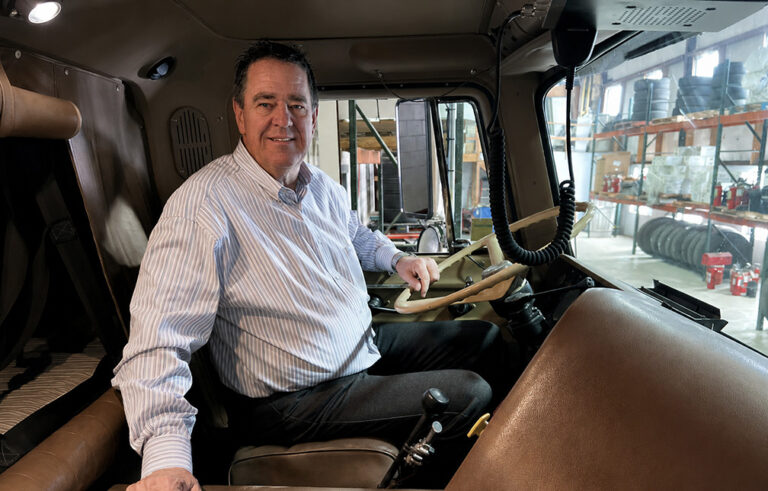
When visiting with Mark Seymour, chairman of the board for the Truckload Carriers Association (TCA) and CEO of Kriska Transportation Group, about the state of the trucking industry, one message comes through loud and clear: People are the heart of trucking. On the heels of that sentiment comes another: Those people can’t afford to sit back passively while others fight to improve the industry. Participation and taking action are key to changing the industry for the better. As we visited one morning in June, Seymour offered insights into the whirlwind of change surrounding the North American trucking industry and how TCA is working to shape the future.
By the time this issue of Truckload Authority hits readers’ desks, you’ll have completed your first quarter as TCA Chairman. What’s the road been like so far?
Not everybody wants to have a seat at the “big table,” so to speak — where you have an opportunity to influence or craft legislative and administrative agendas. I’m not one of those people.
I find it incredibly rewarding to work with the member committees to come to a consensus on issues. I’ve had the privilege of seeing how the association works and seeing how much of a difference TCA can make in the crafting of policy and its influence on how things are going to look going forward. I’ve enjoyed that — and I’m lucky to have the time to be able to do it.
As I’ve gradually become more active in TCA, going from the big board to the executive to the officer group to chair, I’ve met so many fantastic people. It’s great to work with people with shared interests and shared desires.
This is a people business. We have trucks and trailers as tools, but it’s a people business. I’m enjoying being around people who care and participate, who want to make a difference. I love the satisfaction of participating and having a seat at the table.
There have been several pieces of legislation making headlines in the U.S. over the past few months. One is the Combating Organized Retail Crime Act of 2025 (CORCA), which the industry hopes will help prevent cargo theft and fraud by increasingly sophisticated criminals. What are your thoughts?
There’s a very good article about this legislation in this edition, titled “Gaining Ground: CORCA legislation could be a valuable tool in fight against cargo theft.” If you haven’t already, check it out!
TCA is very encouraged by the progress that’s being made on this front. In general terms, there is now a coordinated effort to put one body or group in charge, namely Homeland Security.
In the past when it came to cargo-related theft issues, there was a lot of finger pointing by enforcement agencies: “Who’s really responsible for stopping this?” So having a single, coordinated effort by the federal government is something that we’re very supportive of. It’s exciting for us to think progress will be made to suppress some of this criminal activity.
Cargo theft and fraud is out of control, and it’s something that’s very problematic for us and our customers. You could easily liken the situation to an epidemic.
Cybersecurity is frequently noted as a weapon against cargo theft. How are the two related and where do they diverge?
Cybersecurity is in-house-specific to a company. It’s a good defense against cyberattacks because you can build walls and moats around yourself, protecting your own data.
It’s hard to do that with crime against property or cargo theft when there’s corruption that’s seemingly left unattended to. So they’re similar, or at least related, but not exactly the same, in my opinion.
Of course, we can’t skip over the BUILD America 250 act, which is designed to take the place of the highway reauthorization bill that’s set to expire later this year. At the time of this interview, the bill is still in the markup stage, and it’s anyone’s guess as to what the final legislation will look like. What are your thoughts?
I actually just talked to (TCA President) Jim Mullen about it this morning! We are keenly aware of the situation. To your point, who knows where it will be by the time this article is printed.
However, TCA likes the figures proposed, largely for roads and bridges. As it stands now, $750 million is marked for truck parking, and that’s very important to the industry. The lack of safe, accessible parking for our drivers is something that’s been talked about in great detail.
Battery-electric vehicle registration fees is another important key to funding, and until this point it’s been left out. I was surprised and pleased that hair testing for the FMCSA Clearinghouse is part of the bill as well, which is something TCA and many of its members support.
The one thing that we don’t like — and it’s something that may or may not end up on the final bill — is the increase in weights and axles for commercial vehicles in some states.
But by and large, the TCA is very enthused by the BUILD act. We like the number and we like the things that are within it, with the exception of the increased weights.
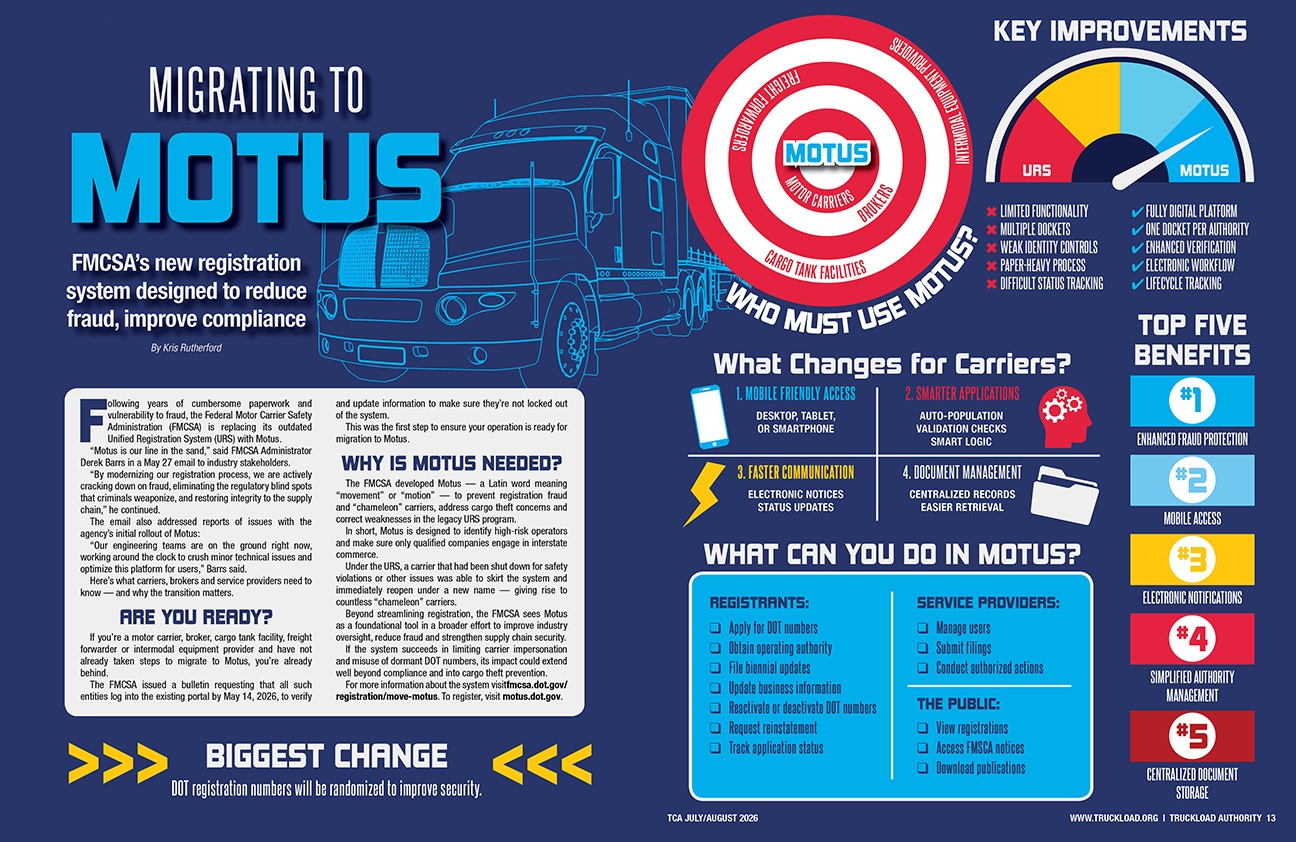
Motor carriers in the U.S. area in the process of converting to Motus, a new registration system for the Federal Motor Carrier Safety Administration. What can you tell me about the changeover and why it’s necessary?
Motus is replacing the Unified Registration System, or URS, which was old and antiquated. The URS had various layers that not only made it complicated for businesses to understand and use — those layers made it all too easy for so-called “bad actors” to worm their way through and hide who they really are.
Once it’s completely implemented and fine-tuned, Motus will be a better, more simplified and less complicated registration system. The new system has got the firewalls and protections needed to mine out fraud.
Usually when a system is more simplified (and arguably faster), it’s going to be less robust relative to fraud and the chameleon carriers that we’re trying to flush out. That’s NOT the case here. Motus promises to be more robust and faster and easier, all at the same time.
Check out the infographic at the end of this article for an overview.
The effort to remove commercial drivers that are unqualified — due to a lack of English language proficiency, poor driver training and licensing, or the improper issuance of CDLs to non-domiciled drivers — continues in the U.S. Please share your thoughts on the issue (actually issues, plural).
Regarding English proficiency, I think it’s incumbent on any responsible carrier to make sure their drivers can understand, read and speak English. That applies to carriers in Canada and Mexico as well, especially if their trucks are going to cross the border into the U.S. If their drivers can’t pass a basic proficiency test, that’s a big problem.
TCA certainly is very supportive of all the things that are going on, as am I.
Jim Mullen shared a fact with me recently regarding non-domiciled CDLs that’s worth mentioning: During the first six months of the crackdown, 28,000 drivers have been removed from the system, and it’s estimated there could be as many as 250,000. So they’ve only got about 10% in the first six months. Whether the 250,000 number was a stretch in the estimate or not, there are still a lot of drivers being taken out of the system that should not have received CDLs. That’s good news.
Also, just through random auditing — the FMCSA didn’t even target specific schools or regions — there’s been 4,500 CDL training facilities identified as problematic. These audits also uncovered numerous CDL “mills,” as well as fraudulent trainers.
Going back to the English language proficiency situation: Right now it’s a state-led issue, with a lack of coordination across different jurisdictions. I believe it would be far more effective if, for example, the FMCSA coordinated the English language proficiency test, audits and consequences so it doesn’t differ from region to region.
In short, TCA supports flushing out non-domiciled drivers with improperly issued CDLs. Keep flushing out the ill-prepared and inadequate CDL schools and mills, and coordinate the effort behind enforcing the English language proficiency requirement.
What in-person events can TCA members look forward to this year?
TCA has four in-person events each year: our annual convention and business meetings, the Safety & Security Meeting, the Refrigerated Meeting, the Call on Washington and fall business meetings, and the TCA Truckload Forum – One Border, No Barriers. The annual conference is usually in March, and we just got home from the Safety & Security Meeting, which was held in Oklahoma City in June.
The next big event is the Refrigerated Meeting, scheduled for July 22-24 in Nashville. If you haul temperature-controlled freight, I strongly encourage you to attend. If you haven’t already signed up, visit tcarefrigerated.com for more information.
This year’s Call on Washington and Fall Business Meetings are set for September 1-2. It’s a great opportunity to talk to federal legislators about issues you face every day as a motor carrier, and to encourage them to support the industry. You can find out more at tcafallcall.com.
I’m particularly looking forward to this visit to Capitol Hill: The Canadian Embassy is hosting a dinner event that’s co-sponsored by a couple of allied trade members of TCA that happen to be Canadian — ISAAC Instruments and Manac. I’m really looking forward to showcasing all of that and sharing all that with other TCA members.
Beyond that, the Call on Washington is simply an important thing to do. Advocacy is a large part of what TCA does amongst lots of other things. If you’ve never been before, I encourage you to check it out. We need to arrange as many meetings as possible with as many members of Congress as possible so that we sort of carpet-bomb Washington. We only have one opportunity a year to do this.
What would you say to TCA members who are on the fence about taking time off for in-person events like the Call on Washington?
It’s just two days, and it’s well worth it. You know, if you get sick and can’t go to work for two days, your business isn’t going to fall apart. So maybe put it in that perspective; it’s only two days, and Washington is easy to get in and out of.
In addition to in-person events, TCA offers numerous online education and meeting opportunities. What are a few coming up?
The next few months are exciting for TCA education. Our webinar series continues with a focus on leadership and recruitment and retention. We’ll be covering topics such as insurance, technology, succession planning and maintaining a healthy fleet.
The education department is also finalizing a new best practice series and expanding the Fundamentals of Safety Management LIVE series. Look for more information soon!
What benefits can members gain from the webinars and other growth opportunities TCA offers?
You know, as officers of TCA, we constantly talk about member value. It’s important to get involved; not just sit back and watch. The association’s advocacy in Washington is important, but taking true value back to your business involves learning and sharing ideas and experiences with others.
In short, TCA’s programs can teach you how to run a better business. Whether that means being a better place to work, safer, more efficient, making better use of technology — we have the tools, but you have to use them.
How would you describe a “typical” TCA-member carrier? Is the association geared certain-size companies?
Any carrier can join TCA, regardless of size. And, regardless of size, you can participate and find value. Continuous improvement and continuous learning is just that; it needs to be continuous. That may be even more the case when you’re small.
One of the greatest advantages of TCA is networking, and you’ll get that best by participating in events. If you want to get a lot out of anything, you’ve got to put a lot in. It’s not going to just come to you; you have to go after it and get it.
To me, TCA members’ willingness to share and be open is an experience that I’ve been most appreciative of. If anyone calls me for free advice, I’m happy to do that, because so many members have done that for me over the years.
Big or small, there are benefits to TCA membership — but only if you participate.
Thank you for your time, Mr. Chairman. I look forward to our next visit.
This story first appeared in the July/August 2026 print edition of Truckload Authority, the official publication of the Truckload Carriers Association.

Linda Garner-Bunch has been with The Trucker since 2020, picking up the reins as managing editor in 2022. Linda has nearly 40 years of experience in the publishing industry, covering topics from the trucking and automotive industry to employment, real estate, home decor, crafts, cooking, weddings, high school sports — you name it, she’s written about it. She is also an experienced photographer, designer and copy editor who has a heartfelt love for the trucking industry, from the driver’s seat to the C-suite.