





Much has been written in recent days about federal efforts to shut down CDL mills. (If you’ve been living under a rock, so-called “CDL mills” are truck driver training centers that send thousands of ill-prepared and potentially unqualified new CDL holders to the industry each year.)
While most drivers tend to agree with the public reasoning behind the recommended closures — which primarily involve failure to comply with English language proficiency (ELP) standards and non-domiciled licensing — some closings involve paperwork or equipment issues that schools can fix to remain open.
Professional drivers, who are required to keep safety in the forefront of all they do, have a right to demand that new drivers be brought in under the same stringent safety requirements.
There is, however, another way to look at the CDL school conundrum.
In any field of work, your education is a resource. Students who receive the best training get a better start in the industry, develop better safety habits and are far more likely to become assets to the industry.
In the interest of full disclosure, in the course of a 45-year (and counting) career in the trucking industry, I have held positions as an instructor at two CDL schools. Both positions lasted less than a year, and the two institutions were vastly different in their approach to driver education.
My own trucking education goes back even further than that.
I obtained a “Chauffer’s License,” the equivalent of today’s Class B CDL, in 1982 while working at a trash-hauling company. During a later period of unemployment, I attended CDL school in 1990, using the Stafford student loan program to fund the schooling.
Back then, the six-week program featured lots of driving and range work, but it also included classes in each potential CDL endorsement plus maintenance, mountain driving, traffic law and other topics that helped me become well-rounded as a professional driver.
Unfortunately, the Stafford program was being phased out. My class was the last to qualify for the loan program.
The very next class after mine was drastically different.
Without government loans to help fund the program, the school was forced to make large cuts to tuition funding, and that meant large cuts to driver training:
The course length was cut in half, down to three weeks.
The focus went from producing well-rounded truck drivers that carriers were eager to hire to simply getting students past the CDL test.
Some carriers adjusted by adding to their driver-finishing curriculum, hoping to replace what was no longer taught in the schools.
One of the schools I later taught at followed a similar path.
Our “textbook” was simply the state CDL manual, shipped directly from the state’s department of motor vehicles (DMV).
Students were expected to take and pass the written CDL exam and obtain a commercial learner’s permit (CLP). Then they spent a week performing range maneuvers that mirrored those on the state CDL skills exam.
After that, they piled into trucks to hit the road for some behind-the-wheel training. With four students in the truck sharing time at the wheel, each student might have received the equivalent of one day of supervised, behind-the-wheel driving experience before testing for their actual CDL.
Much of the funding for this school was tied to unemployment benefits. Laws were passed that required those receiving unemployment compensation to attend government-funded training in a marketable skill, or lose their benefits.
The result was enrollment of students that never intended to work as drivers or who couldn’t qualify for hire due to criminal records or other issues. And, since the school didn’t get paid if the student didn’t graduate, instructors were asked to overlook testing standards and pass unqualified students — a practice that led to my resignation.
I had a better experience at the next school.
The other school I taught at was owned by a motor carrier that maintained a six-week program. Much more material was presented, and the school developed its own testing regimen to assess knowledge before sending students to the state for testing.
Since students signed contracts agreeing to work for the carrier for specified period of time in exchange for their training, the pressure to find funding for training was removed. The goal was to produce safe, quality truck drivers.
Obviously, this wasn’t the case at every CDL school.
Unfortunately, even the three-week CDL schools became too long and too expensive for some folks. Ads started appearing for training programs that lasted a week — or even less. “Get your CDL in three days,” one ad said. Others didn’t specify a training length at all, simply promising to get the student past the state testing and on the road.
Making sure each driver has standardized, quality training is important.
So, the news that Federal Motor Carrier Safety Administration is applying standards — getting rid of the bad apples and working to increase the quality of drivers entering the industry — is welcome.
On an individual basis, however, there’s a better way.
Consider your education to be a resource rather than a “check the box” necessity for entry into the trucking industry.
When you’re without a job and the bills are piling up, it’s tempting to look for the shortest and cheapest training option: You want to find a job and get to work as quickly as you can.
As any experienced driver will tell you, however, you will encounter situations on the road that you weren’t trained for. If your “school” was of the “shortcut” variety, you’ll encounter many more of those situations.
In some of them, the wrong decision can be deadly.
In my own case, the training I received helped prepare me for jobs pulling a flatbed, a tanker and double trailers, as well as driving a church bus to pick up kids on Sundays. They helped me understand what to do when the engine ran hot, when tires were low and, on one particularly harrowing occasion, what to do when the brakes failed.
Think about it this way.
Would you trust your children to a teacher whose education consisted of a discount, thee-week teaching course?
Would you have confidence in a surgeon who passed his medical exams after just one week of training?
Or, as often happens in trucking, how would you like to find out your dentist “was trained by Uncle Harvey?”
Follow these rules:
- Choose a quality school.
- Review the curriculum before you sign up.
- Talk to some of their former students.
Consider your CDL training an important resource — and choose wisely.
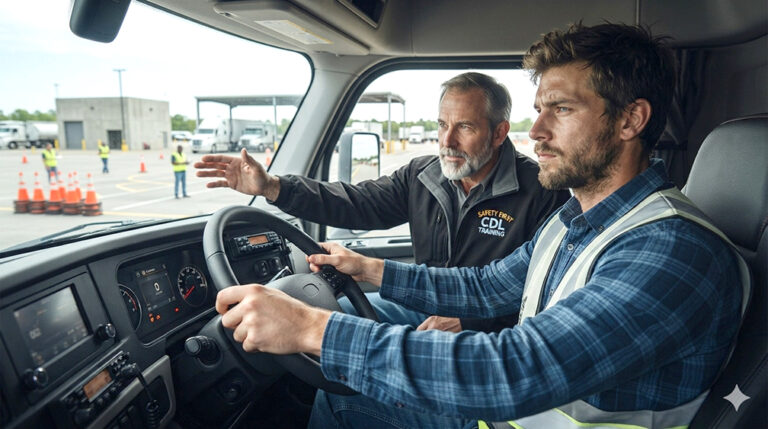
BONUS POINTS: Look at the image accompanying this story. What’s wrong with it? Add a comment below with your answer!

Cliff Abbott is an experienced commercial vehicle driver and owner-operator who still holds a CDL in his home state of Alabama. In nearly 40 years in trucking, he’s been an instructor and trainer and has managed safety and recruiting operations for several carriers. Having never lost his love of the road, Cliff has written a book and hundreds of songs and has been writing for The Trucker for more than a decade.




CDL Schools Are Scams
Employers Should Be Able To Train And Pay While Training And States Should Have The Most Qualified Testers For Anyone Getting A CDL
I Want My $3500 Back