




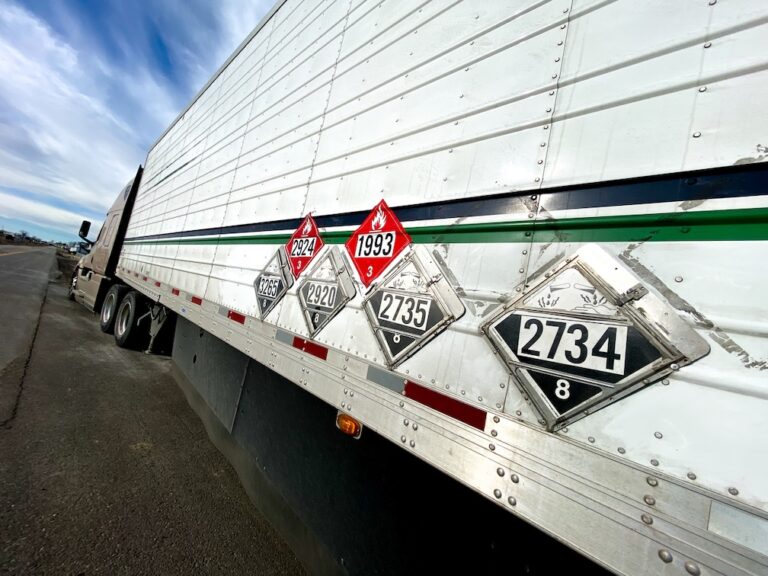
Unannounced inspections by the Commerical Vehicle Safety Alliance (CVSA) produced some good news and some not-so-good news over a five-day stretch.
Over five days this summer, commercial motor vehicle inspectors in the U.S. and Canada conducted 5,046 inspections of commercial motor vehicles transporting hazardous materials/dangerous goods (HM/DG) as part of the CVSA unannounced HM/DG inspection and compliance enforcement initiative.
CVSA said in a recent release that its inspectors affixed 1,187 CVSA decals to 794 power units and 393 trailers. A CVSA decal is placed on a vehicle or vehicle combination after an eligible inspection to indicate there were no critical vehicle or specification cargo tank violations on those vehicles.
On the other hand, out of 4,122 total HM inspections conducted in the U.S., 500 (12.1%) vehicles were placed out of service. And out of the 924 total DG inspections completed in Canada, 183 (19.8%) of those vehicles were placed out of service. The total number of vehicles placed out of service was 683, a 13.5% total out-of-service rate.
“Vehicles are declared out of service when inspectors identify any conditions that fail to communicate the HM/DG hazard(s) or are an imminent hazard, as noted in the North American Standard Out-of-Service Criteria, a set of pass-fail guidelines used by safety inspectors to identify critical violations that prohibit commercial motor vehicles, drivers or cargo from continuing en route until all out-of-service violations are addressed,” CVSA stated.
The initiative, which took place June 8-12, focused on identifying violations involving the transportation of hazardous materials and dangerous goods, ensuring that motor carriers and drivers comply with rigorous regulations designed to protect motorists, enforcement personnel, emergency responders and the environment. CVSA said those regulations ensure hazardous/dangerous cargo is properly classified, packaged, marked, labeled, documented, and transported.
Inspectors documented a variety of hazardous materials and dangerous goods violations including:
Label, Placarding and Marking Violations
Label, placarding and marking violations involve failing to accurately communicate hazards under the U.S. Hazardous Materials (HM) Regulations and Transportation of Dangerous Goods (TDG) Regulations.
There were 197 total placard violations, 55 of those violations, or 27.9%, were out-of-service violations.
Inspectors found 64 total marking violations, of which 20 (31.3%) were out-of-service violations along with 32
label violations.
Package Integrity
Inspectors identified 29 out-of-service HM/DG package integrity (leaking) violations.
“Leaking hazardous materials/dangerous goods pose a significant threat to human health and safety, property, and the environment,” CVSA stated. “HM Regulations and TDG Regulations mandate specific packaging requirements to ensure package integrity and prevent leaks or releases.”
Loading and Securement
Inspectors discovered 128 out-of-service cargo securement violations. Loading and securement requirements prevent cargo/goods/materials from moving in a manner that would cause damage to the package, resulting in leaking, spilling, etc.
Emergency Response Documentation
In the U.S., there were 73 emergency response information violations.
“Emergency response information details the specific actions and information needed to address a hazmat release, including containment and mitigation,” CVSA stated. “Emergency response documentation is mandated for specific hazardous materials and quantities, as outlined in the HM Regulations, and designed to facilitate a quick and coordinated response to HM incidents.”
There were two emergency response assistance plan (ERAP) violations in Canada. An ERAP describes what to do in the event of a release or anticipated release of certain higher-risk dangerous goods while they are in transport. ERAPs are required in the transportation of certain dangerous goods beyond the quantity specified in the TDG Regulations.
Registration, Permitting and Endorsements
Inspectors discovered 47 HM registration violations. Anyone who transports a shipment containing certain categories of hazardous materials/waste, as identified by the Pipeline and Hazardous Materials Safety Administration (PHMSA), must register with that agency.
There were eight HM safety permit violations. An HM safety permit is a federal credential issued by the Federal Motor Carrier Safety Administration (FMCSA) to motor carriers that transport specific high-risk, dangerous materials in certain quantities.
Sixteen HM endorsement violations were found. An HM endorsement is a special supplementary designation for a commercial driver’s license that legally allows a driver to haul hazmat.
Shipping Papers
Inspectors identified 265 shipping paper violations, of which 57 (21.5%) were out-of-service violations. HM/DG shipping papers must contain specific basic descriptions, quantity and package information, emergency response phone number, and shipper certification, and there are in-cab accessibility and storage requirements as well.
Certificates
Inspectors in Canada identified five equivalency certificate violations, which are official government documents that allow the transportation of dangerous goods under conditions that deviate from standard rules.
In addition, 70 violations were issued related to dangerous goods training certification violations. Dangerous goods training certificate requirements mandate general awareness, function-specific safety training and testing.
Undeclared/Misdeclared Packages
In the U.S., inspectors discovered five undeclared packages. An undeclared hazardous material is a hazardous material that is subject to any hazardous communication requirements and offered for transportation in commerce without any visible indication to the person accepting the package(s) for transportation that a hazardous material is present.
In Canada, inspectors found 24 misdeclared DG packages, which is dangerous cargo shipped with missing, false or misleading labels, documentation, or packaging.
Classes and Divisions
Classes and divisions of HM/DG designate materials into categories based on the materials’ chemical and physical properties and the risks associated with those materials. A total of 5,805 Class 1-9 packages were inspected during the five days of the HM/DG inspection and enforcement initiative.
“The HM/DG inspection and compliance initiative is one of several CVSA enforcement initiatives conducted annually to improve commercial motor vehicle safety through education, inspections and enforcement,” CVSA said. “It is made possible through participation from CVSA’s member jurisdictions throughout North America and supported by PHMSA, FMCSA and Transport Canada.
The initiative was adopted by the CVSA Hazardous Materials Committee, which is open to CVSA’s law enforcement members and transportation-safety industry members who work together to reduce HM/DG incidents and encourage uniformity and consistency in the application of country-specific regulations.

Bruce Guthrie is an award-winning journalist who has lived in three states including Arkansas, Missouri and Georgia. During his nearly 20-year career, Bruce has served as managing editor and sports editor for numerous publications. He and his wife, Dana, who is also a journalist, are based in Carrollton, Georgia.