




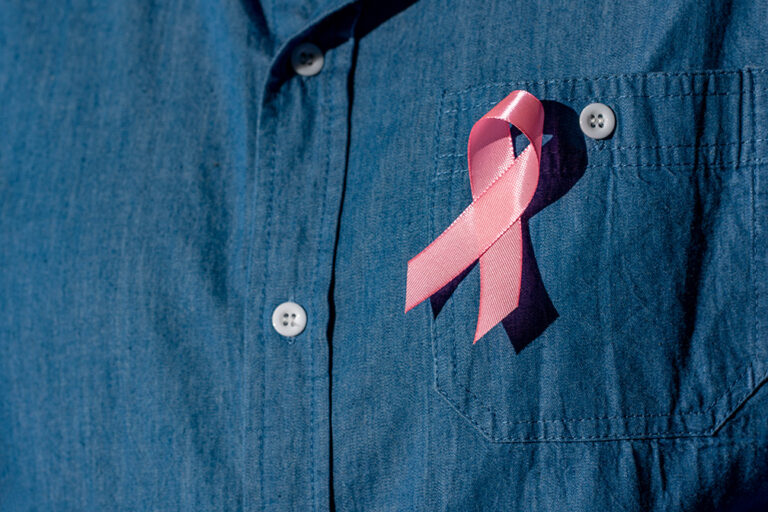
October is Breast Cancer Awareness Month. Both men and women are at risk.
Most everyone who reads this knows someone who has been diagnosed with breast cancer — or perhaps someone who has lost their life to metastatic breast cancer. For generations, breast cancer awareness has understandably focused primarily on women.
And while the vast majority of breast cancer cases do occur in women, here’s an important message to the truck drivers who keep America moving every day:
Men can get breast cancer, too.
There are approximately 3.7 million truck drivers in the United States, and roughly 90% are men. That means there are about 3.3 million male truck drivers out there working hard every day.
With that many men behind the wheel, it’s worth taking a closer look at a health risk that many may never have considered.
Yes, breast cancer in men is rare. The estimated lifetime risk for a man is approximately 1 in 755. If that lifetime risk were applied hypothetically to 3.3 million male truck drivers, it would represent more than 4,000 drivers over their lifetimes who could potentially be affected.
That number is not meant to suggest that 4,000 truck drivers will be diagnosed this year. Rather, it illustrates an important point: “Rare” does not mean “impossible” — and with millions of men working in trucking, even a rare disease can affect thousands of people.
Why does this matter to truck drivers?
Truck drivers spend long hours on the road, often away from home and regular medical care. Long workdays, irregular schedules and the demands of keeping freight moving can make it easy to put off a doctor’s appointment or ignore a change in your body.
There’s another obstacle: Perception.
Since breast cancer is often viewed primarily as a woman’s disease, a man who discovers a lump or other unusual change may not immediately think, “Could it be breast cancer?” He may assume it is nothing, wait for it to go away — or simply be embarrassed to bring it up.
That is exactly why awareness matters.
A lump, swelling, changes in the nipple or skin, or another unusual change in the breast area shouldn’t simply be ignored because you’re a man. Most breast changes in men are not cancer — but an unusual change is something worth discussing with a health care professional.
The impact goes beyond the diagnosis
For a professional driver, a serious illness can affect much more than health.
A cancer diagnosis and treatment can potentially mean time away from the road, medical appointments, surgery, radiation, chemotherapy and recovery. For an employee driver, that can mean time away from work, lost driving time and income.
And the impact doesn’t stop with the driver. A serious illness can disrupt family routines, strain household finances and place emotional and practical burdens on loved ones. A diagnosis can affect the financial stability of a household and place emotional and practical burdens on people who depend on that driver.
While breast cancer awareness is vitally important to all the women behind the wheel, it should not be limited to the women’s side of the trucking community.
A reminder for the men behind the wheel
Every October, people across the nation wear pink to honor the women in their lives who have faced breast cancer — and rightly so.
But let’s also remember the men who may face a breast cancer diagnosis. The message is simple:
Know your body. Pay attention to changes. Don’t ignore something simply because you’re a man. And talk to your health care provider when something doesn’t seem right.
The trucking industry is made up of millions of men and women who spend their lives keeping this country supplied and moving.
Breast cancer doesn’t discriminate — and neither should awareness.
This Breast Cancer Awareness Month, let’s remember everyone affected by the disease, particularly the women and the men behind the wheel.
To learn more about what St. Christopher Truckers Relief Fund offers over-the-road truck drivers or to get information about the free cancer screenings available to drivers, visit the Get Preventative Screenings page on the SCF website.

Julie Dillon serves as the health and wellness Manager at St. Christopher Truckers Relief Fund.
Julie enjoys helping people take practical steps toward better health and supporting them along the way. She is a National Board-Certified Health & Wellness Coach, a Therapeutic Nutritional Counselor, and a Certified Tobacco Treatment Specialist. When she’s not working with the St. Christopher Fund, you’ll likely find her in the garden or helping care for cattle on her family’s Century Farm in Tennessee.