





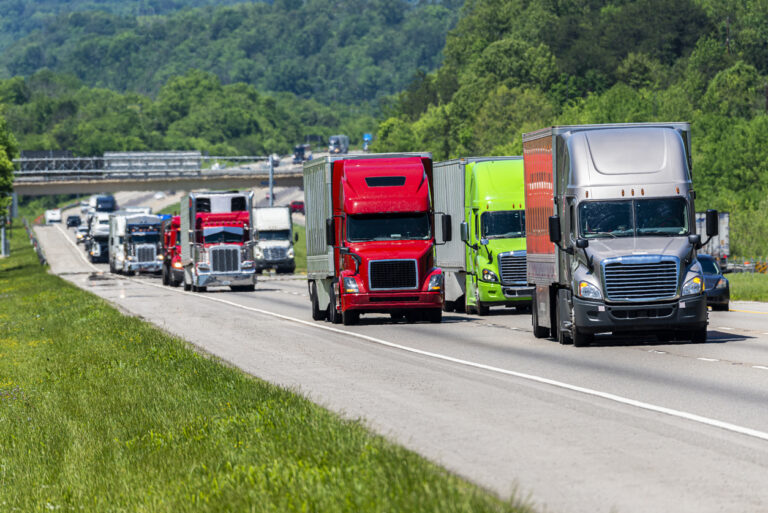
WASHINGTON — The U.S. Department of Transportation along with the Federal Motor Carrier Safety Administration and the National Highway Traffic Administration are withdrawing speed limiters.
“The old ways of doing things in Washington are over,” said Lewie Pugh, executive vice president, Owner-Operator Independent Drivers Association (OOIDA). “After nearly 20 years, big trucking’s proposed speed limiter mandate is dead. This failed proposal represented the worst of Washington and the worst of trucking: big corporations trying to use big government to undercut small businesses and increase corporate profits. Not only would this proposal have harmed working class Americans – small business truckers in our communities – it would have made our highways less safe for all motorists. We thank Secretary Duffy and the Trump Administration for listening to truckers by prioritizing safety, small businesses, and common sense.”
Background
According to the Federal Register, on Sept. 7, 2016, in response to separate petitions from the American Trucking Associations (ATA) and Schneider National, Inc. et al. (including 9 other ATA-member motor carriers), NHTSA and FMCSA issued a joint National Proposed Rulemaking (NPRM) proposing to require heavy vehicles with a GVWR of more than 26,000 pounds be equipped with a speed limiting device initially set to a speed no greater than a speed to be specified in a final rule.
NHTSA and FMCSA also proposed to require motor carriers operating such vehicles in interstate commerce to maintain the speed limiting devices for the service life of the vehicle NHTSA and FMCSA requested comment on speeds ranging from 60 to 68 miles per hour (mph). The estimated economic impacts of the joint NPRM varied widely based upon the set speed, with annual costs ranging from $209 million to $1.561 billion. The agencies also estimated that, at a 65 mph set speed, the proposed rule would save between 63 and 214 lives annually, monetized at between $716 million and $2.4 billion using both the value of statistical life in 2013 as well as economic costs and would also result in $848 million in fuel and emissions savings based on then-current price estimates.
The NPRM was based on a review of the available data, which suggested that limiting the speed of these heavy vehicles would reduce the severity of crashes involving these vehicles. However, NHTSA and FMCSA were not able to estimate the effects of speed reduction on the number of crashes occurring (collision avoidance), and the proposal did not include estimated costs or benefits related to crash reductions or increases. The NPRM sought comment on the analysis of the costs and benefits of amending the Federal Motor Vehicle Safety Standards (FMVSS) and Federal Motor Carrier Safety Regulations (FMCSRs) to require speed limiting devices and their usage.
Withdrawing Speed Limiters
“NHTSA and FMCSA have determined that the 2016 NPRM lacks a sufficiently clear and compelling safety justification for its implementation and raises significant concerns regarding federalism,” the Federal Register said. “NHTSA and FMCSA’s research and analyses contained significant data gaps regarding potential safety benefits and economic impacts, and information obtained through the public comment process did not provide the information necessary to proceed to a final rule. NHTSA and FMCSA therefore withdraw the Sept. 7, 2016 NPRM. For the same reasons, FMCSA also withdraws the May 4, 2022 ANSPRM.”
The benefits estimation in the NPRM was based on the value of equivalent lives saved, plus property damage reduction, plus fuel savings. This analysis had limitations, which together create significant uncertainty regarding its conclusions.
Considerations for the Withdrawal
“Considering advancements made in crash avoidance technologies in recent years, NHTSA and FMCSA believe there is a large degree of uncertainty about the baseline number of crashes which calls into question the magnitude of the estimated safety benefits of the rulemaking,” the Register said. “In particular, rear-end crashes involving heavy vehicles (where the truck is the striking vehicle) could be reduced by crash avoidance technologies designed to mitigate or prevent such crashes, such as automatic emergency braking (AEB) and forward collision warning (FCW).”
An increasing percentage of vehicles, including heavy vehicles, will be equipped with crash avoidance technologies in the future as more fleet owners purchase trucks with those technologies.
“NHTSA and FMCSA believe a portion of the crashes that they assumed would be mitigated by speed limiters may also be mitigated by AEB and FCW systems,” the Register said. “ATA commented that safety technologies such as AEB and adaptive cruise control have evolved since the publication of the 2016 NPRM and may mitigate some of the concerns about speed differentials, productivity, and safety. Both ATA and Road Safe America advocated for establishing a higher speed limiter setting of 70 mph for vehicles equipped with and using AEB and AEC. However, OOIDA and an anonymous commenter expressed concern that AEB triggers false or unexpected activation of the brake system and causes dangerous driving situations.” Because advanced crash avoidance technologies that could prevent or mitigate crashes affected by the 2016 NPRM were not considered, the baseline in the analysis may not accurately project potential safety benefits and costs of speed limiting devices.”
Crash-Avoidance Technologies
“Regulation in this area should not proceed until a more certain assessment of the effect of advanced crash avoidance technologies can be made, which would inform the analysis of the potential impacts of speed limiter technologies,” the Register said. “The voluntary development and adoption of new crash-avoidance technologies, such as AEB, demonstrates that markets are progressing toward goals similar to those a speed limiter regulation would be expected to achieve. All recently manufactured heavy vehicles come equipped with the speed limiting devices (in the form of ECUs); the withdrawal of the NPRM and ANSPRM has no impact on the ability of operators to use those devices to manage speeds. Various operators have set maximum speeds voluntarily, in part to realize many of the fuel-saving and assumed safety benefits that users attribute to the devices. The withdrawal of the proposal will have no effect on the availability of speed limiting devices and the ability of operators to limit the speed of their own vehicles if they so choose.”
NPRM Did Not Include an Estimate of Crashes Avoided or Caused
“The NPRM did not include an estimate of crashes avoided or caused,” the Register said. “It remains unclear whether implementing the NPRM would lead to a net increase in crashes, including those involving motorists striking the rear of CMVs at a device-limited speed, which NHTSA and FMCSA have been unable to quantify. Research varies on the topic of speed differentials and their impact on crash rates.”
The comments did not include any clear research not already cited in the 2016 NPRM that could be used to establish the safety impacts associated with crash avoidance characteristics of the proposed rule. NHTSA and FMCSA received some comments that referenced international studies that reported specific changes in crash rates during the time period for which speed limiting devices were implemented internationally; however, it is not clear that these rate changes can be attributed to speed limiting devices, or that the same crash rate changes could be anticipated for traffic conditions in the United States.
“One concern about international studies is that drivers behave differently in different countries and have different risk-tolerances,” the register said. “In addition, trucks in other countries may differ from those in the U.S. in terms of size and shape. Other comments referenced another study that was unable to provide specific quantitative risks associated with the installation of speed limiting devices and the risks associated with different car and truck travel speeds.”
NHTSA and FMCSA do not have reliable estimates of crash avoidance benefits based on trucks driving at lower speeds or of a possible reduction in safety resulting from the risks associated with speed differentials.
Least Burden on Society
“Executive Order (E.O.) 12866, Regulatory Planning and Review (58 FR 51735 (Oct. 4, 1993)), directs agencies to tailor their regulations to impose the least burden on society, including individuals and businesses of differing sizes, consistent with obtaining the regulatory objectives, considering, among other things, and to the extent practicable, the costs of cumulative regulations,” the Register said. “The crash avoidance technologies under development may achieve the safety goals of this rulemaking better than a speed limiter requirement. The potential effects of the rulemaking on trucking commerce are difficult to predict because they would affect a wide range of economic activities, a limited subset of which were explored in the Preliminary Regulatory Impact Analysis (PRIA) and NPRM. As discussed in the PRIA and NPRM, NHTSA and FMCSA are unable to predict the secondary impacts of a speed limiter requirement, such as the rebound effect (as the fuel used per mile would likely decline) and driver wage rates (which have historically been based on miles, rather than hours, driven), which could have significant impacts on the trucking industry.”
The NHTSA and FMCSA estimated that the rulemaking could put small owner-operators at a disadvantage in some circumstances, resulting in a reduction in profits.
Trump’s Deregulation Initiatives
“Executive Order 14219, Ensuring Lawful Governance and Implementing the President’s “Department of Government Efficiency” Deregulatory Initiative (90 FR 10583 (Feb. 25, 2025)), directs agencies to rescind regulations that are unlawful or undermine the National interest. It establishes classes of regulations that should be reviewed for rescission or modification, including ‘regulations that are based on anything other than the best reading of the underlying statutory authority or prohibition,'” the Register said. “In light of comments from the Texas Public Policy Foundation and OOIDA stating that the 2016 NPRM would violate section 205(d) of the National Highway System Designation Act of 1995 (Pub. L. 104-59, 109 Stat. 568, 577, Nov. 28, 1995, which repealed the national maximum speed limit enacted in 1975 that was formerly codified at 23 U.S.C. 154), the proposed rule could be viewed as inconsistent with the prohibition on the adoption of traffic safety regulations in 49 U.S.C. 31147(a). Therefore, NHTSA and FMCSA believe it is appropriate to withdraw this rulemaking, consistent with the intent of E.O. 14219.”
Concerns About Industry Response
“NHTSA and FMCSA are concerned about the uncertainty regarding industry response to daily driving distance limitations that could result from the rulemaking,” the Register said. “Because the speeds under consideration were all below the legal speed limit applicable to these vehicles on many of the Nation’s highways, the rulemaking would reduce the maximum potential distance a driver could theoretically travel in a single day within the maximum allowed hours of service if the driver is currently driving the maximum number of hours allowed by law. NHTSA and FMCSA assumed that industry would respond through a combination of increased driver efficiency and team driving when such response is feasible and practicable, but other responses, such as adding additional trucks to move the same amount of goods, might also occur. NHTSA and FMCSA did not consider the possibility that the rulemaking could result in an increase in the overall number of trucks required to be on the roads, which would lead to increased costs for those trucks, reduced overall fuel savings and environmental benefits, and possible safety disbenefits from greater exposure of drivers of light vehicles to vehicles with substantial speed differentials.”
Economic Value Lost
“NHTSA and FMCSA attempted to estimate the aggregate economic value lost due to the depreciation of goods as a result of slower travel speeds but have been unable to consider how the cost would be distributed across industry sectors, particularly to deliveries that are time-sensitive, such as those in the agricultural industry,” the Register said. “While commenters suggested that the rule would affect certain industry sectors disproportionately, they did not provide data to enable NHTSA and FMCSA to quantify this effect.
Costs for Truck Operators Resulting from Longer Travel Times
“While NHTSA and FMCSA considered the costs to truck operators resulting from longer travel times, they have been unable to account for the potential delays and other costs to other road users, caused by factors such as decreased speed of other vehicles traveling resulting from an inability to pass slower moving heavy vehicles,” the Register said. Although the potential for delays to other road uses was an issue raised by many commenters, they did not provide data enabling NHTSA and FMCSA to quantify the magnitude of this effect.”
Displacing State Authority
“Finally, if implemented, the proposal could have, over time, displaced State authority to set speed limits for heavy vehicles, given that the speeds under consideration in the 2016 NPRM (60 mph, 65 mph, and 68 mph) are below the maximum posted daytime speed limits on many roads, including rural Interstates in over half of the states,” the Register said. “Because many states have determined that it is safe for heavy vehicles to operate above 68 mph on certain roads, the rulemaking would, in effect, undercut the ability of those States to set the speed limits they have deemed appropriate on their roadways.”

Dana Guthrie is an award-winning journalist who has been featured in multiple newspapers, books and magazines across the globe. She is currently based in the Atlanta, Georgia, area.


So we can’t go no faster then 68 for top speed now
Thank God for men with commonsense and the brilliance to slam the door in the face of bureaucrats. The bureaucrats would have killed more people just by creating road rage and road blocks. This is allowing us to Make America Great Again!
This will cause more death. Road rage with more Truckers as they try to pass each other. Then the drivers if the cars passing then hitting the breaks while drivers are going up a Mt pass. To more road rage.
Truckers will in fact tie up traffic for everyone going into a truck stop at the same time. as well as the scales at the same time. No room to avoid a wreck while everyone is cluster up like a large box on the freeway.
And the truck stops will fill faster leaving the rest stuck somewhere. The Democrats who ran this country into the ground are idiots. and 4 years of the Biden Administration proved it 100%.
Forward facing cameras in the cabs. Radar for distance driving, 11/14/10 hrs rule didn’t do much. E logs Is nice to a degree. you are now closer to where your at vrs guessing where your at on the map. Driver still can run 2 or 3 E logs if you know what your doing.
so all in all what I have seen. Trucking is more dangerous than ever before.
Ever since the Feds Nailed Swift Transport back in 2010. The trucking Schools went down hill big time. Even when the Feds tried to take control with more regulations.
Then they want tp slow the driver down even more. Thats cool and dandy. How ever!! The cost will increase at the stores.
They can Ship perishable items thru Raillnk. How ever still need a trucker to take it to the DC then the stores.
so your still looking at a big rig on the roadway.
Has anyone gone shopping for meat at Walmart? noticed the beef is with in a day of expired date on package? How about FoodMax in the NW. Their products are pretty much expired when you shop.
list goes on & on.
USPS Mail is shipped by Trucking companies and Passenger Jets. Ever flew somewhere and the flight attendants ask if anyone would take a voucher to give up their seat? When they do. no one get on in replacement of that empty seat?? replaced by US Mail.
pretty interesting what the avg American Does Not Realize How much America freight is actually shipped by big rigs.
and the political ppl who want to change this on your state. Dont really give a crap about you! The tax payer. If they actually did?? They make Trucking #1 out on the interstate. They out more law enforcement to crack down on speeders. Do you actually see that right now? Not at all. what you do see is ppl in cars break checking Truckers, Cutting them off, Giving the bird & so on.
The job is hard to many. Others its a life style. How ever it dies not need to be regulated by a politician who knows nothing about the job ir the industry.
Perhaps they should focus on regulating the drivers in the cars. Perhaps after the car hits 60 MPH Their ceil phones only work on 911 calls !!.
Cars are equipped with GPS. so no need for the phone. If its a distraction for the trucker. its Obviously a Distraction for the driver in the car to. Especially when their kids ate not bucked in the seats.