




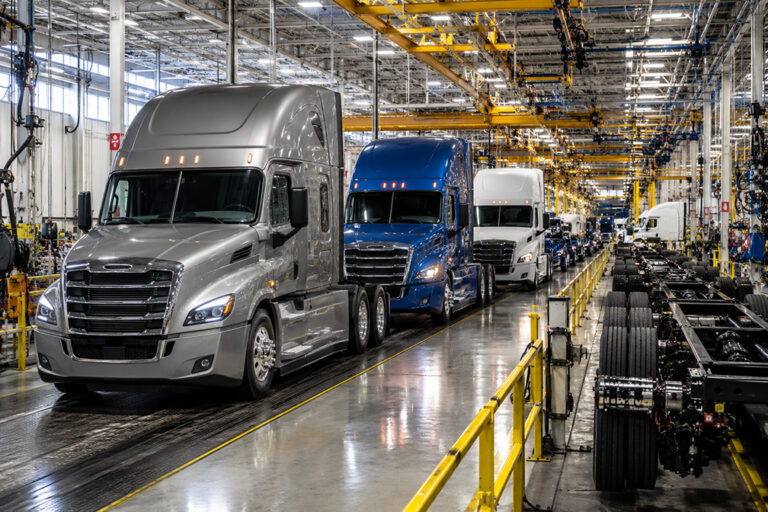
The month of May brought a modest increase in U.S. sales of new Class 8 trucks, but the results still lagged 8.0% behind May 2025 numbers and were nearly 15% worse than the average for the five previous years (2021-2025).
According to data received from Omdia, 17,280 Class 8 trucks were sold on the U.S. market in May, a gain of 1,339 from April sales numbers.
Orders for trucks yet to be built also increased according to an FTR (Freight Transportation Research Associates) release.
The analyst group reported May North American Class 8 preliminary net orders of 26,600, an increase of 4% from April. Compared with May 2025, orders rose 124%, making May the fourth consecutive month with more than 120% growth over the same month in 2025.
According to FTR, orders for vocational trucks — those equipped with bodies for trash, concrete, dump and other purposes other than fifth wheels — were responsible for much of the gain.
“The May result reinforces that demand remains healthy, supported by replacement needs, firming freight rates, rising utilization, tighter capacity, limited remaining 2026 build availability, and moderate EPA 2027 NOx pre-buy activity,” explained Dan Moyer, senior analyst/commercial vehicles for FTR.
He cautions, however, that ordering is likely to slow as “normal summer seasonality” takes effect. Manufacturers typically introduce the next year’s models around the August timeframe and buyers can choose to delay ordering to get in on the new models.
Labor market, tariffs could impact production
Another potential issue is the truck builders’ ability to keep up with higher ordering activity. Tight labor markets and tariff-related materials issues could make it difficult to increase production to match demand.
And then, there’s always the possibility of cancelled orders.
“Risks remain,” Moyer said. “If freight improvement stalls, financing pressure persists, geopolitical risks are not resolved, or the final EPA rule materially differs from expectations, some fleets could defer or cancel orders placed to secure 2026 capacity.”
Carter Vieth, research analyst at ACT Research, points to potential equipment cost increases for 2027 models.
“Demand for new equipment remains robust, driven by the sustained and supply-side-led run up in freight rates and looming cost increases associated with the EPA’27 regulations come Jan. 1,” he said.
Trailer orders leap 249% year over year
Orders for new trailers remained robust in May as well. FTR reported net U.S. trailer orders of 20,189 — much higher than the 16,553 units trailer manufacturers reported building in the month.
The order number represents a whopping increase of 249% over May 2025 orders in what was an extremely weak month. Moyer notes that future price increases could be a motivating factor for ordering trailers now.
“Cost pressures are building and are reflected in May’s sharp increase in the already-elevated Producer Price Index for truck trailers and chassis,” he wrote. “A recent change in how Section 232 tariffs are applied means higher overall tariffs on trailers, and upcoming antidumping/countervailing duty exposure for van-type trailers and subassemblies could add more costs on top of Section 232 tariffs.”
Vieth also remarked that domestic trailer manufacturers could benefit from antidumping actions with more orders, but the result could strain supply chains and increase the build backlog.
Jennifer McNealy, ACT’s director of commercial vehicle market research and publications, reports a 1.9% cancellation rate in trailer orders, referring to the figure as “elevated territory.”
She indicates that build backlogs continue to grow, but uncertainty over freight volumes and pricing have some customers unsure about the number of trailers they take delivery of. Builders don’t seem to be increasing their build rates to reduce the backlog — possibly due to squeamishness about whether the increased order rate is sustainable in the current economy.
“It appears the end of the road is in sight, but there is a little more traveling to do before the industry is again standing in the sunlight of healthier times,” McNealy said.
OEM performance for May
As for U.S. sales of new, Class 8 trucks, Freightliner bounced back from a lackluster April with a 23.9% increase in May, reporting sales of 6,617.
For perspective, all major manufacturers together reported selling 1,339 more trucks in May than in April — and 1,275 of that 1,339 units were Freightliners. The OEM was the only one to report higher sales in May than in May 2025, with an increase of 8.9%.
For the year to date, Freightliner owns 34.5% of new Class 8 U.S. sales, down 2.2% from their 36.6% market share at the same point last year.
International sales of 1,953 topped April’s 1,851 by 5.5% but ran behind May 2025 sales by 3.5%. For the year to date, the company is running 4.2% behind its 2025 pace after five months. That’s the smallest decline of any of the manufacturers, and it’s well beneath the 16% industry average.
Kenworth’s 2,368 units sold in May lagged 6% behind its April sales total — and 27.5% behind its May 2025 figures. Year to date, the builder is running 20.4% behind its sales total for the first five months of 2025; its share of the U.S. Class 8 market has declined 0.8%.
Peterbilt fared a little better, with sales of 2,611 in May. That’s an increase of 1.7% over April but still 15.9% behind its May 2025 total. The company is running 16.5% behind its pace for January-May 2025. For this year, Peterbilt’s share of the Class 8 market has slipped 0.1%.
Volvo experienced a solid May, with sales of 1,604, an increase of 5.9% over April, just 4.2% behind its May 2025 sales number. Year to date, the company is running behind its 2025 pace by 4.9%, beating the industry average. Volvo’s share of the Class 8 market has grown by 1.1%.
Volvo-owned Mack Trucks reported sales of 1,a469 in May. That’s 3.5% better than April but 10.3% worse than May 2025. Mack’s share of the total Class 8 market has grown too, by 1.1%.
Daimler-owned Western Star reports selling 657 units in May, down 7.3% from April and 33.7% behind a strong May 2025. The builder is running 25% behind last year’s pace, and its share of the Class 8 market dropped by 0.6%.
June sales should be stronger as the month closes out the second quarter, but there is plenty of uncertainty remaining for the year.

Cliff Abbott is an experienced commercial vehicle driver and owner-operator who still holds a CDL in his home state of Alabama. In nearly 40 years in trucking, he’s been an instructor and trainer and has managed safety and recruiting operations for several carriers. Having never lost his love of the road, Cliff has written a book and hundreds of songs and has been writing for The Trucker for more than a decade.