




Owner-operators spend their careers being treated as the “deep pocket” in a crash. When a four-wheeler, a shipper’s dock, or a failed part puts them in the hospital, the rules for getting made whole are different, and the clock starts fast.
A car merges onto I-81 near Harrisburg without looking, clips the steer axle of a loaded tractor-trailer, and the rig goes into the median. The car’s driver walks away. The owner-operator has a torn rotator cuff and a truck that is out of service for six weeks–and no paycheck until both are fixed.
That scenario plays out more often than the public assumes. Federal crash studies have repeatedly found that in fatal truck-and-car collisions, the passenger vehicle driver is more often the one who initiated the crash. The trucker is frequently the injured party, not the defendant, and most owner-operators have never thought through what that means.
Who is actually on the hook?
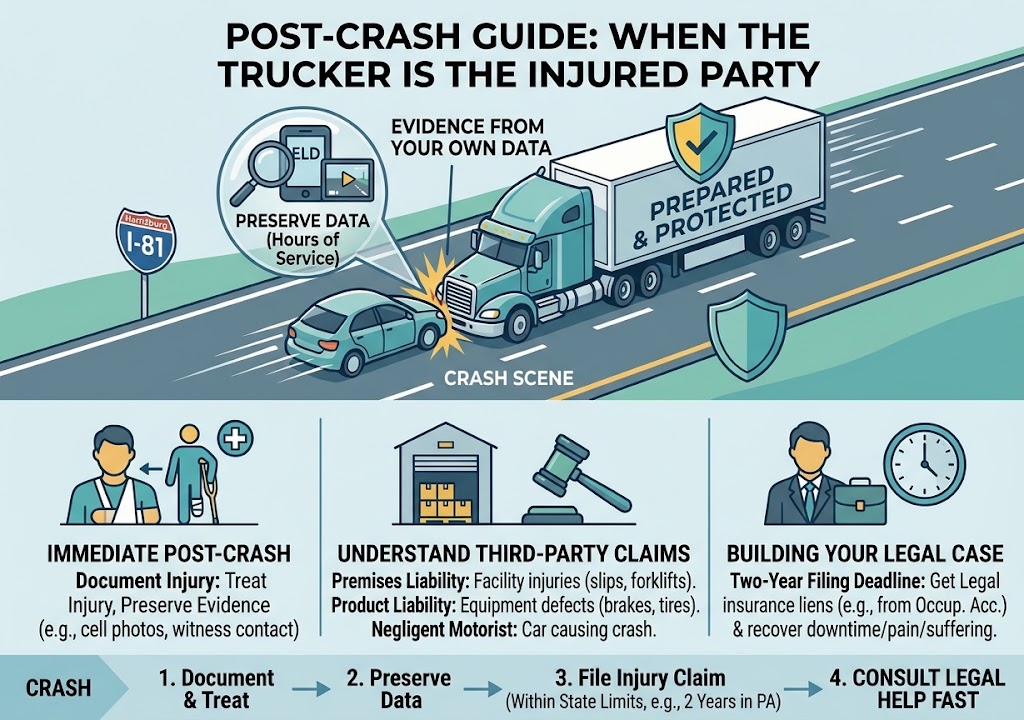
When a passenger vehicle causes the crash, the claim is against that driver’s auto liability policy. The problem is the limits, according to many industry experts. Many states allow minimums of $15,000 to $25,000 per person–nowhere near enough to cover surgery, rehab, and months of lost revenue for a driver whose truck is the business. Underinsured motorist coverage on the owner-operator’s own policy fills that gap, and it is the coverage most drivers skip or carry at the lowest limit their lease allows.
Loading and unloading injuries are a separate category.
A driver hurt at a shipper’s dock by a forklift, an unsecured pallet, or a neglected floor may have a premises liability claim against the facility. Federal rules at 49 CFR 390.6 bar shippers from coercing drivers into unsafe operations, but the injury claim itself runs under state negligence law, and it turns on who controlled the dock and what they knew about the hazard.
Equipment failures are another issue.
A steer tire that delaminates well inside its service life, a brake component that fails after a recent replacement, or a coupling defect can support a product liability claim against the manufacturer or the shop that did the work.
“Drivers are conditioned to think every crash is their fault until proven otherwise, because that is how the industry treats them,” said Joseph Leeson, managing attorney at Leeson & Leeson, a personal injury firm based in Pennsylvania that handles truck accident cases.
“I have owner-operators come in after a crash where the police report clearly puts fault on the other car, and the first thing they ask is whether they are going to lose their authority. What they should be asking is who is going to pay for their shoulder and their downtime.”
What occupational accident coverage does and does not do
Most owner-operators leased to a carrier carry occupational accident insurance instead of workers’ compensation.
It is cheaper for a reason. Occ-acc policies pay defined benefits: a weekly disability amount with a cap, a medical benefit with a ceiling, and a lump sum for death or dismemberment. They are not designed to make an injured driver whole, and they say nothing about pain and suffering, the value of the truck sitting idle, or the contracts lost while the driver recovers.
Occ-acc also pays regardless of fault, which is useful, but the policy will often have a lien on any third-party recovery. A driver who settles with the at-fault motorist may owe part of that settlement back to the occ-acc carrier. That is manageable if planned for and a serious problem if discovered at the end.
Your own data is your best witness.
After a crash, the electronic logging device (ELD) and the dashcam that drivers often resent are the most credible evidence in the case. ELD data required under FMCSA’s hours-of-service rule establishes that the driver was legal and rested. Engine control module data shows speed and braking. A forward-facing camera settles the merge argument in about four seconds.
“The other side’s insurer is going to come after your logs anyway. When the logs are clean and the camera shows the car cutting you off, the case is over before it starts,” Leeson said. “Where I see drivers hurt themselves is by not preserving the footage, or by giving a recorded statement to the other insurer the day after the crash while they are still on pain medication.”
The final piece is timing.
Every state sets a deadline for filing an injury claim. In Pennsylvania, where I-78, I-80, I-81, and the Turnpike carry some of the heaviest through-truck volumes in the Northeast, it is two years from the date of injury; other states range from one to six. A driver who spends the first year dealing with the truck and the second arguing with insurers can lose the claim entirely.
Leeson says the drivers who come out of these situations in the best shape share one habit.
“They treat the injury like a breakdown. They document it, they get it looked at right away, and they do not let anybody talk them into driving on it.”

The Trucker News Staff produces engaging content for not only TheTrucker.com, but also The Trucker Newspaper, which has been serving the trucking industry for more than 30 years. With a focus on drivers, the Trucker News Staff aims to provide relevant, objective content pertaining to the trucking segment of the transportation industry. The Trucker News Staff is based in Little Rock, Arkansas.