





A phony Meta support message uses a misspelled name, a 24-hour deadline and a suspicious PDF to scare you into surrendering your Facebook login
For many truck drivers and motor carriers, Facebook is more than a place to scroll. It is where they connect with other drivers, follow current events and participate in trucking groups while spending long hours on the road.
That makes an urgent message claiming your Facebook account is about to be deleted especially alarming. Scammers know that threatening to cut off access to your groups, contacts and business pages may push you to act before checking whether the warning is real.
Angela wrote to CyberGuy after receiving one of these messages:
“Forwarding a screenshot of a threat I got on Facebook… It looks suspicious! I tried following the prompts and think it’s a scam. Just reporting to you because you’re the cyber guy!”
Angela was right to be suspicious. The message used Meta’s logo, a misspelled account name, a 24-hour deadline and a PDF attachment to create a sense of emergency. Here is how the scam works and what you should do before it steals your login.
📧 Missed CyberGuy Live: “Sick of Spam?” Get the replay and checklist.
Our free CyberGuy Live class, “Sick of Spam?”, has ended, but you can still watch the full replay and download our spam-stopping checklist. Kurt “CyberGuy” Knutsson walks you step by step through simple ways to reduce robocalls, spam texts, junk email and unwanted messages. You’ll also learn how to curb political texts, clean up your inbox and spot messages that could put your personal information at risk.
Get the free replay and checklist now at CyberGuyLive.com.
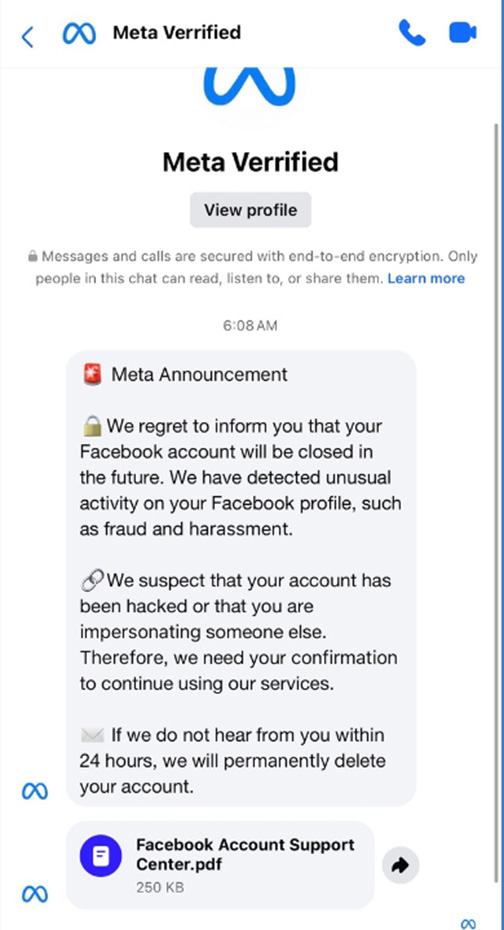
Meta Verified scam uses fear to get your attention
The message claims to be a “Meta Announcement” and says your Facebook account “will be closed in the future.” It then accuses your profile of unusual activity, including fraud and harassment.
That language is meant to scare you into acting fast. Scammers know that losing access to Facebook can feel personal, especially if you use it for family photos, business pages, groups or Marketplace. So, they lead with the biggest threat they can: Your account may disappear.
However, the message gives no real details. It does not name a specific post. It does not show a case number. It does not explain where the alleged violation happened. Instead, it throws out vague accusations and hopes panic takes over.
Meta Verified scam red flag #1: The name is misspelled
Look closely at the chat name in the image above. It says “Meta Verrified” with an extra “r.”
That typo is one of the biggest red flags in the screenshot. Scammers often create fake pages with names that look close to official brands. They count on you reading quickly, especially when the message sounds urgent.
The page also uses the Meta logo, which can make the warning feel official. Still, a logo means very little. Anyone can copy a company logo and add it to a profile photo. The name, message quality and delivery method tell you much more.
Meta Verified scam red flag #2: It arrives in Messenger
This warning appears inside a Messenger chat. That alone should make you pause.
If you receive a serious account warning, do not trust a random chat message or attached file. Open Facebook yourself through the app or by typing the address into your browser. Then check your account status, notifications or support inbox from inside your account.
That extra step helps you avoid fake links, fake PDFs and look-alike pages built to steal your password.
Meta Verified scam red flag #3: Encryption does not prove anything
The screenshot shows Messenger’s note about end-to-end encryption. Scammers may benefit from that because it can make the chat feel safer.
The encryption note only describes how the chat is protected between participants. It does not confirm that the sender works for Meta.
A scammer can still send you a phishing message inside an encrypted chat. So, do not let that security language lower your guard.
Meta Verified scam red flag #4: The wording sounds off
The message says, “We regret to inform you that your Facebook account will be closed in the future.” That is strange phrasing for an official account enforcement notice.
It also says Meta suspects your account “has been hacked or that you are impersonating someone else.” Those are very different issues. A hacked account means someone may have broken into your profile. Impersonation means someone may be pretending to be another person.
The message combines both claims without evidence. That broad wording helps scammers cast a wider net. No matter what you worry about, the message has a threat that may feel possible.
Meta Verified scam red flag #5: The 24-hour threat
The message says Meta will permanently delete your account “If we do not hear from you within 24 hours.”
That deadline is the hook. Scammers want you to react before you think. They want you to open the PDF, tap a link, enter your password or share a security code.
Real account problems should still be handled carefully. A legitimate warning does not require you to trust a random attachment inside Messenger.
Meta Verified scam red flag #6: The PDF attachment
The attachment is labeled “Facebook Account Support Center.pdf.”
That name sounds official, which is exactly the point. A PDF can contain a phishing link, a fake appeal form or instructions that push you to a scam website. In some cases, files can also lead you toward harmful downloads.
Do not open attachments from unknown Messenger accounts, even if the file name sounds like customer support. If you have already opened it, do not enter any passwords, codes or payment information from anything inside that file.
Why scammers impersonate Meta and Facebook support
A fake Meta warning works because it targets something you may use every day. Your Facebook account can include years of photos, contacts, memories and private messages. If you manage a business page, the stakes feel even higher.
Scammers may be after your Facebook password. They may also want your two-factor authentication code, your page admin access or payment details tied to ads. Once they get in, they can lock you out, message your friends or run scams from your account. That is why one fake warning can create a lot of damage.

What to do if you clicked the Meta Verified scam
If you tapped the attachment, followed the prompts or entered any information, treat it as urgent and secure your account from inside Facebook directly.
1) Change your Facebook password.
Open the Facebook app > tap Menu > Settings & privacy > Settings > Accounts Center > Password and security > Change password > choose your Facebook account > enter your current password and create a new one. Use a password manager to create and save a strong, unique password you have not used anywhere else.
2) Turn on two-factor authentication.
In the Facebook app, tap Menu > Settings & privacy > Settings > Accounts Center > Password and security > Two-factor authentication > choose your Facebook account > select an authentication app or security key and follow the prompts. An authenticator app or security key gives you stronger protection than a text message code.
3) Review where your account is logged in.
In the Facebook app, tap Menu > Settings & privacy > Settings > Accounts Center > Password and security > Where you’re logged in > choose your Facebook account. Review the devices, browsers and locations listed. Tap any session you do not recognize; then choose Log out. You can also select multiple sessions and log them out at once.
4) Check your Facebook contact details.
In the Facebook app, tap Menu > Settings & privacy > Settings > Accounts Center > Personal details > Contact info. Review every email address and phone number listed. Remove anything you do not recognize; then make sure your own email address and phone number are current.
5) Secure the email tied to Facebook.
Open the email account connected to Facebook and change that password, too. Then turn on two-factor authentication (2FA) for that email account. If a scammer controls your email, they may be able to reset your Facebook password.
6) Protect your bank or card.
If you entered payment information, contact your bank or card company right away. Ask them to watch for suspicious charges and replace the card if needed.
7) Run strong antivirus software.
If you downloaded anything, run strong antivirus software on your device. This can help catch malicious files, unsafe downloads and hidden threats that may have come from the PDF.
Get the CyberGuy’s picks for the best 2026 antivirus protection winners for your Windows, Mac, Android & iOS devices at Cyberguy.com.
8) Report and block the fake Messenger account.
Open the Messenger app > open the scam conversation > tap the sender’s name at the top > scroll down > tap Report or Something’s wrong if shown > choose the closest reason, such as scam or impersonation > submit the report. Then go back to the same profile screen > tap Block > choose Block messages and calls or Block on Facebook.
9) Delete the scam chat.
In Messenger, go to Chats > press and hold the scam conversation > tap Delete > tap Delete again to confirm. Note: Meta’s Messenger Help Center says deleting a chat removes it from your chats, but it does not remove it from the other person’s inbox.

Ways to stay safe from a Meta Verified scam
A message like this is meant to rush you, so the safest move is to slow down, verify the warning inside Facebook and protect your account before clicking anything.
1) Check Facebook directly.
Never trust a Facebook account warning that arrives through a random Messenger chat. Open Facebook yourself and check your account from there.
2) Look closely at the sender name.
Spelling errors are a major warning sign. In Angela’s screenshot, “Meta Verrified” has two r’s, which immediately makes the message suspicious.
3) Do not trust a logo by itself.
A Meta logo can make a fake account look official, but scammers can copy logos easily. Always judge the message by the sender name, wording, attachment and where it asks you to go.
4) Avoid suspicious PDF attachments.
A file name can look official while still leading you into a scam. Avoid opening PDF attachments from unknown support accounts, especially when they claim your account will be deleted.
5) Never share login codes.
Meta will not need your password or two-factor authentication code through a Messenger chat. If someone asks for a code, treat it as a scam.
6) Be suspicious of urgent deadlines.
A 24-hour deletion threat is designed to make you panic. Scammers use deadlines because they want you to act before you verify the message.
7) Use a password manager.
A password manager can help you avoid typing your Facebook password into a fake website. It also makes it easier to use a strong, unique password for every account.
Check out the best expert-reviewed password managers of 2026 at Cyberguy.com/Passwords.
8) Use strong antivirus software
Strong antivirus software can help protect your device from malicious links, unsafe downloads and hidden threats inside suspicious files.
Get the CyberGuy’s picks for the best 2026 antivirus protection winners for your Windows, Mac, Android & iOS devices at Cyberguy.com/LockUpYourTech.
9) Use a data removal service.
A data removal service can help reduce how much of your personal information is available online. Scammers often use exposed details to make phishing messages feel more believable. Check out my top picks for data removal services and get a free scan to find out if your personal information is already out on the web by visiting Cyberguy.com/Delete.
Get a free scan to find out if your personal information is already out on the web: Cyberguy.com/FreeScan.
Kurt’s key takeaways
Truck drivers and motor carriers often depend on Facebook groups to stay connected, follow industry conversations and keep up with current events. That makes a sudden account deletion warning feel like a real emergency.
However, this message falls apart when you look closely. The misspelled “Meta Verrified” name, vague accusations, 24-hour threat and suspicious PDF all point to phishing. If a warning arrives through Messenger, do not open the attachment or follow its instructions. Open Facebook yourself, check your account status and secure your login before a scammer gets access to your profile, groups or business pages.
Have you ever received a fake Meta, Facebook or Instagram warning that looked official enough to make you click? Let us know your thoughts by writing us at Cyberguy.com/Contact.
Sign up for the FREE CyberGuy Report
-
- Get Kurt’s best tech tips, urgent security alerts and exclusive deals delivered straight to your inbox.
- For simple, real-world ways to spot scams early and stay protected, subscribe to my free CyberGuy Report Newsletter by heading to Cyberguy.com/Newsletter, trusted by millions who watch CyberGuy on TV daily.
- Plus, you’ll get instant access to Kurt’s Ultimate Scam Survival Guide free when you join.
Copyright 2026 CyberGuy.com. All rights reserved.
Kurt the CyberGuy is an award-winning tech journalist who helps people make smart tech decisions from his contributions to Fox News & FOX Business, beginning mornings on “FOX & Friends.” Stay safe & in the know — at no cost. Subscribe to Kurt’s The CyberGuy Report for free security alerts & tech tips.
Join Kurt on his podcast, The CyberGuy Report, as he explores the most fascinating breakthroughs in tech and the people behind them. Look for new episodes every Wednesday at CyberguyPodcast.com.
Ask Kurt a question or let us know what stories you’d like us to cover.
Follow Kurt on his social channels:
Facebook • YouTube • Instagram • TikTok
Kurt Knutsson — best known as “Kurt the CyberGuy” — has a deep love of technology that makes life better. Because of this, along with a passion for helping others, he created the largest syndicated tech lifestyle franchise on television. As a trusted source, Kurt’s unique insider access to major tech launches and industry visionaries has helped earn him two Emmy Awards and a Golden Mic.
Kurt lives between his home in California and New York City, where he is also the chief tech contributor on Fox News & Fox Business networks beginning his mornings on Fox & Friends.
Kurt’s a curious guy. Like many entrepreneurs in life, he wears several hats like running a private investment fund, giving inspirational talks, mentoring start-ups and traveling the world chasing down the next breakthrough.