



For the trucking industry, 2025 could be called “The Year of Enforcement.”
From English language proficiency (ELP) to non-domiciled CDL requirements to training regulations, the federal government finally pushed states to enforce certain fundamental rules — and put real consequences on the table for those who might ignore those enforcement efforts.
According to David Heller, who serves as the senior vice president of safety and government affairs for the Truckload Carriers Association (TCA), it’s about time agencies within the U.S. Department of Transportation (USDOT) — particularly the Federal Motor Carrier Safety Administration (FMCSA) — got serious about enforcement.
“Whether it’s entry-level driver training facilities or motor carrier compliance, English language proficiency or non-domiciled CDLs, there is a flavor of enforcement that is coming out of the agency that is certainly welcome, and it is one that we have been asking for for years,” Heller said.
ELP Enforcement
In late April 2025, the powers that be in Washington, D.C., called for the enforcement of “commonsense rules of the road for America’s truck drivers.” The first of these was the enforcement of the English language proficiency (ELP) requirement — something that had been on the books for close to a century but hadn’t been enforced since 2000.
Under federal regulation 49 CFR § 391.11(b)(2), commercial drivers must “read and speak the English language sufficiently to converse with the general public, to understand highway traffic signs and signals in the English language, to respond to official inquiries, and to make entries on reports and records.”
Enforcement began across the U.S. in late June. Currently, two tests are used to determine if a driver is considered proficient enough to operate a commercial vehicle. Failure to pass either test can place a driver and vehicle out of service.
- Drivers must be able to communicate the basics of their operation. They must be able to tell inspection officers what they are carrying, their destination and other basic facts about their loads.
- Drivers must be able to pass a road sign test. Can they identify various road signs and explain what they mean?
Tragic, widely reported-on accidents in California and Florida pushed the need for enforcement of the ELP rule to top priority in the minds of the American public.
In August 2025, a deadly crash involving a tractor-trailer shut down all northbound lanes of Florida’s Turnpike in Fort Pierce. According to local authorities, a truck driver attempted an illegal U-turn, jackknifed and came to rest on top of a minivan, killing the passenger vehicle’s three occupants. The truck driver was later identified as Harjinder Singh and determined to be in the U.S. illegally.
Then, in October 2025, a 21-year-old big rig driver, later identified as Jashanpreet Singh, an Indian national who entered the country by crossing the U.S.-Mexico border in 2022, was arrested in connection with a crash that killed three people on the 10 Freeway near Ontario, California.
This crash, which involved multiple tractor-trailers and passenger vehicles, happened when the driver allegedly drove through slowed traffic without braking. The incident left at least three people dead and two hospitalized.
The two incidents prompted an immigration crackdown on those illegally working as drivers as well as the U.S. Government applying pressure to states to clean up their CDL rolls through threats to remove funding from states like California and Pennsylvania.
The CDL training industry was also affected by a new mandate that all drivers be tested in English and prohibited from driving if ELP tests were failed.
Update: On February 20, 2026, U.S. Transportation Secretary Sean P. Duffy formally announced that all truck and bus drivers must test in English to obtain their CDL. Read the story here.
Non-Domiciled Drivers
Another issue thrown into the spotlight, in large part because of the focus on ELP requirements and high-profile accidents, is the process by which non-domiciled drivers — who live in the U.S. but are not citizens — may be granted CDLs.
In September 2025, following a nationwide review of states’ CDL issuance procedures, the USDOT announced an emergency interim final rule. A statement released by the FMCSA noted that the goal was to “strengthen federal oversight of how states issue non-domiciled commercial learner’s permits (CLPs) and commercial driver’s licenses (CDLs).”
According to the FMCSA, the review revealed “widespread non-compliance among state driver licensing agencies and a troubling series of fatal crashes caused by non-domiciled CDL holders.”
However, in mid-November 2025 the U.S. Court of Appeals for the District of Columbia Circuit issued a stay pending review of the interim final rule. The stay prevents the implementation of the rule until further notice.
In an article published on TheTrucker.com on December 1, 2025, attorney Brad Klepper, president of Interstate Trucker, addressed the conundrum.
“In plain English: The rule is paused. It is frozen in time. As of now, the strict “visa-only” restriction is NOT in effect,” he wrote. “States are legally permitted to revert to the issuance standards they used before Sept. 29.”
Motor carriers employing drivers with DACA (Deferred Action for Childhood Arrivals) status or asylum claims need not worry, he noted — provided the state’s department of motor vehicles has not taken independent action to revoke these drivers’ CDLs.
“However, this is a temporary reprieve,” Klepper stressed. “If the court lifts the stay, those drivers could become disqualified overnight. You must watch the legal docket like a hawk.”
Nevertheless, the USDOT has threatened to withhold federal funding from several states — including California, North Carolina, New York and others — if CDLs issued to unqualified immigrants are not revoked.
Update: On February 19, the FMCSA issued a final rule regarding non-domiciled CDL drivers. Read the story here.
CDL Training Facilities
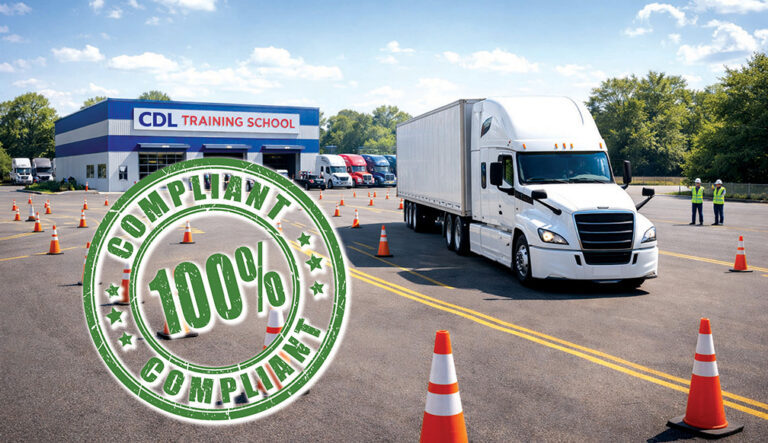
CDL training providers are also feeling the heat as the federal government works to control industry standards.
On December 1, 2025, the USDOT announced plans to revoke the accreditation of nearly 3,000 schools unless they can comply with training requirements in the next 30 days. The targeted schools must notify students that their accreditation is in jeopardy. Another 4,500 schools are being warned they may face similar action.
Schools that lose accreditation will no longer be able to issue certificates showing that prospective drivers have completed the training required to get a license. The result? It’s likely that students will abandon those schools.
“The No. 1 priority always needs to be that every school or institution is responsible for training individuals to be safe and fully prepared CDL drivers,” said Julie Post, president of West Georgia Technical College, which operates a CDL training program. “While the need is incredibly great, quality training is of paramount importance over quantity of completers.”
Trucking industry groups have praised the effort to tighten up licensing standards and ensure that drivers can meet basic English proficiency requirements, which the Trump administration began enforcing this summer. However, groups that represent immigrant truck drivers say they believe many qualified drivers and companies are being targeted simply because of their citizenship status.
“Bad actors who exploit loopholes in our regulatory systems are putting everyone at risk. This is unacceptable,” said Paul J. Enos, CEO of the Nevada Trucking Association. “We are focused on solutions and resolute on seeing them implemented.”
Todd Spencer, President of the Owner Operator Independent Drivers Association says the industry has long warned of the potential for problems if trucking schools are allowed to self-certify.
“When training standards are weak, or in some instances totally nonexistent, drivers are unprepared, and everyone on the road pays the price,” Spencer said.
According to Martin Garsee, who serves as program director for transportation training at Houston City College (HCC) in Texas, one of the immediate consequences of the FMCSA’s action was that four students who had enrolled in the school’s CDL training course had to drop out.
“They didn’t meet the qualifications of the new rule,” said Garsee, who is also executive director for the National Association of Publicly Funded Truck Driving Schools (NAPFTDS).
“Up until that was passed, they were eligible for a CDL,” he continued. “We are actually dropping students, and unable to admit students.”
In a more recent conversation with Garsee, he told Truckload Authority that he doesn’t see many potential students who are not eligible for a CDL. If there’s a question about a potential student’s eligibility, the student is referred to the state’s Department of Public Safety.
Jeff Burkhardt, senior director of operations at Ancora Training said during a stakeholder briefing in early January 2026 that multiple campuses throughout the U.S. coordinated an audit with FMCSA investigators early last December.
“No findings were issued as a result of audits of selected Ancora locations,” said Burkhardt, who also serves as chairman of the Commercial Vehicle Training Association.
“From February (2025) on, we have seen more activity on the federal level for enforcement than ever before,” Burkhardt said.
Update: On February 18, 2026, Duffy announced that the FMCSA has notified more than 550 CDL training facilities in the U.S. of the agency’s intent to remove them from the training provider registry. Read the story here.
Looking Ahead
According to Burkhard, the demand for qualified truck drivers remains critical.
“While freight volumes saw a slight 3% softening in late 2025, the supply of drivers is contracting even faster due to the ‘Triple Threat’ of the ELP crackdown, non-domicile revocations and the removal of thousands of training providers,” he said.
The federal government’s focus on policy and regulation enforcement is expected to continue.
The changes that are currently being digested by the trucking industry “are designed to restore integrity to the CDL system but will likely lead to a ‘capacity crunch’ in early 2026,” Burkhardt wrote. “Prioritizing high-compliance training and rigorous driver vetting is now a competitive advantage, not just a legal requirement.”

Bruce Guthrie is an award-winning journalist who has lived in three states including Arkansas, Missouri and Georgia. During his nearly 20-year career, Bruce has served as managing editor and sports editor for numerous publications. He and his wife, Dana, who is also a journalist, are based in Carrollton, Georgia.