



We’ve become accustomed to updates. Smartphones, tablets, personal computers — all of these have become essential to daily life for many people. And all of them operate on software that must be updated occasionally to work with the latest apps and to ward off security threats.
We’re mostly unaware of other computerized devices, like personal and commercial vehicles, medical equipment, and equipment that controls the electric grid — but the software systems controlling these devices and systems also require updates.
Therein lies the potential for serious problems.
What if the next “update” contains something sinister, like a command to immediately shut down? Even worse, what if that update contained instructions to secretly record everything done on that device and forward all that information to an enemy of the U.S.?
Preventing such an occurrence is one of the stated purposes of the Connected Vehicle Security Act of 2026 (S.4429) that was passed by the U.S. Senate Committee on Commerce, Science & Transportation on July 22, 2026.
Co-sponsored by Senators Bernie Moreno (R-Ohio) and Elissa Slotkin (D-Michigan), the bill would enable the Department of Commerce to “identify and block high-risk vehicle technologies, components and transactions that threaten U.S. economic or national security.”
The bill would also ban “foreign adversary vehicles,” prohibiting the sale of, for example, Chinese made vehicles in the U.S.
The technology is already here.
Your smartphone, computer, television, AI assistants and other devices collect all sorts of information, passing it on to businesses that are willing to pay for it.
For example, ask Alexa about hats and you’ll soon be seeing advertisements for hats in your social media feed. Have a conversation about your lawnmower within in range of your television, and you might see more ads for lawn equipment. Mention pillows in an email to your mother and suddenly pillow ads are everywhere.
Information collection is big business — and it’s a model that can be used by governments to collect all kinds of information.
“Chinese cars are surveillance packages on wheels, with the ability to collect on American citizens and sensitive sites,” Slotkin said.
How does this impact the trucking industry?
While the Connected Vehicle Security Act protects the American auto industry by prohibiting the sale of Chinese vehicles in the U.S., it also bans the “importation, manufacture, sale, and resale of connected vehicles, software, and hardware linked to China or other foreign adversaries, including those from joint ventures or entities under their control.”
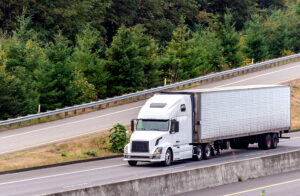
However, that software and hardware may already be installed in the truck you drive. It’s certainly installed in the autonomous trucks that are increasingly traveling the nation’s highways.
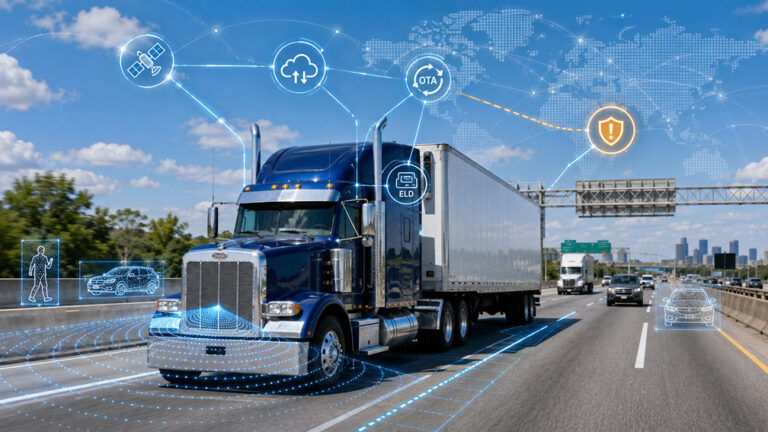
Lidar sensors make Advanced Driver Assistance Systems (ADAS) possible. If your vehicle has a system that automatically brakes to avoid a hazard ahead, Lidar is what makes it work. By firing laser pulses and measuring how long it takes for them to bounce off of an object and return, Lidar systems create a three-dimensional map that allows systems to “see” and navigate.
A Chinese company, Hesai Technology, is a major supplier of Lidar components worldwide. Their sensors are used in Amazon’s autonomous taxi service, Zoox, as well as in agricultural automation, at major airports and in Aurora, Waabi and Kodiak autonomous vehicle systems.
Hesai also contributes to the Chinese military industrial base, according to the U.S. District Court for the District of Columbia in a lawsuit filed by Hesai against the U.S. Defense Department (now the Department of War) in July 2025. The department had blacklisted Hesai for its cooperation with the Chinese military, prompting the company to sue — and lose.
However, this particular blacklist only prohibits U.S. government agencies from doing business with Hesai. The company is still free to sell its technology to the private sector, which it does.
Hesai denies any ties with the communist Chinese government; but the company does receive economic subsidies and substantial tax breaks from China, and it is difficult to imagine total independence under the communist regime. Add to this China’s support of countries that are hostile to the U.S., such as North Korea, Iran and Russia. There are also hacker organizations that can infiltrate programming.
What could possibly go wrong?
Trucking organizations, as well as professional truck drivers, like to point out the critical role that trucking plays in the U.S. economy. “If you have it, it was brought by a truck” is the mantra, and the statement is backed up by the numbers.
So, what could go wrong?
A professor at Duke University demonstrated how Lidar systems can be defeated by malware, which manipulated readings to insert a person into the digital mapping. Detection of a person, whether it’s real or generated by malware, can stop an autonomous vehicle in its tracks. Downloaded into an entire fleet of vehicles, malware could interfere with the country’s food supply. Likewise, a hacker could insert software that instructs the system to ignore specific objects, resulting in a failure to stop.
In another example of “what could go wrong,” Hesai failed to account for the year 2024 being a leap year in a firmware update it issued to its sensors. As a result, its sensors stopped working on Feb. 29, 2024, a date the software didn’t recognize.
Lidar isn’t the only software that can be manipulated.
Electronic logging devices (ELDs) contain software that collects and reports data on millions of drivers. If malware were introduced, hundreds of thousands of trucks could be shut down, disrupting the U.S. economy.
OOIDA quickly spoke out in favor of S.4429.
The Owner Operator Independent Drivers Association (OOIDA) strongly supports the Connected Vehicle Security Act and is urging the Senate to pass the bill.
“It’s unfathomable that 80,000-pound driverless commercial vehicles currently operating on American roadways rely upon technology from a global adversary for navigation,” said OOIDA President Todd Spencer in a July 22 press release. “Currently, autonomous systems put Americans, their vehicles, and their personal privacy at risk given so many critical unanswered questions related to cybersecurity, operational safety, and data transparency.”
The bill would implement restrictions over several years to give U.S. manufacturers time to find other suppliers for impacted parts.
China’s strategy of flooding foreign markets with heavily subsidized products is well-known. The country is flooding markets in Mexico, Europe and elsewhere with cars bearing artificially low prices due to government subsidies, taking market share from manufacturers in those countries.
According to proponents of the Connected Vehicle Security Act, the bill aims to protect U.S. auto manufacturing by preventing such an occurrence in the U.S.
However, the security of the U.S. supply chain may ultimately be the larger issue.

Cliff Abbott is an experienced commercial vehicle driver and owner-operator who still holds a CDL in his home state of Alabama. In nearly 40 years in trucking, he’s been an instructor and trainer and has managed safety and recruiting operations for several carriers. Having never lost his love of the road, Cliff has written a book and hundreds of songs and has been writing for The Trucker for more than a decade.