





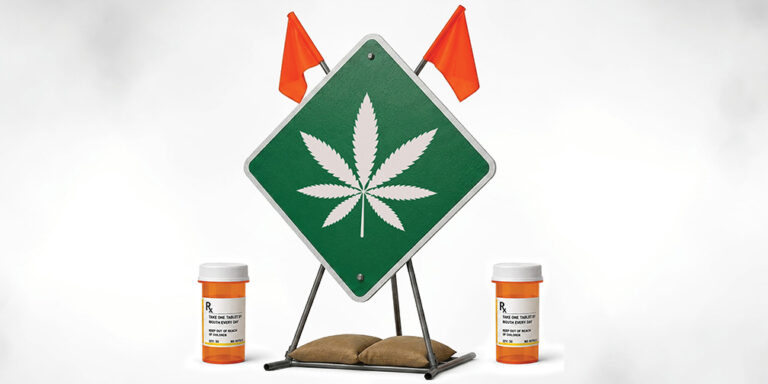
With all of the changes that have already taken place when it comes to the use of marijuana, and the promise more changes on the horizon, one thing that has not changed is the drug’s bipolar effect.
The debate continues morally, ethically and politically about what marijuana is and how it should be used by the public. The big question is: Does marijuana have a place in the trucking industry?
Most industry stakeholders, including the Truckload Carriers Association (TCA), answer that question with a resounding “NO!”
For decades, marijuana — commonly known by many slang terms including weed, pot, mary jane and many others — was listed as a Schedule 1 drug. This classified the drug as a controlled substance and prohibited universities, hospitals, drug manufacturers and doctors to study the substance properly under Food and Drug Administration (FDA) standards.
Status Change
What is Schedule 1 versus Schedule 3?
The DEA defines a Schedule 1 drug as an illegal substance with a high potential for abuse and no accepted medical use. Key examples include heroin, LSD and ecstasy. Under federal law set by DEA, these items cannot be prescribed or dispensed.
Meanwhile, a Schedule 3 substance is a drug that has an accepted medical use and a moderate to low risk of physical dependence — but a higher risk of psychological dependence.
President Donald Trump entered the debate in December 2025, issuing an Executive Order requiring the federal government to complete the process and shift marijuana to Schedule 3. The order calls for the creation of federal research infrastructure for marijuana and a federal regulatory system for CBD/hemp cannabinoids. The order also sets the stage for FDA-approved marijuana medicines, medical dosing standards and drug interaction guidelines, as well as insurance or Medicare integration and a safer CBD market.
Currently 40 states and the District of Columbia are running medical marijuana programs, with more certain to follow. Millions of patients use the drug for pain, nausea and anorexia, among other ailments, and doctors are increasingly recommending it to patients.
What the order does NOT do is legalize recreational use, override state laws, decriminalize possession or create a commercial marijuana market.
Reaction has been cautious throughout the industry spectrum.
The Trucking Industry Takes a Stance
When the news broke, TCA issued a formal statement:
“Looking at this change through a lens focused on commercial motor vehicle and highway safety, TCA has concerns that this reclassification could carry unintended consequences for an industry that prohibits truck drivers from using it.
“Notifications such as these often lead to misinterpretations of federal regulations, but even with the rescheduling, we must continually stress that marijuana use, even medical marijuana, is strictly prohibited.”
Additionally, reclassification may complicate transportation safety and enforcement measures, according to TCA.
Unlike alcohol, there is no universally accepted standard for measuring marijuana impairment at roadside checks. To help clarify this standard, TCA supports the admission of hair follicle testing results in the Federal Motor Carrier Safety Administration’s Drug and Alcohol Clearinghouse.
The American Trucking Associations (ATA) also weighed in on the move.
“We are reviewing DEA’s announcement and assessing what near- and long-term impacts it could have on USDOT’s drug and alcohol testing program,” said Brenna Lyles, ATA’s vice president of safety policy. “…we are concerned about the safety risks of rescheduling (marijuana) without clear safeguards to preserve USDOT’s testing authority for safety-sensitive workers.”
Impact on Drug Testing
Jo McGuire, who serves as the executive director of the National Drug & Alcohol Screening Association (NDASA), is leading the charge against relaxing the standards for safety in the trucking industry.
Here’s why: Federal law grants the U.S. Department of Health and Human Services (HHS) authority over which substances may be included in federally authorized drug testing programs. With marijuana no longer classified as a Schedule I controlled substance, HHS would be required to remove it from the federal drug-testing panel.
The U.S. Department of Transportation (DOT), which mandates testing for marijuana, cocaine, PCP, amphetamines and opioids, is legally required to follow HHS drug-testing guidelines. If HHS is no longer permitted to test for marijuana, USDOT would likewise be forced to remove marijuana from its testing panel.
NDASA is calling for a safety carve-out — a regulatory exception that keeps safety-sensitive rules or drug testing in place when broader laws change — noting that driver safety, as well as the safety of the public, could be at risk without guardrails.
“Absent a specific safety carve-out, this regulatory shift would eliminate marijuana testing for DOT-regulated employees — including school bus drivers, commercial truck drivers, airline pilots, air traffic controllers, transit operators, mariners and pipeline operators — effectively allowing individuals to legally be impaired while performing safety-critical functions,” NDASA said.
In fact, McGuire says, if no safety carve-out is enacted, the foundation of drug testing will be in grave danger.
“We feel very certain that once Schedule 3 goes through without any safety carve-out, or provision for HHS to continue to certify the labs, testing for THC under DOT will stop,” she said. “It’s not about them having the authority to test; that’s all well and good. The problem is that HHS will not be able to certify the labs to test outside Schedule 1 and 2.”
It’s important to note that this does not prevent companies from initiating or keeping in place their own policies for testing.
As the debate continues and marijuana inches toward legalization, it’s vital that safety remain a top priority in the trucking industry.
This article first appeared in the September/October 2026 print edition of Truckload Authority, the official publication of the Truckload Carriers Association.

Bruce Guthrie is an award-winning journalist who has lived in three states including Arkansas, Missouri and Georgia. During his nearly 20-year career, Bruce has served as managing editor and sports editor for numerous publications. He and his wife, Dana, who is also a journalist, are based in Carrollton, Georgia.






I personally am against some of the overreach by the government in trucking. I stand strong against any drugs being used by truck drivers marijuana has no place in the industry.
The real problem is that THC, the main constituent of marijuana, cannot be tested for. The only indicator of marijuana use that can be used is the metabolite, which can be detected in the bloodstream for 90 days, or more, after last use. Any of the other drugs that are tested for are not detectable after a few days, or even hours. This represents an unfair imbalance between marijuana and other drugs.
DOT rules regulating physical qualification allow for the use of prescription opioids if the examiner concludes that the subject can ‘handle’ their use. The same standard should apply to marijuana.
Hello. It IS only another drug prescribed for pain relief. Are you prohibiting ALL prescription medications? The only regulations required are on performance in the field regarding safety to public and property, nothing different from what exists now.