




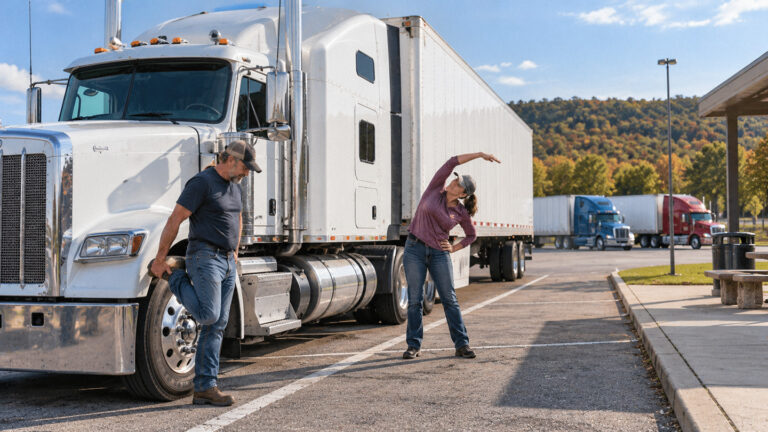
We talk a lot about heart health, blood pressure, circulation, back pain, tight hips and stiff muscles in trucking. But there’s another system in the body that I think deserves a little more attention, especially when your job requires you to sit for hours at a time.
I’m talking about your lymphatic system.
Now, before you say, “Good grief! Another wellness trend!” — hear me out.
Your lymphatic system isn’t new. And taking care of it doesn’t require some fancy detox, expensive equipment or complicated routine.
Your lymphatic system is working behind the scenes every single day:
- It helps manage fluid throughout the body;
- It supports your immune system;
- It absorbs certain fats from the digestive system; and
- It helps return excess fluid from your tissues back into your bloodstream.
But here’s what makes it interesting for truck drivers.
Unlike your cardiovascular system — which has the heart continuously pumping blood — your lymphatic system doesn’t have one central pump moving lymph through the body. Normal lymph movement is supported by things like muscle contractions, breathing, and simply moving your body.
And what do drivers spend a whole lot of time NOT doing?
Moving.
Think about how your body feels after several hours behind the wheel. Your hips have barely moved. Your knees have been bent. Your ankles haven’t moved through much range of motion. Your calves haven’t been contracting like they would if you were walking — and chances are your breathing has gotten a little shallower too.
This is exactly why I talk so much about “movement snacks.”
Your body doesn’t necessarily need another hour-long workout. It needs opportunities to move throughout the day.
And supporting your lymphatic system can be a lot simpler than you think.
Four simple moves to get things moving
The next time you’re safely parked, try these four simple movements. You can do the first three right from the driver’s seat and the fourth when you get out of the truck.
1. Breathe
Yep. We’re starting with breathing.
Sit tall and place your hands around your lower ribs. Take a slow breath in through your nose and feel your ribs and belly expand. Slowly exhale and let everything soften back in.
Do this for five to 10 breaths.
Your diaphragm does more than help you breathe. The pressure changes created as it moves can also help support the normal movement of lymph and other fluids through the body.
And let’s be honest: Slowing down and taking a few intentional breaths probably isn’t a bad idea for the nervous system either.
2. Pump your feet
Keep your feet on the floor and alternate lifting your heels and toes. You can also straighten one leg slightly and point and flex your foot, then switch sides.
Try 20 to 30 repetitions.
Simple? Absolutely! But simple doesn’t mean useless.
Your calf muscles are sometimes called a “second heart” because those muscle contractions help move venous blood out of the lower legs and back toward the heart. Muscle contractions also help support lymph movement.
After hours of sitting, get those feet and calves moving.
3. Reach, bend and move your upper body
Reach one arm overhead and gently bend to the opposite side. Come back to center and switch.
Reach both arms overhead.
Roll your shoulders.
Move your ribs.
Add a gentle twist.
And breathe while you do it.
It doesn’t have to look pretty, and nobody needs to give you a score.
The point is to move areas of the body that haven’t been moving much while you’ve been driving.
4. Add some gentle bounces
This is one of my favorites! Try it next time you get out of the truck.
Stand with your feet about hip-width apart and loosen your knees; then begin gently bouncing your body up and down.
And when I say bounce, I don’t mean jump. Your feet don’t even need to leave the ground.
Think: Bounce. Bounce. Bounce.
Let your arms stay relaxed. Let your shoulders loosen up. Keep breathing and allow your entire body to move.
Start with 30 seconds. Rest. Then do another round.
That gentle rhythmic movement creates repeated muscle contractions throughout the body, giving you another simple way to support normal circulation and lymph movement after sitting for hours.
Try doing these bounces:
- 30 seconds beside the truck;
- One minute at a rest stop; or
- A few rounds before getting back behind the wheel.
It all counts.
And if you can do one more thing … walk
If you have five minutes, walk.
Not because walking is trendy, but because the human body was designed to do it.
Walk around your truck. Walk across the parking lot. Take a few laps at the rest area. Let your arms swing, move your ankles, use your calves, and breathe.
This is exactly what my 15-Minute Wellness Method is about.
Fifteen minutes of on-purpose movement every day.
And no, it doesn’t always have to happen all at once — five minutes here. Two minutes there. Another five minutes later.
Those small opportunities to move start adding up.
Don’t make this more complicated than it needs to be.
I think this is where wellness loses a lot of people. We hear something like “lymphatic drainage,” and suddenly we think we need a special routine, a new tool or another 45-minute program added to our day.
You don’t. Your body already knows what to do.
We just have to give it what it needs to do its job.
- Breathe.
- Pump your feet.
- Move your upper body.
- Bounce.
- Walk.
- And then do it again later.
That’s it.
If you’ve been sitting for hours, your body doesn’t need you to become a fitness fanatic overnight. It simply needs you to stop expecting it to function at its best while barely moving.
One important note for drivers
If you experience sudden or unexplained swelling, especially in only one leg, or swelling accompanied by pain, warmth, redness, chest pain or shortness of breath, don’t assume you simply need to “get your lymph moving.” Those symptoms need medical attention.
Otherwise, start looking for little opportunities throughout the day to get your body moving.
Because your truck needs things flowing, moving, and functioning properly to keep rolling down the road.
So does your body.
Take care of it.
One breath, one bounce, one walk, and one small simple change at a time.

Hope Zvara is a regular contributor to The Trucker, providing tips for healthy living on the road as well as tips to control stress. She is also the CEO of Mother Trucker Yoga and Road Relief Wellness. She has been featured in Forbes and Yahoo News, and is a regular guest on SiriusXM Radio. Her practical strategies show drivers how they can go from unhealthy and out of options to feeling good again.