



In 1609, as explorer Henry Hudson ventured up the river that would one day bear his name in New York state, he must have been shocked when, about 25 miles north of Manhattan, he arrived at a vast widening of the waterway. The river, which had been roughly a mile wide on his course northward, suddenly expanded to over 3 miles wide.
Hudson had been sent to the area on behalf of the Dutch East India Co. to find the elusive Northwest Passage through the Arctic Circle. Records indicate he thought he’d found it in the widening of the river.
Unfortunately for Hudson, the river narrowed again about 10 miles upstream. By the time he reached Troy, about 150 miles north, the river narrowed to only a tenth of a mile wide. Ultimately, he gave up his quest to find a Northwest passage — at least via the Hudson River.
Still, the discovery of the wide area of the river, now known as the Tappan Zee, became the first in a series of events that improved transportation routes north of New York City some 350 years later.
Seeking a more convenient route
At first glance, the Tappan Zee (“cold sea”) wouldn’t seem to be a logical location to build a bridge across the Hudson. Sure, in very cold winters, like those such back in 1911 and 1917, the river froze to the point it could be crossed on foot — but venturing out on the ice to ship supplies across the river was too risky.
Still, a need existed for a crossing between the towns of Tarrytown and Nyack, which were positioned on opposite sides of the Hudson. As automobiles and trucks took to the roads, this need grew exponentially. While several crossings existed to the south, in and near New York City, a northern crossing would allow part of the traffic to avoid the congested metropolitan area and continue into central and upstate New York along a more convenient route.
But the Tappan Zee also brought other advantages to the state of New York that a more southern crossing did not provide.
In 1950, the Port Authority of New York and New Jersey proposed building a bridge at Dobb’s Ferry to ease commuter traffic coming into the city. However, then-New York Governor Thomas Dewey nixed the project, preferring a more northern route that would connect directly to the New York Thruway.
While a crossing south of Nyack, perhaps between Irvington and Piermont, would have made more engineering and financial sense, the Port Authority held the rights to any bridge construction within 25 miles of Manhattan. A bridge south of Nyack — at a narrower point in the river — would have fallen under the Port Authority, and all tolls for the crossing would go to that agency.
Dewey wanted to fund the Thruway instead, and tolls from a bridge across the Hudson would do just that. But he didn’t want to the bridge to be too far north of New York City. The southernmost point Dewey could build his bridge would be across the Tappan Zee.
Bridging the Tappan Zee
Over the next two years, architect and civil engineer Emil Praeger designed a bridge using technology he helped develop during World War II for the planned Allied invasion of Normandy. Caissons, watertight retaining structures, were employed in the design of the Tappan Zee crossing and served as piers between sections of the bridge. Eight caissons were constructed; the goal was for their buoyancy to increase the loadbearing aspects of the bridge.
Construction of the bridge began in March 1952, and it opened to traffic in December 1955. In 1956, it was named the Tappan Zee Bridge.
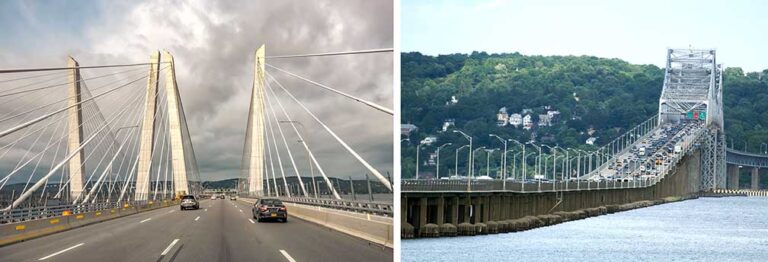
The final project was a bridge that was 3.1 miles in length and formed a bit of an “S” shape as it crossed the Hudson. Aside from the caissons, the central portion of the bridge was of a cantilever design, with 1,212-foot main spans joining in the middle some 108 feet above normal river level. The bridge weighed in at nearly 49,000 tons.
Designed to carry 100,000 vehicles daily, the bridge was divided into seven lanes of traffic, with the center lane serving as an HOV lane that changed directions based on traffic demands during the day.
The total cost of the bridge was $81 million — more than $1 billion in today’s dollars. However, the bridge was not built to standards that would allow long-term use. When construction began on the bridge, the Korean War put a strain on building materials in the U.S., so the bridge was designed using materials that were available at the time. This led to a short life for such an expensive structure.
Building a new Tappan Zee
By 2000, the Tappan Zee Bridge was carrying 138,000 vehicles a day from points in southern New England westward from the Hudson River. The bridge, designed to carry far fewer vehicles, had deteriorated and expensive repairs were needed.
By 2009, the Tappan Zee Bridge was noted as one of the most “decrepit and potentially dangerous bridges” in the country. Its lifespan was over, and it was time to move on. In 2013, the New York State Thruway Authority began construction on a replacement bridge.
The new Tappan Zee Bridge — now named the Gov. Mario M. Cuomo Bridge — is eight lanes wide and includes lanes for buses, as well as pedestrian/bicycle paths on its shoulders.
Completed at a cost of $3.9 billion, the bridge opened in September 2018, a year behind schedule. Located just 150 feet from the site of the old bridge, control of the structure is still maintained by the Thruway Authority. The bridge is considered part of Interstate 287, which connects to Interstate 87 at Elmsford, New York. At 183 feet wide, the new bridge is among the widest cable-stayed bridges in the world. The stays contain 4,900 of steel cable.
Unlike its predecessor, this bridge is designed to last at least a century before significant deterioration is expected.
Making travel easier for truckers
And that, my friends, is the tale of how a failed expedition led to a major traffic corridor.
Perhaps for truckers, the major point in the story is the tolls charged for trucks crossing the bridge. First, it should be noted that tolls are only collected in the westbound lanes. Those traveling east get a free ride across the Hudson, largely on the supposition that the same vehicles will cross back over and pay a toll when westbound.
If you’re paying tolls by mail, the rate for a four- or five-axle truck will set you back in the neighborhood of $100, with additional charges for more axles. But don’t fret. If you invest in an EZ-Pass, rates are significantly reduced.
Those crossing the Hudson River today probably don’t spare a thought to Henry Hudson’s voyage up the river in 1609. But if Hudson had known the money-making venture controlling the crossing of the Tappan Zee would become, perhaps he would have docked at the site himself and started a ferry service.

Since retiring from a career as an outdoor recreation professional from the State of Arkansas, Kris Rutherford has worked as a freelance writer and, with his wife, owns and publishes a small Northeast Texas newspaper, The Roxton Progress. Kris has worked as a ghostwriter and editor and has authored seven books of his own. He became interested in the trucking industry as a child in the 1970s when his family traveled the interstates twice a year between their home in Maine and their native Texas. He has been a classic country music enthusiast since the age of nine when he developed a special interest in trucking songs.