



This story is Part 2 of a series. To read Part 1, click here.
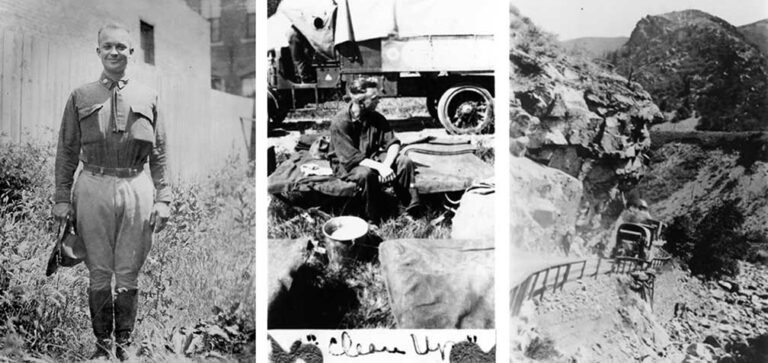
When Lt. Col. Dwight D. Eisenhower documented the trek of the 1919 Trans-America Military Convoy, he noted that despite the challenges various vehicles met on the trip from the east to west coast, the expedition DID prove the value of such an improved route.
Based on passage of the Federal Aid Road Act in 1916 and the subsequent Federal Aid Highway Act of 1921, the government set up a framework for funding a national system of numbered roadways that was first implemented in 1926.
However, the roads built under the system were usually state-funded and were mainly two-way routes, such as the Texas Farm to Market roadway system. It wasn’t until 1953, when Eisenhower became President of the United States, that a serious effort for a four-lane nationwide system of highways took root.
The Interstate Highway System was designed to national standards for both construction and signage. All roads were “freeways,” and although some established routes were incorporated into the system, most were completely new.
The planning of the roads created problems in urban areas, where the poorest neighborhoods were subjected to eminent domain — an issue that created socio-economic issues that will be discussed in a future article in this series.
Long-range transportation plan
But the purpose of the interstates was clear — to provide a system of high-quality roads to assist in the transportation of goods, services and people in a growing era of road transportation.
Transport of goods and people by rail was beginning to wane, and interstates were seen as the future of the nation’s transportation system. The military-trained Eisenhower recalled the 1919 Convoy in his push to make the interstate system a reality, also remembering the advantages of the German Autobahn during World War II, a highway system that helped move troops and equipment for both the Allied Nations and Germany.
Because of Eisenhower’s military background, some claim the interstate system is a series of roads built primarily for military use. For instance, one long-held fallacy is that Eisenhower ordered 1 in every 5 miles of the system to be straight so that airplanes could use them as runways. This claim is patently false, and there is no mention of airplanes in the legislation creating the system.
While some highways have indeed been used as emergency landing strips by small planes, the interstate system was intended for the movement of goods and people. At the time of the system’s inception, trucking was growing as a transportation method and people were beginning to take trips far from home. The growth in tourism as an industry coincided with the development of the interstate highway system.
The original National Highway Policy and Plan, delivered in 1918, called for a grid of highways across the country with a total length of 50,000 miles. Ten north-south routes were planned, along with five east-west routes; the Lincoln Highway served as a model for these routes.
Planned at a cost of $25,000 per mile, those original routes are largely included in the interstate highway system today — but the system itself has grown to include numerous routes, spurs, loops and other shorter sections of roadway.
With Eisenhower’s backing, the Interstate Highway System officially came into existence in 1956 with the passage of the Federal Highway Act, a 10-year $100 billion public works project that would construct 40,000 miles of divided highway connecting cities with populations of at least 50,000. After a brief struggle related to funding in the House of Representatives, the Act won Congressional approval, and Eisenhower signed it into law in June 1956. Many jobs were created in the highway construction industry, and the nation immediately went to work.
Who built it first?
The claim to the first section of interstate is disputed. In fact, three states take credit for starting to work first.
- Missouri states that it immediately signed contracts for a section of interstate, a portion of Route 66 (now Interstate 44), on Aug. 2, 1956.
- Kansas, on the other hand, claims it was the first to begin paving a highway, with construction on a section of Interstate 70 beginning on Sept. 26, 1956.
- And Pennsylvania, with the well-established Pennsylvania Turnpike already in place, claims to have unofficially opened a section of what would become Interstate 76 in 1940; thus, it was already operable when President Eisenhower signed the law some 16 years later.
In any event, when the law became official, it was met with a flurry of activity as engineers and road crews across the nation went to work.
Changing with the times
What began as a 10-year project in 1956 grew into a nearly four-decade project — and new interstates are still being built today.
The interstate system is no longer used to only connect large cities. The hundreds of towns along the interstate route became exits on the controlled-access highways and interstate routes often veer slightly to encompass some communities.
In other cases, smaller cities expanded toward the interstate, taking advantage of the accessibility afforded by the routes of and providing services needed by travelers. Service stations, motels, restaurants and hundreds of tourist destinations sprouted at intersections of local highways with the interstate system, a type of economic development that continues today.
Notable milestones
Road workers met several milestones along the way to the completion of the interstate highway system:
- In 1974, the first interstate within a state, Nebraska’s I-80, was officially completed.
- In 1979, the first interstate connecting Mexico to Canada was opened, largely through California, designated as I-5.
- In 1986, the east-to-west coast I-80 was completed, officially opening the route that the military took during its 1919 Convoy (with a few adjustments).
- In 1992, the original interstate system was proclaimed complete with the opening of I-70 through Colorado. This section of interstate contains over 40 tunnels and bridges and went down as the most expensive and complicated section of the interstate system to be built.
And so, the U.S. interstate system was officially completed. What began as a ten-year project took thirty-five years to complete, and the initial $25 billion price tag is dubbed at $634 billion in 2025. That figure, of course, does not include hundreds of millions of dollars in upgrades and maintenance that have been required along the way.
While the original interstate system has been completed for over three decades, the routes designated as interstate continue to grow, expand, contract and relocate.
Tune in next month, when we’ll discuss the highway system’s developments over the past three decades.

Since retiring from a career as an outdoor recreation professional from the State of Arkansas, Kris Rutherford has worked as a freelance writer and, with his wife, owns and publishes a small Northeast Texas newspaper, The Roxton Progress. Kris has worked as a ghostwriter and editor and has authored seven books of his own. He became interested in the trucking industry as a child in the 1970s when his family traveled the interstates twice a year between their home in Maine and their native Texas. He has been a classic country music enthusiast since the age of nine when he developed a special interest in trucking songs.