





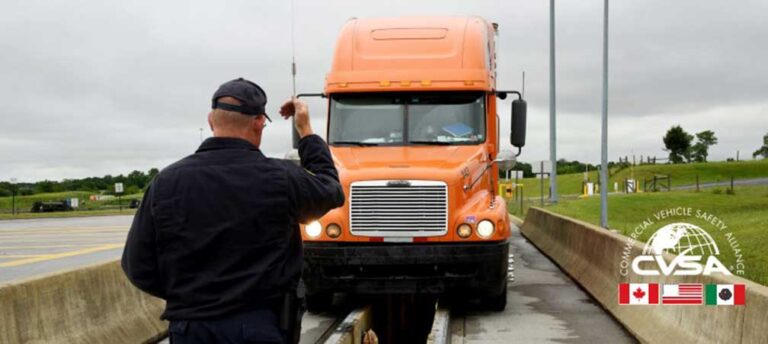
Commercial motor vehicle enforcement personnel in Canada, Mexico and the U.S. conducted 56,178 commercial motor vehicle, driver and cargo inspections on May 13-15 as part of the Commercial Vehicle Safety Alliance’s (CVSA) 72-hour International Roadcheck inspection, enforcement and data-gathering initiative.
Most of the vehicles (81.6%) and drivers (94.1%) inspected did not have any out-of-service (OOS) violations.
“Conversely, inspectors discovered 13,553 vehicle, 3,317 driver and 177 hazardous materials/dangerous goods (HM/DG) out-of-service violations, and placed 10,148 commercial motor vehicles and 3,342 drivers out of service,” CVSA said. “The vehicle out-of-service rate was 18.1% and the driver out-of-service rate was 5.9%. Meaning, those drivers and/or vehicles were restricted from further travel until all out-of-service violations were resolved.”
Driver and Vehicle Focus Areas
“Each year, International Roadcheck places special emphasis on a driver violation category and a vehicle violation category to highlight those aspects of the North American Standard Inspection process,” CVSA said. “This year, the vehicle focus was tires and the driver focus was false records of duty status (RODS).”
Inspectors identified 2,899 tire-related out-of-service vehicle violations, the second most-cited out-of-service vehicle violation, after brake systems. Tire violations accounted for 21.4% of all vehicle out-of-service violations. Examples of tire violations include flat tires, insufficient tread depth, severe cuts exposing cord ply or other damage resulting in bulges, improper repairs, or tires not rated for the load being carried or not rated for highway use, etc.
Tire Safety
According to the U.S. Federal Motor Carrier Safety Administration’s (FMCSA) roadside inspection violation data for 2025, “Tires – All others, leaking or inflation less than 50% of the maximum inflation pressure” was the fourth most-cited violation, accounting for 65,184 vehicle violations nationwide, as of Aug. 29.
Tires are critical for vehicle safety and compliance and roadway safety. Checking tires is part of a driver’s pre- and post-trip inspections and a devoted portion of the vehicle inspection process for a certified commercial motor vehicle inspector. Tires in poor condition can rupture, causing loss of control, vehicle rollovers or debris hazards on the road.
False Logs
“Ten percent (332) of all driver out-of-service violations were for false logs/RODS,” CVSA said. “Falsifying logs is a serious violation. It conceals the real hours a driver has been driving or on duty, which directly impacts safety, compliance and trust. According to FMCSA’s 2025 roadside inspection violation data, there were 6,823 ‘False report of driver’s record of duty status’ driver violations nationwide, as of Aug. 29.”
Vehicle Violations
“North American Standard Level I, II and V Inspections are the inspection types that involve inspections of commercial motor vehicles,” CVSA said. “Of the 44,435 Level I, II and V Inspections conducted, 13,553 out-of-service vehicle violations were discovered and 10,064 vehicles or combinations (22.6%) were placed out of service. A vehicle is placed out of service when an inspector identifies an out-of-service violation, as detailed in CVSA’s North American Standard Out-of-Service Criteria.”
The top vehicle out-of-service violation in North America was for brakes. Inspectors identified 3,304 out-of-service brake system violations, 24.4% of all vehicle out-of-service violations. In addition, the third most-cited (2,257) vehicle out-of-service violation was for 20% defective brakes, which is when 20% or more of the vehicle’s (or combination of vehicles) brakes have an out-of-service condition. Combined, there were 5,561 brake-related out-of-service violations (brake systems and 20% defective brakes), accounting for 41.1% of out-of-service vehicle violations.
Driver Violations
“North American Standard Level I, II and III Inspections are the inspection types that involve inspections of commercial motor vehicle drivers,” CVSA said. “Of the 54,953 Level I, II and III Inspections conducted, 3,342 drivers (6.1%) were placed out of service. Examples of driver out-of-service violations, according to the CVSA’s North American Standard Out-of-Service Criteria, include hours-of-service infractions, licensing issues, driving under the influence of drugs or alcohol, falsified logbooks or supporting documents, etc.”
The top driver out-of-service violation in all three countries of the Alliance – Canada, Mexico and the U.S. – was for hours of service, accounting for 32.4% (1,076) of all driver out-of-service violations. Federal hours-of-service restrictions are in place to prevent fatigue-related crashes and to safeguard professional drivers’ health, safety and wellness.
Mexico’s out-of-service violations were all vehicle violations, therefore, the reported driver out-of-service violations are for Canada and the U.S.
Seat Belt Violations
“During International Roadcheck, 726 seat belt violations were issued. According to FMCSA, 14% of commercial motor vehicle drivers do not wear their seat belt,” CVSA said. “The U.S. National Highway Traffic Safety Administration states that wearing a seat belt is the single most effective thing drivers and passengers can do to protect themselves in a crash. Seat belts saved an estimated 14,955 lives and could have saved an additional 2,549 people if they had been wearing seat belts, in 2017 alone.”
Hazardous Materials/Dangerous Goods Violations
“The top HM/DG out-of-service violation was for loading,” CVSA said. “There were 51 out-of-service loading violations, accounting for 28.8% of all HM/DG out-of-service violations. Loading and securement requirements prevent cargo/goods/materials from moving in a manner that would cause damage to the package resulting in leaking, spilling, etc. This is especially important when it comes to the transportation of HM/DG.”
The transportation of HM/DG demands rigorous training and heightened compliance requirements. For motor carriers and drivers, safely transporting HM/DG is imperative to the safety of the driver, the public and the environment. For inspectors, inspecting vehicles transporting HM/DG is a complex and detailed process that involves safely looking for leaking materials or unsecured HM/DG cargo, and verifying shipping papers, placarding, marking, labeling, packaging and loading compliance.
Inspections
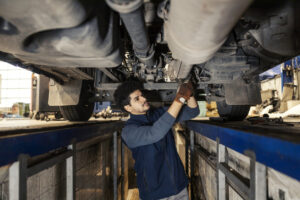
“Inspectors conducted 56,178 Level I, II, III and V Inspections during the three days of International Roadcheck,” CVSA said. “The Level I Inspection is a 37-step procedure that checks the driver’s operating credentials and the vehicle’s components. It is the most-commonly performed inspection, not only during International Roadcheck, but throughout the year. However, there are several other inspection levels that an inspector may conduct. For example, an inspector may conduct a Level II Inspection, which includes the portions of an inspection that do not involve the inspector physically getting under the vehicle. The Level III Inspection is an inspection of the driver’s credentials, status in the Drug and Alcohol Clearinghouse, and hours-of-service records. Another option is a Level V Inspection, which is a vehicle-only inspection and does not need a driver to be present.”
In all, there are eight inspection levels, including the levels stated above, which range from the strict inspection of radioactive materials by a specially certified inspector to electronic inspections that can be conducted while the vehicle is motion without direct interaction with an enforcement officer.
CVSA Decals
Inspectors affixed 16,521 CVSA decals to power units, trailers and motorcoaches/buses during International Roadcheck. A CVSA decal is placed on a commercial motor vehicle or each vehicle in a combination after a certified inspector has confirmed, by completing a Level I or V Inspection, that the vehicle did not have critical vehicle inspection item violations.
International Roadcheck
“International Roadcheck, CVSA’s annual three-day commercial motor vehicle inspection snapshot, plays a critical role in roadway safety,” CVSA said. “Inspectors focus on driver operating requirements and vehicle mechanical fitness, ensuring only safe commercial motor vehicles and drivers are on the road. Since its inception in 1988, more than 1.8 million roadside inspections have been conducted during International Roadcheck. For this year’s initiative, approximately 13 vehicles per minute were inspected throughout North America.”
To read the report in full, click here. To see how the 2025 results compare to 2024, click here.

Dana Guthrie is an award-winning journalist who has been featured in multiple newspapers, books and magazines across the globe. She is currently based in the Atlanta, Georgia, area.




seeing a pattern here..since illegal drivers taken off road ..accidents down now this…JS
Thank you for you comment! We always appreciate when our readers interact with us. The International Roadcheck was held in May of 2025, prior to any adjustments made to CDL holder requirements in the United States. It also covers Canada and Mexico which have different regulations than the U.S.