



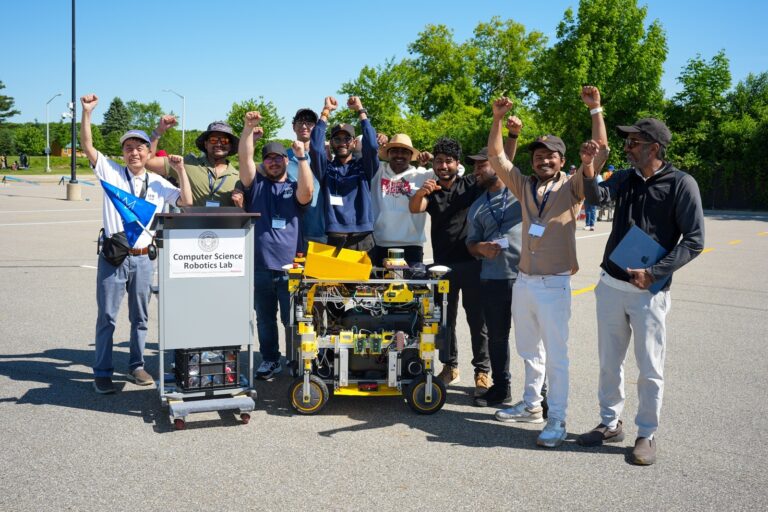
SOUTHFIELD, Mich.—The Lawrence Technological University Self-Drive 2026 team “rACTor” from the university’s Department of Mathematics and Computer Science won first place in the 33rd annual Intelligent Ground Vehicle Competition’s Self-Drive Challenge, hosted May 29-June 1 on the campus of Oakland University.
“While AI is transforming computer vision and robotics, the toughest barriers still sit at the intersection of hardware, software and real-time data,” said Devson Butani, LTU Computer Science Robotics Research Lab Manager.
Butani who was the LTU IGVC team lead in 2024, has been participating in IGVC competition since 2017. He has Bachelor of Science in Mechanical Engineering and Master of Science in Computer Science degrees from LTU.
A Motto of Theory and Practice
“At LTU, we live our ‘Theory and Practice’ motto by embedding those exact challenges directly into student coursework,” Butani said. “Through hands-on projects and competitions like IGVC, our students prove that when you integrate real-world applications into the curriculum, you build AI that actually works outside the lab.”
This year, 24 college teams registered in two performance challenges—Self-Drive for automated driving assisted vehicles and trucks, and Auto-Nav for unmanned ground robots that must successfully navigate complex outdoor obstacle courses. The event was co-hosted by Oakland University, the Association for Unmanned Vehicle Systems International (AUVSI) Great Lakes, and the U.S. Army’s Ground Vehicle Systems Center (GVSC) in Warren.
In the Self-Drive challenge, both LTU and Hosei University from Japan achieved a perfect score, which is 2,100 points, but the LTU team clinched the first place championship banner by the time of the competition. LTU’s robot vehicle was much faster, completing the course in two minutes, 48 seconds, vs. the Hosei team’s four minutes, 57 seconds.
Lawrence Technological University Team
The LTU team’s technical lead Jacob Hallett also participated in LTU’s Robofest autonomous robotics competition during his high school years in Tecumseh, Mich.
“Excellence is never the work of one person—it is the collective effort of a team committed to a common goal,” Hallett said. “Our team’s performance is proof of what can be achieved when everyone pulls in the same direction. Every challenge we faced became an opportunity to grow, and every success was built upon the knowledge and experience gained through IGVC.”
Hallett is a resident of St. Clair Shores. He also works full-time at helpdesk at LTU.
LTU’s rACTor team members include:
- Arun Tejaswi, PhD computer science.
- Bru Lamarca, BS mathematical sciences, team co-lead.
- Deepak Goud Nalla, MS data science, team co-lead.
- Ilyarzhan Assimov, MS computer science.
- Jacob Hallett, MS computer science, team technical lead.
- Jurius Azar, Dual enrollment.
- Manjunadh Reddy Kommireddy, MS computer science.
- Shaik Mohinpasha, MS computer science.
- Siva Ganesh Varma Paidi, MS computer science.
- Srii Akhillessh Gaddam, MS computer science.
The Self-Drive Challenge
In Self-Drive challenge, teams build and program autonomous vehicles to navigate a real-world outdoor urban road environment without any human intervention or remote control. Sixteen autonomous functions included real and fake stop sign detection, obstructed dynamic pedestrian detection, obstacle detection and lane changing, pothole detection and lane changing, various types of parking, and other basic traffic functions.
In the Self-Drive Category, teams that participated were:
- Hosei University (Japan).
- Indian Institute of Technology Madras (India).
- Lawrence Technological University Department of Mathematics and Computer Science.
- Manipal Academy (India).
- Oakland University.
- Texas A&M University, Kingsville.
- University of North Carolina Charlotte.
- University of Oklahoma.
- Wayne State University.
Faculty advisors are CJ Chung, professor and director of the Computer Science AI Robotics Lab, and Vijay John, professor of computer science.
“We have been focusing on the reliability of mobile robotics functions so far,” Chung said. “However, it is time to extend our research focus to speed as well. LTU is now involved in the Indy Autonomous Challenge, which requires the control of super-fast Indy race cars driving at speeds approaching 200 mph.”
IGVC was established in 1993 by the U.S. Army’s Combat Capabilities Development Command Ground Vehicle Systems Center, formerly known as TARDEC, host school Oakland University, and the AUVSI Great Lakes Chapter.
The IGVC provides multidisciplinary design experience in engineering education, blending theory and hands-on practice. It involves the latest industrial technologies and is ideal for a senior year capstone course or extracurricular project, offering students real-world constraints and the chance to win recognition and financial rewards. The competition involves participants learning business, engineering management, and public relations skills. They engage with automotive and defense sponsors for hardware and advice, gaining insights into industrial design and employment opportunities.”

Dana Guthrie is an award-winning journalist who has been featured in multiple newspapers, books and magazines across the globe. She is currently based in the Atlanta, Georgia, area.