



Roadside checks uncover how much a driver values — or does not value — highway safety
Take a drive down a section of interstate highway anywhere in North America and see how long it takes to count eight passing commercial motor vehicles (CMVs). In most cases, it won’t take long!
Now, consider that one of those eight vehicles would not pass the Federal Motor Carrier Safety Administration (FMCSA) standards for brakes and would be placed out-of-service (OOS) if inspected. Statistically, one truck out of the next group of eight would also fail. You could do this all day.
The Commercial Vehicle Safety Alliance (CVSA) did just that, more or less, on April 14 with an unannounced Brake Safety Day. The surprise enforcement action was part of Operation Airbrake, CVSA’s annual inspection, compliance and data-collection initiative. Inspectors in 47 jurisdictions throughout Canada, Mexico and the U.S. participated. A total of 4,021 inspections were conducted; 574 (14.3%) of the CMVs inspected were placed OOS.
The question every professional driver should be asking themselves is this: “Would my truck be one of the eight placed OOS for safety violations?”
Not all violations result in an OOS status.
Shifting back to April’s surprise inspection event: Keep in mind that the 574 vehicles noted are only the ones placed OOS — countless other CVMs were guilty of violations that did not require them to be placed OOS.
For example, CVSA standards call for a CMV with 20% or more of its brakes in a defective condition to be placed OOS. If you drive a typical 18-wheel tractor-semitrailer combination, your vehicle has 10 wheel-end brake discs or drums. Having one that’s out of adjustment is a violation, but the vehicle may remain in service, However, having two of the 10 out of adjustment is an OOS order.
Other violations discovered in the April inspection blitz included:
- Defects in brake hoses or tubing;
- Air-loss rates above specifications;
- Inoperative tractor protection valves;
- Non-working low air warnings;
- Broken drums or rotors;
- Rusted rotors and metal-to-metal contact; and
- Worn brake shoes and pads.
Multiple factors impact the final tally.
In fairness, the 14.3% OOS rate shouldn’t be interpreted as applying to all trucks on the road, because it doesn’t. It applies to those trucks that were selected for inspection — and the criteria for that selection can change between jurisdictions.
For example, one state may be on the lookout for the oldest, rustiest equipment on the road, ignoring newer equipment more likely to pass inspection. Another state may be focused on a particular trucking segment, inspecting logging trailers using a particular road or trash haulers near a certain dump. Some jurisdictions may employ technology such as infrared cameras to identify trucks with temperature differences between brake units.
The 47 participating jurisdictions were a factor, too.
There are, of course, 50 U.S. states; but there’s also the District of Columbia, as well as five inhabited territories (Puerto Rico, Guam, Northern Mariana Islands, American Samoa and the U.S. Virgin Islands).
A CMV operating on American Samoa, or on one of the Hawaiian islands is not representative of a tractor-trailer running the 48 continental U.S. states. Add in the 10 Canadian provinces (plus 3 territories) and the 31 states of the United Mexican States (Mexico), and it becomes evident that only about half of the possible jurisdictions participated in the event.
Let’s face it: The general public gets most of their information from media outlets that are not specifically focused on the trucking industry. (That’s why specialized industry news outlets like TheTrucker.com exist.)
The media outside of the trucking industry isn’t likely to over-explain inspection results. If the motoring public sees the headlines and believes that one of every eight trucks has unsafe brakes, it’s just part of the industry’s public relations problem.
As technology advances, safety criteria changes.
One of the main issues is that trucks manufactured after Oc. 20, 1994, are required to have automatic slack adjusters as well as a brake adjustment indicator. Truckers of the ’90s and earlier were required to check brake adjustment and adjust as necessary, often during their pre-trip inspections.
Today, drivers are admonished not to attempt to adjust automatic slack adjusters. When they go out of adjustment, they’re considered damaged and replaced.
Who’s ultimately responsible for brake safety?
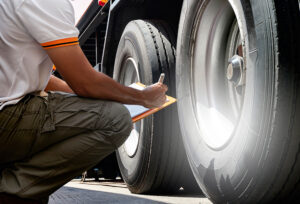
The problem is that drivers often consider brakes to be a carrier or maintenance shop problem. No one likes crawling under a truck to check push rod travel or try to estimate brake shoe thickness through an inspection port.
It’s good for drivers to perform these checks, but if you choose to leave them to someone else, make sure that it’s done correctly. The checks should be a part of scheduled maintenance visits and can be done on a standalone basis when an inspection is anticipated. Some vendors offer them for free prior to inspection events.
Tasks like listening for air leaks, checking hoses for rubbing or chafing, and performing in-cab air system checks to verify that low air warnings and protection valves are working don’t require crawling. These inspection items are easy, but they are ignored all too often.
How can drivers be prepared for brake inspections?
Being knowledgeable about the CVSA inspection procedure, knowing what will be inspected and how, is the best practice.
Every driver should be ready for inspection, whether it’s announced or not. CVSA makes its inspection criteria available for all to see here.
It’s a good idea to perform the in-cab brake system checks periodically, if not daily. These include:
Air leakage test
Allow air pressure to build to its maximum; then turn off the engine and release the parking brake. Apply the service brake pedal and hold it for one minute. Your vehicle shouldn’t lose more than 4 pounds (psi) of air pressure. If you perform the test with your windows down, you may be able to hear air leaks.
Low air warning
Turn the ignition key on (but don’t start the truck) and pump the brake pedal repeatedly to use the air stored in the tanks. You should see a warning light and hear a buzzer when the air pressure drops below 60 pounds.
Protection valve test
Continue pumping the brake pedal to further reduce the air pressure. The Tractor Protection Valve (parking brake button) should pop out between 45 and 20 pounds of pressure. This indicates that the spring brakes have activated.
Hand-brake check
Although it isn’t a part of the in-cab brake check, if your tractor is equipped with a separate hand brake, make sure the air is fully charged; then pull the bar down and listen for leaks.
Be prepared for CVSA’s Brake Safety Week in August.
CVSA’s next brake safety event is Brake Safety Week, set for Aug. 23-29.
With plenty of advance notice given ahead of this particular blitz, the results should be better than in April … but don’t bet on it. So many drivers will shut down for that week to avoid inspection that spot freight rates will temporarily increase, reflecting the lower number of freight-hauling trucks available that week.
With regular inspection and foresight, however, a brake inspection should be nothing to fear.

Cliff Abbott is an experienced commercial vehicle driver and owner-operator who still holds a CDL in his home state of Alabama. In nearly 40 years in trucking, he’s been an instructor and trainer and has managed safety and recruiting operations for several carriers. Having never lost his love of the road, Cliff has written a book and hundreds of songs and has been writing for The Trucker for more than a decade.