





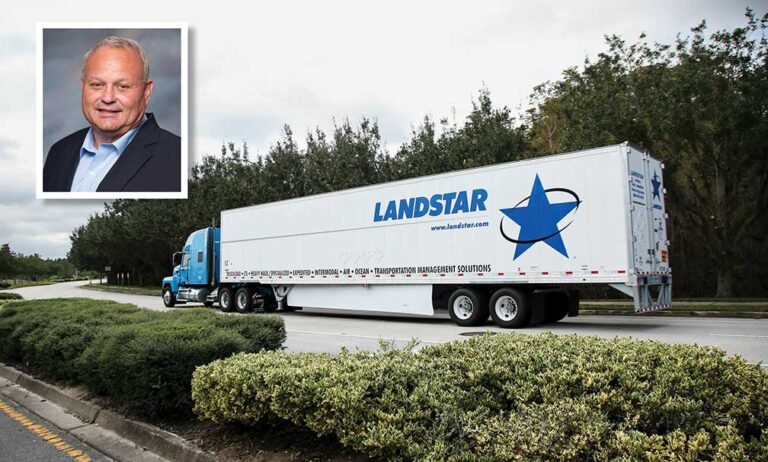
It’s rare to find a company driver who’s never fantasized about becoming an owner-operator. For the majority of the independents out there, there’s simply no other way.
But before you lease a truck and quit your job as a company driver, there are some things to know. We asked Rodney Baker, a Landstar Business Capacity Owner (BCO) and 2025 Roadstar Honoree, to share the wisdom of his 35 years on the road.
Here are Baker’s 10 tips for new or aspiring owner-operators.
1. You are the CEO of your truck.
This can be a hard reality for truckers who just want to drive. Being a business owner comes with both opportunities and responsibilities. For Baker, who bought his first truck at 21, managing his business and maintaining his truck is worth it.
2. Know your cost per mile.
Central to business success as an owner-operator is understanding your operating costs. For example, knowing your cost per mile helps you evaluate which loads will be profitable for your business.
3. Save your money.
Baker recommends resisting the urge to splurge when the money’s flowing. He says to put away $15K to $20K for repairs, unexpected expenses or slow periods.
4. Have some experience.
Baker suggests gaining experience as a company driver before transitioning to an owner-operator. Experience helps you understand industry operations, safety requirements and business relationships.
5. Manage costs wisely.
Discount programs, like Landstar Contractors Advantage Purchasing Program (LCAPP) can be a tremendous advantage for fuel, tires and more.
“It’s amazing how much we save,” Baker said.
6. Own your truck.
Baker believes purchasing your own truck provides more financial control. Before entering into any lease-to-own program, carefully review all terms and make sure it aligns with your business plan and financial situation.
7. Find your specialty.
A key step to success is to find the work you like and stick with it. That could mean committing to a lane or developing repeat business. It could mean specializing in a mode like reefer or flatbed hauling. Under Landstar’s system, leased owner-operators have access to many freight opportunities, all of which are accessible from an app on a smartphone.
8. Choose the model that works.
Put simply, drivers can be company drivers or owner- operators. Owner-operators can operate under their own authority or under a carrier’s authority. As a Landstar BCO, an owner-operator can have the best of both. There is no forced dispatch and there is visibility into rate structures, but with the support of an established company.
9. Business processes.
Being an owner-operator brings business-owner responsibilities such as bookkeeping and marketing. Leasing on with Landstar provides the resources to operate your business, like billing and collections and the backing of a large, financially strong company.
“It’s one of the absolute perks of being leased on to them,” Baker said.
10. Be accountable.
As an owner-operator, you are in the driver’s seat of your own business. Your personal motivation and commitment to professionalism are keys to your success. To stay on track and be accountable, develop a network of mentors and trusted peers as well as tools for measuring your progress in reaching your goals.
Landstar offers resources for owner-operators.
The road to independence can be made easier by the people you meet along the way. Landstar maintains six Field Operations Centers to provide owner-operators with resources for networking, safety and compliance training, and business planning assistance — all the things an owner-operator needs to drive success.
DISCLAIMER: This article is for informational purposes. Landstar does not guarantee success. The profitability of an independent owner-operator depends on various factors, including individual effort, business management skills and market conditions.

Linda Garner-Bunch has been with The Trucker since 2020, picking up the reins as managing editor in 2022. Linda has nearly 40 years of experience in the publishing industry, covering topics from the trucking and automotive industry to employment, real estate, home decor, crafts, cooking, weddings, high school sports — you name it, she’s written about it. She is also an experienced photographer, designer and copy editor who has a heartfelt love for the trucking industry, from the driver’s seat to the C-suite.


well I’m impressed about land star article. I have been in the industry as company driver for over 15years approaching my 2million collision free safety award. but I’m thinking about over the road as a new owner operater just to make more money and independence from corporate. I’m going over several reasons why. I’m alittle stuck just need more advice.