



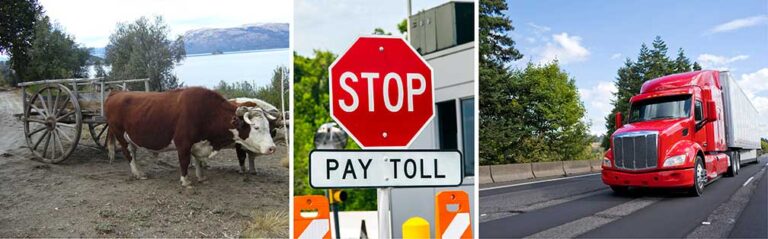
If you’ve been around a while, you probably remember the days in the 1960s, ’70s, ’80s and beyond, when “stop-and-pay” toll booths were a fixture on many American highways.
You’d find them most often in the Northeast, where you’d tool your way up to a toll booth — dollar and punch card in hand — and trade your dollar for 50 cents, handed back with a greeting and a friendly smile from one of the toll workers. These workers toiled at their craft in a 4×6-foot box positioned on some stretch of roadway, often at freeway exits. Or, for efficiency, you might take the express lane, intended for those vehicles with exact change only. You’d toss a couple of quarters into a basket and then receive the “all-clear” green light and proceed along your way.
There was no escaping the toll man (or woman).
Changing times
There’s no doubt that toll roads have come a long way over the past 50 years, and you won’t find many toll takers perched in “chicken coops” anymore. Instead, tolls are collected electronically as you drive, either deducted from your toll pass account or billed to your home address based on a camera image of your license plate.
You really have no way of knowing how much a trip along a toll road will cost you anymore. The rates are posted, but it takes algebra to figure them out — and doing so takes your attention away from the road. Instead, you just trust that the computers are correct and pay your bill, likely with a little steam coming out of your ears.
Of course, the cost is a lot more significant than it was when a few quarters could pay for a hundred miles of travel.
Today, a trip on toll roads around the Dallas-Fort Worth metroplex will easily cost you in the neighborhood of $30 — but that doesn’t even compare to perhaps the most expensive toll road in the country, the Pennsylvania Turnpike. A trip from east to west across the Keystone State — all 391 miles of it — will run upwards of $120 without an EZ Pass.
In the case of crossing some waterways, you can expect to pay $15 a vehicle for a trip across or under a river, lake or ocean bay — and that’s for vehicles with two axles. 18-wheelers pay a steep premium. Perhaps that’s why tolls rank high on the list of expenses for major motor carriers and are enough to make owner-operators wonder why they entered the business.
Origin of toll roads
So, what brought about this idea of tolling (another word for “taxing”) vehicles as they travel highways?
Well, for this U.S., it all started back when highways were actually “high ways” — trails positioned along topography that generally kept them from flooding.
Sometimes these trails were simply relatively clear paths through the forests; other times they were actually constructed. For instance, wooden roadways were once a popular convenience that made for a smoother ride and reduced soil erosion.
But someone had to pay to maintain these primitive transportation routes. Horses and oxen could quickly render a highway useless, and carriages could easily be bogged down in the mud that pack animals left behind.
As for wooden roads, they required constant maintenance. After all, consider the ongoing roadway maintenance you see across the continent today. Imagine if all that concrete and asphalt was wood planks and trusses! Frequent gaps and breaks in the roadway would form, and maintenance would be a daily chore.
All of this maintenance required money, and those using the highways would fund that maintenance in the form of a toll, sometimes called a usage fee. After all, if you have to pay to use a road, you expect it to be in good condition. And the operators of these private roads had to make at least a little bit of profit.
Such were the ways of Colonial America.
From tolls to taxes (and politics)
Today, the subject of user tolls can be a political hot topic.
A few years ago, a Connecticut proposal to place a toll on a 2.5 mile stretch of Interstate 684 that runs through a corner of the state’s panhandle but is used almost exclusively by New Yorkers almost led to a crisis between the two states.
Connecticut lawmakers saw a nifty way for out-of-staters to pay for a chunk of highway maintenance, while New York viewed the proposal as a way to fleece its residents out of millions of dollars for traveling a roadway that lacked a reasonable alternative. In the end, New York strong-armed its neighbor into backing off the proposal. For its part, Connecticut had plenty of other options to add toll roads, none of which were particularly popular.
As much as Americans dislike tolls, proponents of them (usually politicians and government agency leaders) like to point out that user fees are the purest form of taxation. Those who choose to travel on roadways where tolls are collected are the people who pay for those roads’ upkeep. If you don’t travel along the toll road, no fee is due.
Of course, for drivers looking for the shortest route from one point to another, toll roads are often the only real choice available. You won’t find many states tolling “the long way to nowhere.”
One thing’s for sure.
If the past 250 years have shown us anything, toll roads are here to stay — and they’re spreading. Drivers will find stretches of rural highways in states like Texas, where tolls are required. In fact, to avoid the Austin to San Antonio highway turmoil along Interstate 35, travelers have a unique opportunity.
State Highway 130, the “Pickle Parkway,” takes one through the countryside east of the populated area with speed limits posted at 85 mph, among the highest in the nation. For the privilege of avoiding I-35, you’ll pay nearly $30 to travel in a car along the 91-mile stretch of highway. If, however, you’re in an 18-wheeler — the main reason the highway was constructed in the first place — expect to pay upwards of $106.
Maybe a few minutes stuck in I-35 traffic isn’t such a bad deal after all.
The moral of the story? Whether you travel by ox-drawn wagon, a gas-powered car or a semi-truck, America has ways to make you pay.
But look on the bright side: Oxen don’t require fuel taxes.

Since retiring from a career as an outdoor recreation professional from the State of Arkansas, Kris Rutherford has worked as a freelance writer and, with his wife, owns and publishes a small Northeast Texas newspaper, The Roxton Progress. Kris has worked as a ghostwriter and editor and has authored seven books of his own. He became interested in the trucking industry as a child in the 1970s when his family traveled the interstates twice a year between their home in Maine and their native Texas. He has been a classic country music enthusiast since the age of nine when he developed a special interest in trucking songs.