



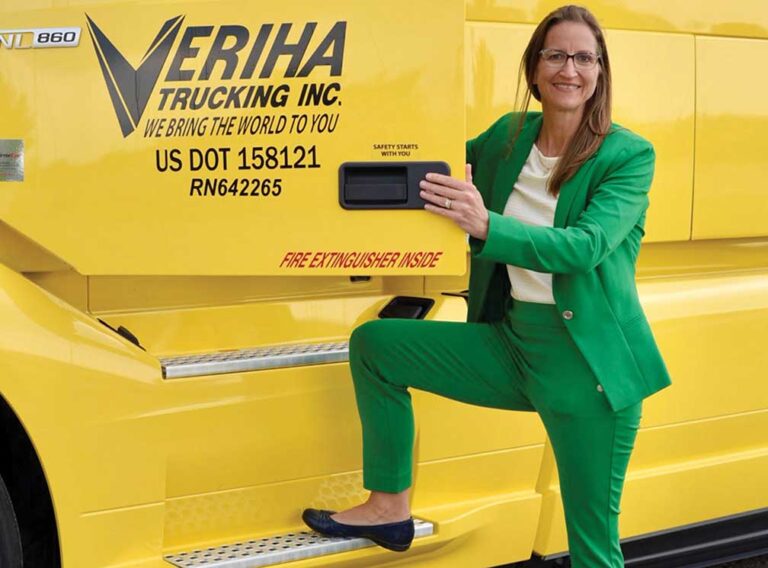
This year has been an eventful one, both for the United States and for the freight industry. At the time of this writing, tariffs are the topic of the day for motor carriers, retailers and consumers alike, with shifting policies adding to the pressures of an already-uncertain freight market. However, as many trucking professionals have said, the trucking industry is integral to the economy of not only North America, but the entire world — and the industry will persevere. The Truckload Carriers Association (TCA) plays a vital role in trucking, providing not only a voice on Capitol Hill but also valuable programs and educational programs designed to help motor carriers succeed. Recently, we had a chance to visit with TCA Chairman Karen Smerchek, who shares her insights into the “state of freight.”
Linda: Good morning, Karen, and thank you for joining me. By the time this edition of Truckload Authority is published, you will have completed your first quarter as TCA’s chairman of the board. Please reflect on the past couple of months.
Karen: Time flies when you are having fun. Political uncertainty is the first thing that comes to mind. It’s been a tense few months and there has been a mix of optimism along with ongoing challenges.
We understand the challenges that our members continue to endure in the truckload markets. It’s tough out there.
TCA continues to be focused on initiatives that will help our membership.
Linda: Since you stepped into the role of chairman, what changes — for the worse or for the better — have you seen in the truckload industry?
Karen: I am cautiously optimistic about the English Language Proficiency (ELP) standard, where a failure is now an out-of-service violation. With enforcement just starting in June, it is still too early to tell what impact this will have on our members. The ELP will be tested with both an oral inquiry and an evaluation of the driver’s road sign comprehension.
I am also glad to hear that there has been an uptick in the cabotage enforcement. Having drivers unlawfully run freight within the U.S. is negatively impacting our members.
Linda: Earlier this year, the American Transportation Research Institute (ATRI) released a list of its top research priorities for 2025. Among those topics are insurance costs, entry-level driver training, in-cab driver monitoring, telematics data and cabotage. Which of these do you see as most important right now, and why?
Karen: If ATRI is putting time and effort toward studying a topic, we all know it is a worthwhile endeavor.
Efficacy of Entry Level Driver Training (ELDT) Safety Outcomes is probably the one that is most near and dear to my heart. The ELDT mandate was created to improve the safety of the motoring public. These drivers are on the highways driving next to our trucks and our families. This is something that should be important for each of us.
Also, as I mentioned earlier, cabotage enforcement is also an important issue for carriers.
Linda: Do you have any topics you’d add to the list? What are they, and why are they important to truckload carriers?
Karen: I wouldn’t necessarily add to the list — but I would say that lawsuit abuse is the most significant cause of rising insurance. Yes, increases in medical and the equipment we use is a portion of that — but lawsuit abuse is the most significant factor.
Our industry has seen wins in individual states, but I want to see this at the federal level. We operate on federal highways. We need consistency across all jurisdictions.
Linda: The Trump administration appears to be reversing vehicle emissions mandates set by the Environmental Protection Agency, something that has received widespread support from the trucking industry. How do you see this impacting motor carriers in the short- and long-term?
Karen: The reversal of the emission mandates was a huge win for our industry.
In the short term, it’s a relief. Carriers need stability and manageable costs, and easing the regulatory pace gives fleets room to breathe.
TCA is a founding member of the Clean Freight Coalition, and this will allow us to continue on a path that is sustainable both fiscally and responsibly. Long-term, we need a roadmap without sacrificing reliability or affordability.
The Coalition can help bridge that gap with common sense and data-backed initiatives.
Linda: The freight industry has been in recession for two years — closer to three, according to some analysts. What factors do you see negatively impacting the truckload industry, and what will it take to turn things around?
Karen: Overcapacity, soft consumer demand and high interest rates have all had impacts. To turn the corner, we need real regulatory clarity. No one has lived through a historic time as we are living in today. Because of that, no one can forecast with certainty.
Linda: What’s on the association’s calendar for the rest of the year? What benefits do these events provide for members?
Karen: We have a full lineup — and one I’m really excited about is the Call on Washington (COW), where members can speak directly with lawmakers about the issues affecting their businesses. It’s a chance to make your voice heard in D.C.
We will tie COW in with the Fall Business Meetings this September 29-30. With the fast pace in which things are moving, I guarantee your time in Washington will be well spent. These events connect our members, shape policy, and offer real-world solutions.
Learn more and register to join us at tcafallcall.com.
Linda: What other industry initiatives does the association support, and why?
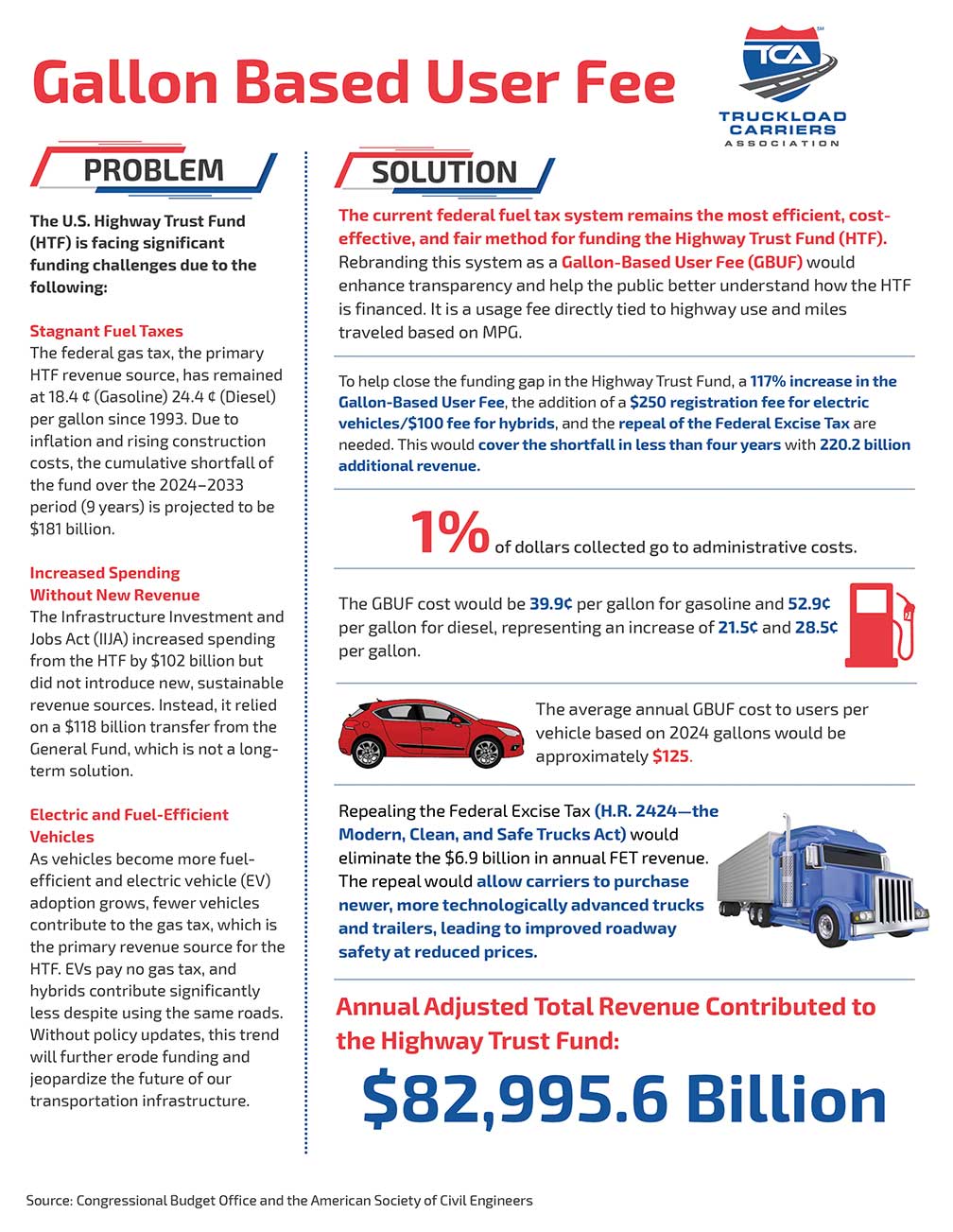
Karen: I am excited to share that the TCA team has been gaining traction in Washington on a Gallon Based User Fee (GBUF). We know funding is needed to improve our highways. Our current fuel tax system is the most efficient mechanism for funding the Highway Trust Fund because it is already in place.
With today’s policy, electric vehicles pay no gas tax. As EVs become more prevalent, it will further erode funding. GBUF would transition all vehicles using our highways to pay a fee utilizing a system that is already set up. For more information, check out the infographic at the bottom of this story.
Linda: Is there anything else you’d like to share with our readers today?
Karen: If you aren’t already a TCA member, now is the time to join — and then get actively involved with the association. I know there is more budgetary pressure in each organization, but tough times are when you need to lean into other like-minded leaders.
Time spent with your TCA peers will always give you a handful of nuggets that you can apply in your business and see a powerful ROI. I know this might be seen as counterintuitive, and I can speak to this firsthand: Membership and participation in TCA are well worth the investment.
Linda: Thank you, Chairman. I look forward to our next visit.

Linda Garner-Bunch has been with The Trucker since 2020, picking up the reins as managing editor in 2022. Linda has nearly 40 years of experience in the publishing industry, covering topics from the trucking and automotive industry to employment, real estate, home decor, crafts, cooking, weddings, high school sports — you name it, she’s written about it. She is also an experienced photographer, designer and copy editor who has a heartfelt love for the trucking industry, from the driver’s seat to the C-suite.