





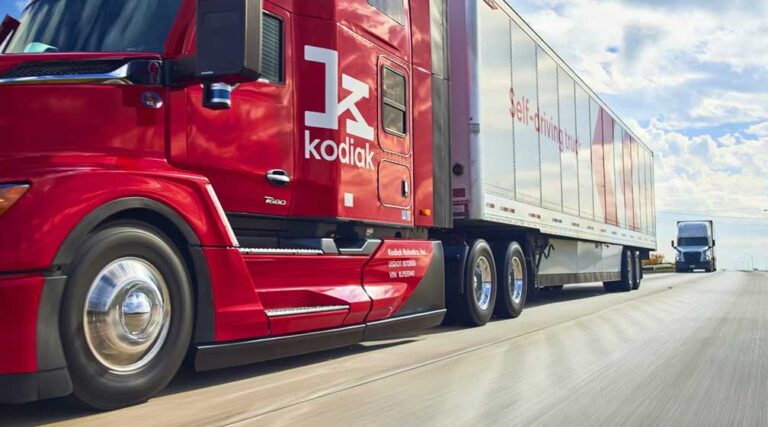
“It’s not ‘coming,’ it’s here. It’s like ‘Veni, vidi, vici’ — I came, I saw, I conquered.”
This statement, made by Ann Rundle, ACT Research’s vice president of electrification and autonomy, was the first point made during an online conference held in November 2025.
Rundle’s comment wasn’t meant to imply that autonomous vehicles (AVs) have “conquered” the trucking industry. In fact, much of the subsequent discussion addressed how the technology would be adopted and regulated. She emphasized that AVs have moved beyond the testing phase and are currently hauling freight in real world, “driver-out” situations.
ACT’s “Road to Autonomy: Understanding the Future of Autonomous Commercial Vehicles” event featured experts in the field of autonomy with carriers, truck manufacturers and autonomous vehicle developers represented.
Panelists included Daniel Goff, vice president of external affairs for Kodiak AI; Paul Konasewich, general manager at PACCAR; and Josh Hankins, senior vice president of safety and security for JB Hunt Transport Services. The panel was moderated by Rundle and ACT’s Lydia Vieth, a research analyst for electrification and autonomy.
Autonomous trucks have gone beyond the initial testing phase.
“Kodiak has a fleet of 10 driverless trucks (as of the end of Q3 2025) that are actually delivering freight every day for a customer in the West Texas oil country,” Goff said. “We’re operating around the clock with those trucks, solving real business needs and planning for launching on-highway operations in the back half of 2026 as well.”
To be sure, other autonomous vehicle (AV) developers are hauling freight, both with and without drivers in the truck cab. It’s happening on highways, on dirt and gravel, and on test tracks in exercises designed to replicate real world conditions.
One of the first objections in any discussion of AVs is safety.
“There’s been a buildup of transparency inside of that safety case conversation, how we measure safety, how folks are validating it, how we continuously work toward improving it,” explained JB Hunt’s Hankins. “We’ve kind of moved from the hypothetical to what’s actually going on and what’s going on inside that safety case, so that there’s a comfort level for us as a carrier.”
Konasewich credits system redundancy with safety improvements.
“You just can’t have a truck on a public road until you have all of this special redundancy and engineering,” he said. “In 2020, you didn’t have that yet. Now, in 2025 you have several platforms from at least three of the four major OEMs that are in late stages of development. Now it’s more of a completed research and development project.”
In spite of public worry over “driverless” trucks, AVs have several safety advantages over human drivers, according to the panel.
Visual scanning
LiDAR, (light detection and ranging) can “see” far beyond human capabilities, and it isn’t hampered by darkness, fog or other factors that impact a driver’s vision.
Drivers are taught to maintain a visual scan, moving their eyes to take in data from all around and inside their vehicles. Scanning helps make up for humans’ inability to look in multiple directions at once by “sampling” each focus area frequently. Computers, however, can monitor all around the vehicle simultaneously, taking in and processing much more information than a human can. Computers aren’t subject to distraction by phone calls, texts, GPS screens or other human inattentiveness.
Safety training
Safety training changes, too. Human drivers learn through a combination of training and experience, whereas computers are programmed.
A human driver, for example, might adjust following distance after experiencing a near collision. Proper following distance is a frequent subject of safety training — but not every driver learns and applies the teaching equally. In the case of AVs, however, the topic isn’t trained; it’s programmed into the system — and 100% of the AVs in the fleet instantly adjust.
How can AV tech be used in the trucking industry?
Vieth then challenged the panel for their thoughts on how AV technology is likely to be deployed by the trucking industry.
“We talk about the three pillars you need to deploy this technology,” Goff said. “The first pillar is the technology, all those software components, that ecosystem on the hardware side. But that’s really only one leg of the stool. You need safety (which is the second pillar). And people think that safety is part of technology, but it’s actually a totally different kind of skillset and idea.”
Once the technology is developed and the evidence shows that it’s safe, what’s next?
“The third piece of it is the product itself. How do you actually make this useful for people?” Goff said. “How do we integrate with companies?
Hankins followed up on this question.
“We’ve got to define what the value proposition is,” he said. “There’s got to be value from an OE (original equipment) perspective, value from a carrier perspective. There’s got to be value from an end customer, shipper and receiver perspective.”
Will autonomous trucks eliminate the need for professional drivers?
Many professional truck drivers fear that the adoption of autonomous technology will take away jobs. Far from drivers’ fear that carriers will simply replace all their trucks with driverless models, the panel discussed specific scenarios where AVs could make sense.
“Autonomous trucks are going to have to coexist with 4 million professional drivers that are on the roadway,” Hankins said. “How do you integrate that manual driving with this autonomous driving? And how do those solutions coexist? If we can get it there sooner and take a layover (rest break) out, do we get (the products) on the shelf faster?”
His example addressed loads that take more than the allowed 11 hours of driving time, necessitating a 10-hour rest break before the driver can proceed. An AV needs no break and could make the delivery much sooner.
AVs could also be used for runs that are unpopular with drivers, such as loads to the New York City area or what Hankins calls “tweener” lanes that fall between one and two full days of driving.
“I think that we see a whole lot of our jobs become more local in nature,” Hankins said.
The human element will remain a factor, according to Goff.
“We always say driverless is not humanless,” he said. You’re — to some extent — shifting the workforce in trucking away from people in the cab and to people near the cab.”
AV development has reached a point where drivers will soon be working alongside driverless trucks. Who will use them and what they’ll be doing are questions the trucking industry will need to answer.

Cliff Abbott is an experienced commercial vehicle driver and owner-operator who still holds a CDL in his home state of Alabama. In nearly 40 years in trucking, he’s been an instructor and trainer and has managed safety and recruiting operations for several carriers. Having never lost his love of the road, Cliff has written a book and hundreds of songs and has been writing for The Trucker for more than a decade.


Most of my immediate thoughts are questions.
1) How is this technology being received by the insurance industry?
2) What additional training will be required by our technicians to operate these trucks?
3) What are the estimates as to initial purchase cost of traditional unit vs AV spec truck?
4) Will maintenance intervals remain the same as non AV equipped units?
5) How do we as an industry sell the technology investment to the general public?
Please accept these questions as a sincere request to positively embrace this technology, and a willingness to invest if the economics justify the costs. If possible, can your publication follow up with an article that could address these real-world operational realities.
All excellent questions, and certainly on the minds of carriers, shippers and the public. Research is already underway for a follow-up story with more information.
As a Professional Truck Driver of 26 years, I don’t like it, because autonomous trucks are taking Truck Drivers jobs and causing the industry to try to meet the standards that come with the autonomous trucks. If you ask me, we don’t need autonomous trucks on the road. we just need to train more legal drivers to drive and haul the freight.