



WASHINGTON — Trucking industry leaders testified before the Subcommittee on Surface Transportation, Freight, Pipelines and Safety on Tuesday to address several vital challenges the industry is facing.
Shifting Gears
U.S. Senator Todd Young (R-Ind.), chairman of the subcommittee titled the hearing, “Shifting Gears: Issues Impacting the Trucking and Commercial Bus Industries in the U.S.” The hearing examines the trucking and motorcoach industries, with an emphasis on enhancing safety, reducing regulatory burdens and ensuring the long-term viability of these essential transportation operators. The hearing also explores opportunities for meaningful regulatory and policy reforms, including consideration of the Federal Motor Carrier Safety Administration’s (FMCSA) regulations, workforce challenges and enforcement and compliance requirements in the context of the next surface transportation reauthorization.
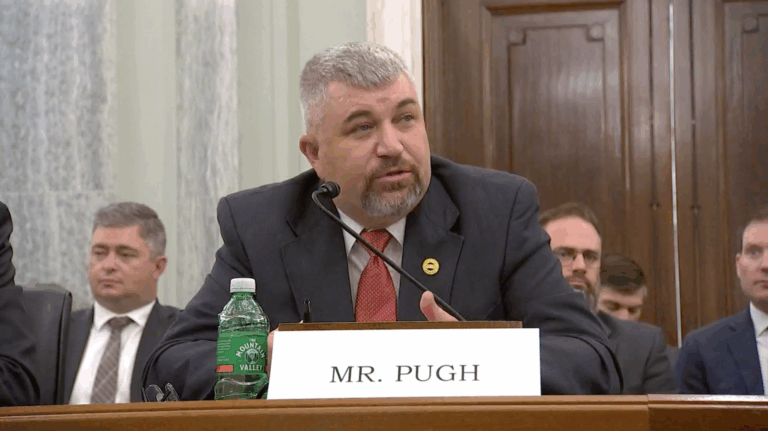
The American Trucking Associations (ATA) president and CEO Chris Spear, Owner-Operator Independent Driver Association (OOIDA) executive vice president Lewie Pugh, International Brotherhood of Teamsters general president Sean O’Brien and American Bus Association president and CEO Fred Ferguson all brought their thoughts to the committee.
Trucking: America’s Backbone
“For over 90 years, ATA has represented an industry that today employs 8.5M of the hardest working [people] in the country,” Spear said. “We appreciate your commitment to safety. Every American benefits from a modern, safe and efficient transportation network. It is even more essential to the three and a half million truck drivers who are indispensable to our way of life. Roads and bridges are their shop floor. ATA was among the first to support the passage of the landmark bipartisan infrastructure law which boosted highway funding by 38%. Unfortunately, rising construction costs and red tape have eroded the impact of federal grants. One consequence is record high congestion now costing our economy more than $109B the equivalent of 435,000 truck drivers sitting idle for an entire year. The next infrastructure bill has to alleviate those bottlenecks, but also prioritize other critical projects like truck parking.”
According to Pugh, Congress has the opportunity to make the next highway bill the “most pro-trucker, pro-safety bill in history. But, only if you prioritize the needs of truckers.”
“The Surface Transportation reauthorization is an opportunity for bipartisan action,” O’Brien said. “Together we must create economic opportunity and improve the lives of millions of Americans. The Teamsters look forward to working closely with the committee to write a bill that prioritizes workers, prioritizes public safety and protection of jobs.”
Should Truckers Under 21 be Allowed to Operate Across State Lines
According to Spear, the Safe Driver Apprenticeship Program, which allows qualified 18, 19 and 20-year olds to operate safely in interstate commerce, shows that trucking is a viable career for all. The program took 3000 individuals in that age range to teach them how to drive and operate safely.
“Every member on this panel should be invested in creating pathways for 18 to 20-year olds to operate safely in interstate commerce and to be able to access good paying jobs in the trucking industry,” Spear said.
Spear noted that 49 states have laws allowing 18-year olds to drive.
“Training is key, Spear said. “None of the 49 states have that. Your pilot program that was enacted has 400 hours of training in which you have to have a supervisor, experienced driver in the cab with you. It has 14 metrics attached to it. This is a step towards safety, unlike the 49 states. Not a step away.”
Pugh called the program “a colossal taxpayer funded failure.”
“It’s enrollment numbers tell the story,” Pugh said.
Biden’s Burdens
Spear noted that the Biden administration hindered the program.
“The reason it got poor attendance is because the last administration put a whole number of requirements into the pilot that you didn’t authorize including inward facing cameras,” Spear said.
Additionally, he made the comparison that in the United States, the military accepts recruits starting at 18 and they are trained and expected to be the best and possibly go to war if necessary.
“If we can do that for 18 to 20-year olds, I’m pretty sure we can teach them to cross state lines in a Class 8,” Spear said.
Pugh noted that there is a need for a pathway for that age range to learn to drive trucks. He got his own CDL after military service and began driving at 21.
“What we have to think about here is how we do this,” Pugh said. “Because, even with 400 hours of training, say you drive around the state of Indiana or Florida. What happens when you go to the Rocky Mountains and you’ve never seen the Rocky Mountains or the Appalachian Mountains. I think a much safer, better way to handle this is…I think what we should think about [is a] 150 mile radius like we do in agricultural or the short haul.”
By doing this, Pugh said the people in that age range can get the training they need in an area they are familiar with first.
“As far as inward facing cameras, I don’t think that had anything to do with it,” Pugh said. “It’s funny that we don’t want inward facing cameras for young kids who are 18 to 21, but we want to have them in this new independent contractor law for owner-operators who have 20 or 30 years of experience.”
Driver Shortages
Panel members vehemently disagreed among themselves on the idea of driver shortages.
“Self-serving, factless claims that there is no driver shortage undermines the serious work of this committee,” Spear said. “Driver pay does not go up 19% during a freight recession unless there is a shortage of qualified drivers.”
O’Brien said that suggestions have been made to overcome the driver shortage by “forcing drivers to work longer hours and operate heavier trucks. He also touted that Teamster members tend to stay in their positions for longer terms or until retirement due to higher pay and better benefit packages.
“In Teamsters shops, workers are incentivized to stay,” O’Brien said. “So-called driver shortages do not occur. To help make this a reality for more workers, the Teamsters urge Congress to invest in high quality CDL training.”
Regarding the shortage, Spear said it did not matter whether you believe it or not because it is a fact.
“We watch it nationwide,” Spear said. “We have the largest number of drivers under our membership and we know the demand for these drivers.”
Parking Shortages
One thing the industry is united on is the lack of safe, legal parking for truckers. According to Spear, currently there is only one parking space for every 11 truckers.
“Expanding parking access is not only the right thing to do for road safety, it’s the bare minimum we owe our drivers,” Spear said. “Particularly women drivers who deserve a secure, well-lit place to rest.
Autonomous Trucking
“Ground breaking develops in the autonomous vehicle space hold future promise for improving safety, by enhancing, not displacing, the invaluable role of truck drivers, our industry’s greatest asset,” Spear said.
O’Brien noted that one of the biggest fights across all industries the Teamsters have is with automation.
“Automation is a real threat to American jobs,” O’Brien said. “We feel strongly that the biggest threat to the trucking industry is autonomous commercial vehicles not requiring human operators. That’s a priority to make certain that we have human operators in these vehicles. I know some people think it’s not coming for a long time. Whether it comes tomorrow or 20 years from now, we have to be prepared. Protecting middle-class jobs is important.”
O’Brien also noted that should autonomous trucking without human operators becomes the norm, where do all the hard-working truckers go for employment.
“There is no better example than what we went through during the pandemic,” O’Brien said. “Truck drivers, regardless if you were union or non-union or independent, we were all looked on as essential workers providing goods and services to this country. We are not assets. We are human beings that provided these goods and services so that this country could keep moving and we should be appreciated and not forgotten.”
Baseless Threat
Spear explained that there are five levels of automation and level 5 is the only driverless level.
“We are a long ways from deploying that widespread,” Spear said.
Spear also noted that levels 1-4 have shown some vast safety improvements.
“There are some really good elements of technology we need to continue to foster,” Spear said.
Circling back to the driver shortage debate, Spear maintains that even including level five trucks, it will not displace any drivers.
“This is a red herring,” Spear said. “It’s a baseless threat that I don’t believe in and the industry has proved that,” Spear said.
Drug Testing
“As more states legalize recreational marijuana and opioids plague our communities, federal acceptance of both oral and hair testing are vital to keeping unsafe drivers off the road,” Spear said.
O’Brien said that drug testing is especially needed when a driver has been involved in a crash. At 22, a driver ran up under his truck and died. O’Brien was immediately taken from the scene and drug tested even though he was not at fault. He believes this practice should continue.
“The problem is enforcement,” O’Brien said. “I don’t think anyone wants an 80,000 lb. vehicle going down the road under the influence of any controlled substance and/or alcohol.”
Spear added that drug testing is paramount and also called for hair follicle testing to be allowed. With more states legalizing marijuana and the opioid crisis, Spear believes more tools are needed.
“We didn’t face that 10, 20 years ago,” Spear said. “We do now.
Pugh said OOIDA does not support hair follicle testing.
“We don’t feel there is enough research or data out there to show that it’s as true as a urine test is,” Pugh said. “Also, with different nationalities and different types of people, it doesn’t always come out accurate. There’s plenty of proof to show that. Urine tests have been working. That’s what scientists set up years ago. That’s what we should be using.
Cargo Theft
The panel was also united in asking for governmental help to combat the skyrocketing problem of cargo theft.
This security threat has exploded in the last few years, with annual losses now totaling a staggering $35B,” Spear said. “To protect our supply chain and employees, we need legislation to combat fraud and empower federal law enforcement to take the lead.
Spear noted that to truly combat this issue, the federal government, state governments and the trucking industry itself need to band together to find ways to end it.
“FMCSA needs the power to go after these folks,” Pugh said. “Truckers and brokers need a place to report these kinds of things. We get calls on a daily basis where drivers and taking loads, they get the load and they deliver the load and it’s fictitious broker or the broker was pretending to be someone else. I know brokers are doing the same thing with truckers. Trucking companies are getting their identities stolen.”
To view the entire hearing and hear more in-depth conversation on these issues and more, click here.

Dana Guthrie is an award-winning journalist who has been featured in multiple newspapers, books and magazines across the globe. She is currently based in the Atlanta, Georgia, area.