





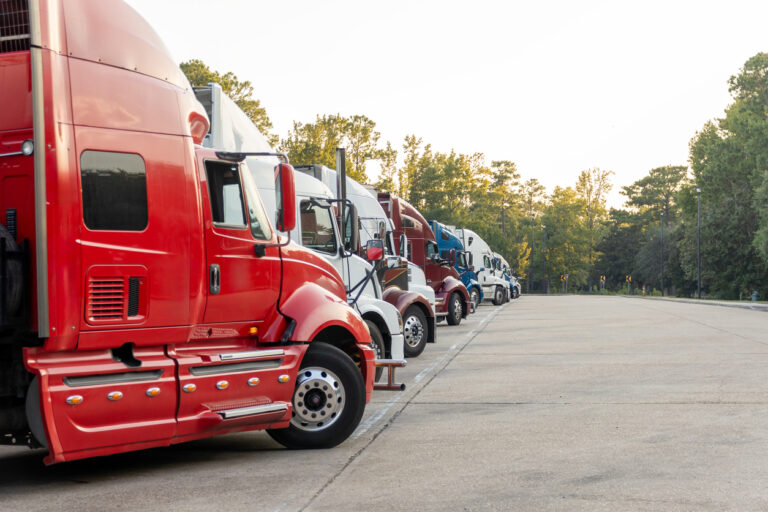
CHATTANOOGA, Tenn. — America’s truck parking shortage is imposing a staggering $100 billion annual burden on drivers, fleets and the trucking industry.
According to groundbreaking new truck parking research, drivers waste 56 minutes and drive 15 extra miles daily searching for legal parking spaces—costs that ultimately ripple through supply chains and increase prices for consumers nationwide.
The research, commissioned by Truck Parking Club and conducted by transportation economist Noël Perry of Transport Futures, exposes a massive disconnect between America’s truck parking needs and available infrastructure. With 2.4 million commercial trucks requiring daily parking for federally mandated rest breaks, the nation provides only 697,000 official parking spaces—creating a shortage of 1.7 million spaces, or roughly 70% of daily demand.
“The $100+ billion in annual costs from truck parking inefficiencies represents a hidden tax on every American consumer,” Perry said. “When drivers spend an hour circling for parking instead of delivering goods, those costs inevitably show up in higher prices at checkout.”
Direct Impact on American Families
The parking crisis creates a cascade of inefficiencies that directly impact households. Supply chain disruptions from parking shortages raise consumer goods prices by 2-3% nationwide—translating to $100-150 billion in additional costs annually on the $5 trillion Americans spend on consumer goods.
Individual drivers face $380 in daily costs from parking-related inefficiencies, including wasted fuel, extended search times and suboptimal locations that prevent maximizing federally allowed driving hours. These accumulate to $37.7 billion annually in extra miles searching for parking and over $82 billion in lost productivity.
A Crisis Hidden in Plain Sight
Most striking is the research finding that America actually has abundant truck parking capacity—it’s just not accessible. The study identified 23.4 million parking spaces nationwide that could accommodate heavy trucks. However, 98% are on private property not offered to the public, forcing the entire trucking industry to compete for just 2% of available capacity.
This forces drivers to park on highway shoulders or in abandoned lots, creating dangerous conditions. Cargo theft costs exceed $700 million annually, much attributed to unsafe parking, while driver turnover—partly from parking stress—costs the industry over $10 billion yearly.
The shortage isn’t distributed evenly. The New York metropolitan area faces a deficit of 186,000 parking spaces—four times worse than the national average. The top ten affected states experience shortages more than double the national average. Meanwhile, western states like Oklahoma and Wyoming maintain surplus capacity, highlighting how capacity exists in the wrong places.
Technology-Driven Solutions Working
Despite the massive scale, innovative solutions are making a measurable impact. Digital marketplace platforms connecting drivers with property owners who have unused parking capacity have added over 44,000 new spaces—a 20% increase in available capacity—without constructing a single facility.
“We have a 1.7 million space shortage alongside 23 million unparked spaces,” said Evan Shelley, co-Founder, CEO of Truck Parking Club. “This isn’t a capacity problem—it’s an access problem that technology can solve. America doesn’t need to build 1.7 million new parking spaces. We need to unlock existing capacity by connecting drivers with the millions of spaces at trucking companies, truck repair shops, self storage operators, tow truck companies, CDL Schools, truck stops, truck parking operators and more. These locations have suitable spaces but either aren’t accessible to the public today or, when they are available, remain difficult for drivers to utilize.”
Economic Opportunity in Crisis
The study positions the parking shortage as both a massive problem and economic opportunity. The $100+ billion in annual waste represents inefficiencies that could be eliminated through better resource allocation and technology deployment.
“The truck parking crisis represents both a massive problem and opportunity,” Perry said. “The $100+ billion in annual costs represents waste that could be eliminated through better information, smarter technology, and more efficient use of existing resources.”
For an economy dependent on trucks to move goods coast to coast, solving the parking crisis represents critical infrastructure investment that doesn’t require massive government spending—just smarter use of resources that already exist.
Access the Full Research
The complete 31-page report provides detailed supply and demand analysis by state, comprehensive economic impact calculations, methodology, and strategic recommendations for all industry stakeholders.
Download the full research report at: truckparkingclub.com/research

Dana Guthrie is an award-winning journalist who has been featured in multiple newspapers, books and magazines across the globe. She is currently based in the Atlanta, Georgia, area.





Truck Parking Club is just looking to make a dollar with a self serving study. They are undermining truckers and others by putting this out. They nab up free places and turn them into piggy banks. As a trucker the government should be paying for it. Truckers pay billions into the highway trust fund so some of those billions should give us a free place to park. Little disappointed on how one sided this story is with the truck parking club trash.